Squares and Cubes (original) (raw)
Last Updated : 23 Jul, 2025
**Squares and Cubes are mathematical operations involving numbers that are essential in various areas of mathematics. The square of a number is obtained by multiplying the number by itself (i.e., n2 = n × n), while the cube of a number is obtained by multiplying the number by itself twice (i.e., n3 = n × n × n)
A square is used to find the area of a 2d figure, whereas a cube is used to find the volume of a 3d figure.
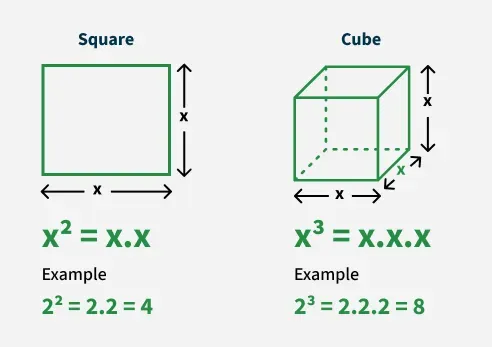
Square and Cube
In this article, we will learn what is Square and Cube Number. We will also learn about Perfect Squares and Cube and Square and Cube charts 1 to 100.
Table of Content
- Square of a Number
- Cube of a Number
- Perfect Square and Cubes
- Squares and Cubes from 1 to 50
- Chart of Squares and Cubes 1 to 100
Square of a Number
When an integer is multiplied by itself, it is called the square of that number. In simple words, a number that is multiplied by two is known as a square number. A square number is denoted as 'n2 ' in mathematics.
**Examples of Square Numbers:
Suppose a number '7' is given. To find its square, just multiply it again by '7'. Here, we get 7⨯7= 49. So, '49' is the square of '7'. Some more examples of finding a square number are below:
- 52 = 5⨯5= 25
- 122 = 12⨯12= 144
Cube of a Number
When we multiply an integer by itself three times, it is called a cube of that number. In other words, when an integer is multiplied by its square, it becomes a cube number. It is denoted as 'n3 ' in mathematics.
**Examples of Cube Numbers
Let us take an integer '3'. First find its square number: 3⨯3= 9. Now, multiply '9' with 3 again, 9⨯3= 27. Here, '27' is called the cube of '3'.
Also, we can simply multiply it thrice to find its cube. Suppose a number '6'. Multiply it three times by itself: 6⨯6⨯6= 216. The cube of '6' is '216'. Some more examples are as follows:
- 23 = 8
- 113 = 1331
Square and Cube 1 to 20
In this, we will learn the squares and cubes of numbers from 1 to 20. Let's have a look at them
| Number | Square(n2) | Cube (n3) | Number | Square (n2) | Cube (n3) |
|---|---|---|---|---|---|
| 1 | 1 | 1 | 11 | 121 | 1331 |
| 2 | 4 | 8 | 12 | 144 | 1728 |
| 3 | 9 | 27 | 13 | 169 | 2197 |
| 4 | 16 | 64 | 14 | 196 | 2744 |
| 5 | 25 | 125 | 15 | 225 | 3375 |
| 6 | 36 | 216 | 16 | 256 | 4096 |
| 7 | 49 | 343 | 17 | 289 | 4913 |
| 8 | 64 | 512 | 18 | 324 | 5832 |
| 9 | 81 | 729 | 19 | 361 | 6859 |
| 10 | 100 | 1000 | 20 | 400 | 8000 |
Chart of Squares and Cubes
Squares and cubes of any number are very important for solving complex mathematical problems. They provide a basic idea to evaluate a question. Every student should memorize the squares and cubes from 1 to 30 as these serve as the basic pillars for simplifying problems.
Table of Squares and Cubes (1 to 30)
In this section, we will learn the squares and cubes from 1 to 30. This will help students to solve the problems related to arithmetic operations. For any student, these are the basic squares and cubes that help them calculate easily and quickly. Here is the table in which the squares and cubes from 1 to 30 are given:
**Read: **Squares 1 to 30

**Read: **Cubes 1 to 30

Perfect Squares and Cubes
Perfect Squares and Cubes are those numbers whose square root and cube root is a natural number or an intger in case of cube. Not every number we come across is a perfect square or cube. Hence, we need to learn what are perfect squares and cubes and also learn how to check a perfect square or cube.
- **Perfect Square: A perfect square is the square of an integer that can be multiplied by itself twice. For example, '16' is a perfect square because 4⨯4= 16.
- **Perfect Cube: A perfect cube is the cube of an integer that can be multiplied by itself three times. For example, '27' is a perfect cube because 3⨯3⨯3= 27.
How to Identify Perfect Squares and Cubes?
After learning the definition of both perfect squares and perfect cubes, we learn some easy ways for their identification. First, we learn about the 'unit digit' or 'end digit' method, then we study another method, prime factorization:
**Unit Digit Method
Unit Digit Method is helpful in knowing about the possibility of a number being perfect square or cube without any actual test just by looking at the unit digit of a number. Let's learn more about it.
- **Squares: If a number is a perfect square, its end digit should only be **0, 1, 4, 5, 6, or 9. Any square whose unit digit is any other digit cannot be a perfect square. For example, the square of '7' is '49'. Here, 49 is a perfect square because its unit digit is '9'. Similarly, take the square of '12'. The square of '12' is '144' which is a perfect square, because its unit digit is '4'.
- **Cubes: The unit digit of a perfect cube should only be **0, 1, 8, or 9. In this way, we can easily verify whether a number is a perfect cube or not. For example, '1728' is a perfect cube because its last digit is '8'.
**Note: There are also some exceptions. Some numbers are both a 'perfect square' and a 'perfect cube'. For example, '64' is both a perfect square and a perfect cube.
Prime Factorization Method
Since, Unit digit method only gives a hint about the possibility of a number being perfect square or cube. However, the actual clarity can be gained only through prime factorization method.
- **Squares: In this method, when we prime factorize any number, each group of prime factors should have an even exponent i.e. 'multiples of 2'. For example, the given number is '36'. Its prime factor is 22 ⨯ 32 . Each group of prime factors has an even exponent '2' therefore 36 is a perfect square.
- **Cubes: In thismethod, when we prime factorize any number, each group of prime factors should have an exponent that is multiple of '3'. For example, the given number is '64'. Its prime factor is 26 . The exponent '6' is multiple of '3' therefore 64 is a perfect cube.
Squares and Cubes from 1 to 50
Here, a list of squares and cubes from 1 to 50 is given. Learning these values will help students to reduce their calculation time and they can easily solve complex problems.
**Squares 1 to 50
| Number | Square | Number | Square | Number | Square | Number | Square | Number | Square |
|---|---|---|---|---|---|---|---|---|---|
| 1 | 1 | 11 | 121 | 21 | 441 | 31 | 961 | 41 | 1681 |
| 2 | 4 | 12 | 144 | 22 | 484 | 32 | 1024 | 42 | 1764 |
| 3 | 9 | 13 | 169 | 23 | 529 | 33 | 1089 | 43 | 1849 |
| 4 | 16 | 14 | 196 | 24 | 576 | 34 | 1156 | 44 | 1936 |
| 5 | 25 | 15 | 225 | 25 | 625 | 35 | 1225 | 45 | 2025 |
| 6 | 36 | 16 | 256 | 26 | 676 | 36 | 1296 | 46 | 2116 |
| 7 | 49 | 17 | 289 | 27 | 729 | 37 | 1369 | 47 | 2209 |
| 8 | 64 | 18 | 324 | 28 | 784 | 38 | 1444 | 48 | 2304 |
| 9 | 81 | 19 | 361 | 29 | 841 | 39 | 1521 | 49 | 2401 |
| 10 | 100 | 20 | 400 | 30 | 900 | 40 | 1600 | 50 | 2500 |
**Cube 1 to 50
| Number | Cube | Number | Cube | Number | Cube | Number | Cube | Number | Cube |
|---|---|---|---|---|---|---|---|---|---|
| 1 | 1 | 11 | 1331 | 21 | 9261 | 31 | 29791 | 41 | 68921 |
| 2 | 8 | 12 | 1728 | 22 | 10648 | 32 | 32768 | 42 | 74088 |
| 3 | 27 | 13 | 2197 | 23 | 12167 | 33 | 35937 | 43 | 79507 |
| 4 | 64 | 14 | 2744 | 24 | 13824 | 34 | 39304 | 44 | 85184 |
| 5 | 125 | 15 | 3375 | 25 | 15625 | 35 | 42875 | 45 | 91125 |
| 6 | 216 | 16 | 4096 | 26 | 17576 | 36 | 46656 | 46 | 97336 |
| 7 | 343 | 17 | 4913 | 27 | 19683 | 37 | 50653 | 47 | 103823 |
| 8 | 512 | 18 | 5832 | 28 | 21952 | 38 | 54872 | 48 | 110592 |
| 9 | 729 | 19 | 6859 | 29 | 24389 | 39 | 59319 | 49 | 117649 |
| 10 | 1000 | 20 | 8000 | 30 | 27000 | 40 | 64000 | 50 | 125000 |
Patterns in Squares and Cubes
Some interesting patterns in squares and cubes often show some distinct properties and mathematical relations. Here are some important patterns that every student should know:
**Patterns in Square Numbers

Patterns of Square Numbers
There are various patterns in the square numbers, some of which are:
- **Difference between square numbers
The difference between any two consecutive squares is always an odd number. For example, Two consecutive squares '4' and '9' are given. Their difference is 9 - 4= 5, which is an odd number.
- **Sum of consecutive natural numbers
Whenever we square any odd number, the resultant will always be the sum of two consecutive natural numbers. Suppose we take the square of '3' which is '9'. Here, '9' is the result of the addition of two consecutive numbers '4' and '5'.
- **Product of two consecutive even or odd natural numbers
The product of two consecutive even numbers or consecutive odd numbers is also an important pattern of square numbers. For example, '25' is the product of odd numbers 5⨯5. Similarly, '64' is the product of two even numbers 8⨯8.
- **Adding the first n odd numbers
A square of any number is obtained by the sum of first 'n' odd numbers. Suppose, a number is given '25'. Here, 25 is obtained by the addition of the first 5 odd numbers i.e. (1+3+5+7+9).
- **Adding triangular numbers
Triangular numbers are the numbers obtained by adding the next natural number and it forms an equilateral triangle. The formula to find triangular numbers is:
T(n)= 1+2+3+4.......+n
Now, by adding these triangular numbers, square numbers can be generated easily. For example, the square number is '4', which is the addition of the first triangular number to itself i.e. (1+3).
Patterns in Cube Numbers
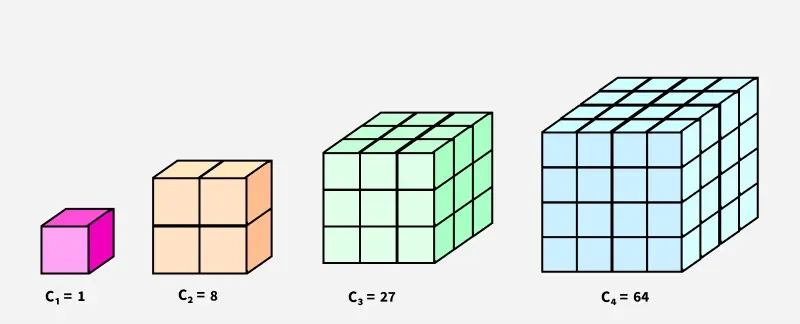
Cube number pattern
Some common patterns in cubes are:
- **Adding consecutive odd numbers
By adding consecutive odd numbers, we can easily find the next cube numbers. For example, the cube of '1' is 1. Now, add the next pair of consecutive odd numbers to find the next cube. Here, 3+5= 8 which is the cube of '2'. Similarly, to find the cube of '3', add the next set of consecutive odd numbers 7+9+11= 27.
- **Difference of Cubes of Two Consecutive Positive Integers
The difference between the two consecutive positive integers can give a cubic number. For example, The difference between 23 - 13 = 7. This represents 23 = 8. Similarly, the difference between 33 - 23 = 19 which represents 33 = 27.
- **Triangular Number Pattern
Similar to square numbers, we can also find cubic numbers by adding the triangular numbers. For example, the cube number is '23', which is the addition of the next triangular numbers i.e. (1+2=3).
Chart of Squares and Cubes 1 to 100
This chart will help students to learn the squares and cubes from 1 to 100. It will help them to solve problems of various mathematical topics such as algebra, geometry and arithmetic. Also squares and cubes are part of the number theory that will help them to deeply understand the integers.
**Squares from 1 to 100
The following table shows the squares from 1 to 100:
| Number | Square | Number | Square | Number | Square | Number | Square | Number | Square |
|---|---|---|---|---|---|---|---|---|---|
| 1 | 1 | 21 | 441 | 41 | 1681 | 61 | 3721 | 81 | 6561 |
| 2 | 4 | 22 | 484 | 42 | 1764 | 62 | 3844 | 82 | 6724 |
| 3 | 9 | 23 | 529 | 43 | 1849 | 63 | 3969 | 83 | 6889 |
| 4 | 16 | 24 | 576 | 44 | 1936 | 64 | 4096 | 84 | 7056 |
| 5 | 25 | 25 | 625 | 45 | 2025 | 65 | 4225 | 85 | 7225 |
| 6 | 36 | 26 | 676 | 46 | 2116 | 66 | 4356 | 86 | 7396 |
| 7 | 49 | 27 | 729 | 47 | 2209 | 67 | 4489 | 87 | 7569 |
| 8 | 64 | 28 | 784 | 48 | 2304 | 68 | 4624 | 88 | 7744 |
| 9 | 81 | 29 | 841 | 49 | 2401 | 69 | 4761 | 89 | 7921 |
| 10 | 100 | 30 | 900 | 50 | 2500 | 70 | 4900 | 90 | 8100 |
| 11 | 121 | 31 | 961 | 51 | 2601 | 71 | 5041 | 91 | 8281 |
| 12 | 144 | 32 | 1024 | 52 | 2704 | 72 | 5184 | 92 | 8464 |
| 13 | 169 | 33 | 1089 | 53 | 2809 | 73 | 5329 | 93 | 8649 |
| 14 | 196 | 34 | 1156 | 54 | 2916 | 74 | 5476 | 94 | 8836 |
| 15 | 225 | 35 | 1225 | 55 | 3025 | 75 | 5625 | 95 | 9025 |
| 16 | 256 | 36 | 1296 | 56 | 3136 | 76 | 5776 | 96 | 9216 |
| 17 | 289 | 37 | 1369 | 57 | 3249 | 77 | 5929 | 97 | 9409 |
| 18 | 324 | 38 | 1444 | 58 | 3364 | 78 | 6084 | 98 | 9604 |
| 19 | 361 | 39 | 1521 | 59 | 3481 | 79 | 6241 | 99 | 9801 |
| 20 | 400 | 40 | 1600 | 60 | 3600 | 80 | 6400 | 100 | 10000 |
**Cubes 1 to 100
The following table shows the cubes from 1 to 100:
| Number | Cube | Number | Cube | Number | Cube | Number | Cube | Number | Cube |
|---|---|---|---|---|---|---|---|---|---|
| **1 | 1 | **21 | 9261 | 41 | 68921 | 61 | 226981 | 81 | 531441 |
| **2 | 8 | **22 | 10648 | 42 | 74088 | 62 | 238328 | 82 | 551368 |
| **3 | 27 | **23 | 12167 | 43 | 79507 | 63 | 250047 | 83 | 571787 |
| **4 | 64 | **24 | 13824 | 44 | 85184 | 64 | 262144 | 84 | 592704 |
| **5 | 125 | **25 | 15625 | 45 | 91125 | 65 | 274625 | 85 | 614125 |
| **6 | 216 | **26 | 17576 | 46 | 97336 | 66 | 287496 | 86 | 636056 |
| **7 | 343 | **27 | 19683 | 47 | 103823 | 67 | 300763 | 87 | 658503 |
| **8 | 512 | **28 | 21952 | 48 | 110592 | 68 | 314432 | 88 | 681472 |
| **9 | 729 | **29 | 24389 | 49 | 117649 | 69 | 328509 | 89 | 704969 |
| **10 | 1000 | **30 | 27000 | 50 | 125000 | 70 | 343000 | 90 | 729000 |
| **11 | 1331 | **31 | 29791 | 51 | 132651 | 71 | 357911 | 91 | 753571 |
| **12 | 1728 | **32 | 32768 | 52 | 140608 | 72 | 373248 | 92 | 778688 |
| **13 | 2197 | **33 | 35937 | 53 | 148877 | 73 | 389017 | 93 | 804357 |
| **14 | 2744 | **34 | 39304 | 54 | 157464 | 74 | 405224 | 94 | 830584 |
| **15 | 3375 | **35 | 42875 | 55 | 166375 | 75 | 421875 | 95 | 857375 |
| **16 | 4096 | **36 | 46656 | 56 | 175616 | 76 | 438976 | 96 | 884736 |
| **17 | 4913 | **37 | 50653 | 57 | 185193 | 77 | 456533 | 97 | 912673 |
| **18 | 5832 | **38 | 54872 | 58 | 195112 | 78 | 474552 | 98 | 941192 |
| **19 | 6859 | **39 | 59319 | 59 | 205379 | 79 | 493039 | 99 | 970299 |
| **20 | 8000 | **40 | 64000 | 60 | 216000 | 80 | 512000 | 100 | 1000000 |
**Also Check:
Solved Question on Squares and Cubes
Here are some solved examples below:
**Question 1: Find the square of the number 28.
**Solution:
Given number: 28
To find it's square, multiply it twice:
Square of 28= 28⨯28= 784The final answer is 784.
**Example 2: A square park is being constructed. The length of one side is 45 m. Find the area of the square park
**Solution:
Given length: 45 m
Area of park = side2
⇒ Area of park = 452
⇒ Area of park = 45⨯45
⇒ Area of park = 2025 m2The area of square park is 2025 m2.
Example 3: Find the square root of 144.
**Solution:
Given that: 144
Square root of 144 = √144
⇒ Square root of 144 = 12, [because 12⨯12= 144]
**Example 4: Determine a cube of 7.
**Solution:
Given number: 7
cube of '7' = 73
⇒ cube of '7' = 7⨯7⨯7
⇒ cube of '7' = 343The cube of '7' is '343'.
**Example 5: Calculate the volume of a cube when one edge is given 2 units
**Solution:
Given edge: 2 units
Volume of cube = edge3
⇒ Volume of cube = 23
⇒ Volume of cube = 2⨯2⨯2Volume of cube = 8 unit3
Practice Questions on Squares and Cubes
Here are some practice questions involving squares and cubes:
**Question 1. Calculate the squares of the following numbers:
- 23
- 44
- 65
**Question 2. Find the cube root of the following integers:
- 64
- 512
- 1331
**Question 3. Choose the correct perfect square:
- 81
- 125
- 8
**Question 4. Choose the correct perfect cube:
- 8
- 9
- 100
**Question 5. A cube whose edge is 8 units. Find the volume of the cube.
**Question 6. Find the square of the number 17.
**Question 7. Determine the cube of 5.
**Question 8. What is the square root of 121?
**Question 9. Find the perfect cube among the following numbers:
- 27
- 50
- 75
**Question 10. Calculate the volume of a cube with a side length of 10 units.
**Conclusion
Understanding squares and cubes is essential for various mathematical and practical applications. The Squares involve multiplying a number by itself, while cubes involve raising a number to the power of three. Mastery of these concepts is crucial for solving problems in algebra, geometry, and real-world scenarios. The Practice with these questions helps reinforce the fundamental skills needed to perform the calculations accurately and efficiently.