Sum of Arithmetic Sequence Formula (original) (raw)
Last Updated : 27 Feb, 2026
We can calculate the sum of all terms in an arithmetic sequence using the sum of the arithmetic sequence formula.
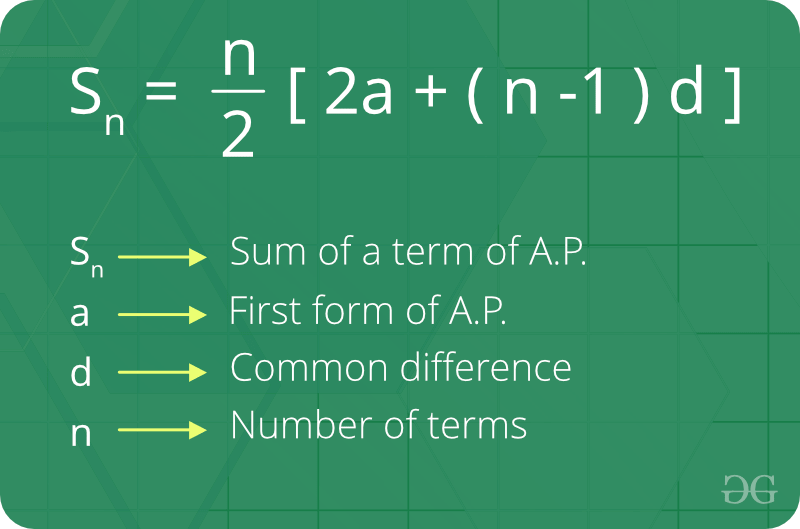
The formula for the sum of the n terms of an arithmetic series when the last term is not given is
The formula for Sum When Last Term is Given:
The formula for the sum of the first n terms of an arithmetic sequence is
S_n = \frac{n}{2} \cdot \left( 2a + (n - 1)d \right)
If we write 2a as a + a, the formula becomes
S_n = \frac{n}{2} \cdot \left( a + a + (n - 1)d \right)
Recognizing that **a + (n − 1)d = a n , we get:
S_n = \frac{n}{2} \cdot (a + a_n)
Where:
- Sn is the sum of the first n terms.
- a is the first term.
- an is the last term.
- n is the number of terms.
**This formula is useful when the last term (a n ) is given.
**Derivation
Suppose the first term of a sequence is a, common difference is d and the number of terms are n.
We know the nth term of the sequence is given by,
an = a + (n - 1)d ...... (1)
Also the sum of the arithmetic sequence is,
Sn = a + (a + d) + (a + 2d) + (a + 3d) + ...... + a + (n - 1)d ...... (2)From (1), the equation (2) can also be expressed as,
Sn = an + an - d + an - 2d + an - 3d + ...... + an - (n - 1)d ...... (3)Adding (2) and (3) we get,
2 Sn = [a + (a + d) + (a + 2d) + (a + 3d) + ...... + a + (n - 1)d] + [an + an - d + an - 2d + an - 3d + ...... + an - (n - 1)d]
2 Sn = (a + a + a + ..... n times) + (an + an + an + ..... n times)
2 Sn = n (a + an)**S n = n/2 [a + a n ]
This derives the formula for sum of an arithmetic sequence.
**Sample Questions
**Question 1. Find the sum of the arithmetic sequence: 4, 10, 16, 22, ... up to 10 terms.
**Solution:
We have, a = 4, d = 10 - 4 = 6 and n = 10.
Use the formula Sn = n/2 [2a + (n - 1)d] to find the required sum.
S10 = 10/2 [2(4) + (10 - 1)6]
= 5 (8 + 54)
= 5 (62)
= 310
**Question 2. Find the sum of the arithmetic sequence: 7, 9, 11, 13, ... up to 15 terms.
**Solution:
We have, a = 7, d = 9 - 7 = 2 and n = 15.
Use the formula Sn = n/2 [2a + (n - 1)d] to find the required sum.
S15 = 15/2 [2(7) + (15 - 1)2]
= 15/2 (14 + 28)
= 15/2 (42)
= 315
**Question 3. Find the first term of an arithmetic sequence if it has a sum of 240 for a common difference of 2 between 12 terms.
**Solution:
We have, Sn = 240, d = 2 and n = 12.
Use the formula Sn = n/2 [2a + (n - 1)d] to find the required value.
=> 240 = 12/2 [2a + (12 - 1)2]
=> 240 = 6 (2a + 22)
=> 40 = 2a + 22
=> 2a = 18
=> a = 9
**Question 4. Find the common difference of an arithmetic sequence of 8 terms having a sum of 116 and the first term as 4.
**Solution:
We have, S = 116, a = 4, n = 8.
Use the formula Sn = n/2 [2a + (n - 1)d] to find the required value.
=> 116 = 8/2 [2(4) + (8 - 1)d]
=> 116 = 4 (8 + 7d)
=> 29 = 8 + 7d
=> 7d = 21
=> d = 3
**Question 5. Find the sum of an arithmetic sequence of 8 terms with the **first and last terms as 4 and 10, respectively.
**Solution:
We have, a = 4, n = 8 and an = 10.
Use the formula Sn = n/2 [a + an] to find the required sum.
S8 = 8/2 [4 + 10]
= 4 (14)
= 56
**Question 6. Find the number of terms of an arithmetic sequence with the first term, last term, and sum as 16, 12, and 140, respectively.
**Solution:
We have, S = 140, a = 16 and an = 12.
Use the formula Sn = n/2 [a + an] to find the required value.
=> 140 = n/2 [16 + 12]
=> 140 = n/2 (28)
=> 14n = 140
=> n = 10
**Question 7. Find the sum of an arithmetic sequence with the first term, common difference, and last term as 8, **7, and 50, respectively.
**Solution:
We have, a = 8, d = 7 and an = 50.
Use the formula an = a + (n - 1)d to find n.
=> 50 = 8 + (n - 1)7
=> 42 = 7 (n - 1)
=> n - 1 = 6
=> n = 7Use the formula Sn = n/2 [a + an] to find the sum of sequence.
S7 = 7/2 (8 + 50)
= 7/2 (58)
= 203
**Related Reads:
- Arithmetic Sequence
- Geometric Progression
- Harmonic Progression
- Arithmetic Sequence vs Geometric Sequence
Practice Problem Based on Sum of Arithmetic Sequence Formula
**Question 1. An arithmetic sequence has a sum of 350 after 20 terms, and the common difference is 5. Find the first term of the sequence.
**Question 2. Find the sum of an arithmetic sequence with the first term a=3, the last term aₙ=39, and the number of terms n=19.
**Question 3. The sum of the first 15 terms of an arithmetic sequence is 570. The first term is 10. Find the common difference.
**Question 4. The first term of an arithmetic sequence is a=12, the common difference is d=3, and the sum of the sequence is 300. How many terms are in the sequence?
**Answer:-
- -30.