Superset (original) (raw)
Last Updated : 23 Dec, 2025
A superset is a set that contains all the elements of another set. For example, if set A = {21, 22, 23, 24} and set B = {21, 23, 24}, we say that set A is the superset of set B. Because all the elements of B [(i.e.,)21, 23, 24] are in set A.
The following illustration shows the relationship between the set and its superset using a **Venn Diagram.
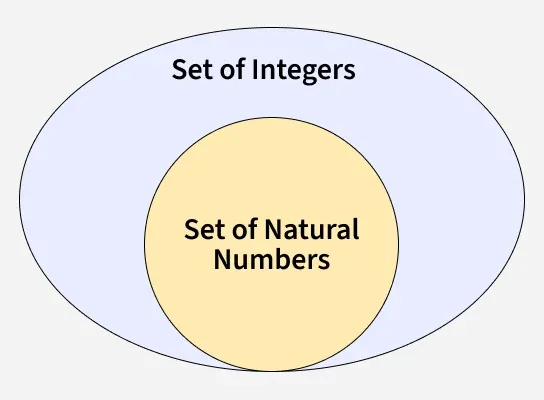
Set A is termed the superset of set B ****(denoted as A ⊇ B)** if all elements of set B are also elements of set A. In other words, every element in B must be contained in A.
Superset Symbol
The superset symbol, often known as the superset operator, is a mathematical symbol that represents the notion of one set being a superset of another.
Here's what the symbols ⊃ and ⊇ stand for:
1) ⊃ (Superset Symbol): This symbol represents a strictly superset connection. If A ⊃ B, then set A is a superset of set B and must contain at least one element not found in set B. In other words, A is larger than B and contains items not present in B.
**2) ⊇ (Superset or Equal Symbol): This symbol represents a superset connection that may or may not be equal. If A ⊇ B, it signifies that set A is a superset of set B, and it may include all of the same items as set B, as well as more elements.
**Example: Let Y = {21, 22, 23, 24, 25, 26} and X = {21, 22, 23, 25, 26}
In the two sets above, every element of X is also an element of Y, and the number of elements of X is smaller than the number of elements of Y.
In other words, n(x) = 4 and n(Y) = 6
⇒ n(x) < n(Y)
As a result, Y is the superset of X.
Other than this example, we can give all the general sets as supersets of each other as follows:
N ⊂ W ⊂ Z ⊂ Q ⊂ R ⊂ C
Where,
- **N is the set of Natural Numbers,
- **W is the set of Whole Numbers,
- **Z is the set of Integers,
- **Q is the set of Rational Numbers,
- **R is the set of Real Numbers, and
- **C is the set of Complex Numbers.
Proper and Improper Superset
A correct superset is often referred to as a stringent superset. If set X is the correct superset of set W, then all of set W's elements are in X, but set X must have at least one member that is not in set W.
Take, for example, four sets.
- W = {u, v, w}
- X = {u, v, w, x}
- Y = {u, v, w}
- Z = {u, v, y}
Because X is not equal to W, it is the proper superset of W from the sets described above.
- Y is a superset of W, however, it is not a proper superset of W because of Y= W.
- Z is not a superset of W since it lacks the element "w" that is present in set W.
Superset vs Subset
| Superset | Subset |
|---|---|
| A set that contains all the elements of another set and possibly more. | A set that contains only a portion of another set. |
| A superset includes one or more other sets. | A subset is included within another set (its superset). |
| Usually has a larger number of elements. | Usually has a smaller number of elements. |
| Symbolized as "⊇" or "⊃" in set theory. | Symbolized as "⊆" or "⊂" in set theory. |
| If A = {1, 2, 3, 4, 5} and B = {1, 2, 3, 4, 5, 6}, then B is a superset of A. | If A = {1, 2, 3} and B = {1, 2, 3, 4, 5}, then A is a subset of B. |
Properties of Superset
The following are the main qualities of a superset:
- Every set is a superset of itself.
- Each set is a subset of itself.
- A set has an endless number of supersets.
- Because the null set includes no items, we may claim that any set is a superset of an empty set, for example, every set H would be represented as H ⊃ φ
- Set B is the superset of set A if A is a subset of B.
Related Articles
Solved Examples on Superset
**Example 1: Determine who is a subset here if M = {x: x is an odd natural number} and N = {y: y is a natural number}.
**Solution:
Given: M = {1, 3, 5, 7, 9, 11,13, …} and N = {1, 2, 3, 4, 5, 6, 7, 8, 9, 10, 11, 12, 13, 14, 15, 16, …}.
It is obvious that set N contains ALL of the items of set M. As a result, set M is a subset of set N, or M ⊂ N.
**Example 2: Show that M is the correct superset of N if M = {32, 33, 37, 39} and N = {32, 37, 39}. Justify your response.
**Solution:
Given:
- Set M = {32, 33, 37, 39}
- Set N = {32, 37, 39}
M is the appropriate superset of set N since all of set N's components are also present in set M, however, we can see that set M contains one more additional element (i.e., 33) than set N.
We can also show that set M is not equivalent to set N.
As a result, we may argue that set M is the correct superset of set N.
**Example 3: Check whether the following statements are true or false.
a) An empty set is a superset of every other set.
b) Every set is a superset of the empty set.
c) Every set is a superset of itself.
d) Every set has a limited number of supersets.
**Solution:
a) **False, as empty set do not contain any element.
b) **True , as empty set is subset of all sets.
c) **True, as set itself contains all the elements it have.
d) **False, as we can add one element to set to make it superset, and that element can be anything.
Practice Problems on Supersets
**Problem 1: Let A = {1, 2, 3, 4, 5} and B = {2, 4}. Determine whether each statement is true or false:
a) A is a superset of B.
b) B is a subset of A.
c) B is a proper subset of A.
d) A and B are disjoint sets.
**Problem 2: Given the sets C = {red, green, blue} and D = {red, green, blue, yellow}. Is D a superset of C or C a superset of D?
**Problem 3: Consider the sets E = {a, b, c, d}, F = {c, d, e}, and G = {a, e}. Draw a Venn diagram to represent these sets and their relationships. Identify any supersets or subsets.
**Problem 4: Let H = {x, y}. Find the power set of H and identify which subset of H is a superset of the set {x}.
**Problem 5: Let M be the set of all mammals and C be the set of all carnivores. Determine whether each statement is true or false:
a) M is a superset of C.
b) C is a subset of M.
c) M is a proper superset of C.
d) C is a proper subset of M.