Surface Area of a Prism (original) (raw)
Last Updated : 7 Apr, 2026
The surface area of a prism is defined as the total area of all its flat faces, including the two congruent and parallel bases and the lateral faces connecting them. It represents the complete exterior area of the three-dimensional solid.
The image below illustrates the surface area formulas for different types of prisms based on their base shapes.
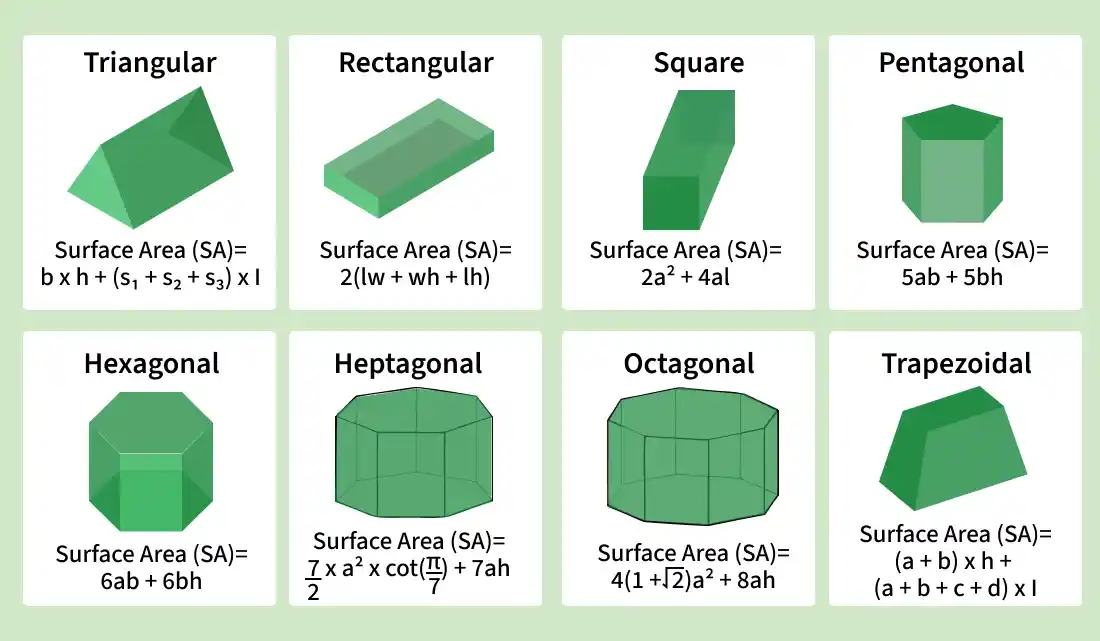
A prism has two key surface area components:
- **Lateral Surface Area (LSA): The area of all the side (lateral) faces, excluding the bases.
LSA = Perimeter of Base × Height
- **Total Surface Area (TSA): The sum of the areas of the two bases and the lateral surface area.
TSA = 2 × Base Area + (Perimeter of Base × Height)
Types of Prism
There are different types of prisms based on the shape of the base of a prism, such as the following:
- Triangular prisms
- Square prisms
- Rectangular prisms
- Pentagonal prisms
- Hexagonal prisms
- Octagonal prisms.
**Calculation of Surface Area of a Prism
The surface area of a prism is the total area covered by all its faces, including the two bases and the lateral faces.
**Step-by-Step Method
- **Step 1: Identify the given values, such as base area, base perimeter, and height of the prism.
- **Step 2: Write the formula for the surface area of a prism:
_(2 × Base Area) + (Base Perimeter × Height) - **Step 3: Substitute the given values into the formula correctly.
- **Step 4: Solve the calculation step-by-step.
- **Step 5: Write the final answer along with proper units (square units).
**Example: Find the surface area of a prism whose base area is 18 square units, base perimeter is 14 units, and height is 9 units.
**Solution:
Surface Area = (2 × Base Area) + (Base Perimeter × Height)
= (2 × 18) + (14 × 9)
= 36 + 126
= 162 square units
**Solved Examples
**Problem 1: What is the height of a prism whose base area is 36 square units, its base perimeter is 24 units, and its total surface area is 320 square units?
**Solution:
Given data,
Base area = 36 square units
Base perimeter = 24 units
The total surface area of the prism = 320 square units
We have,
The total surface area of the prism = (2 × Base Area) + (Base perimeter × height)
⇒ 320 = (2 × 36)+ (24 × h)
⇒ 24h = 248 ⇒ h = 10.34 units
**Problem 2: Find the total surface area of a square prism if the height of the prism and the length of the side of the square base are 13 cm and 4 cm, respectively.
**Solution:
Given data,
The height of the square prism (h) = 13 cm
The length of the side of the square base (a) = 4 cm
We know that,
The total surface area of a square prism = 2a2 + 4ah
= 2 × (4)2 + 4 × 4 × 13
= 32 + 208 = 240 cm2
**Problem 3: Determine the base length of a pentagonal prism if its total area is 100 square units and its height and apothem length are 8 units and 5 units, respectively.
**Solution:
Given data,
The total surface area of the pentagonal prism = 100 square units
The height of the prism (h) = 8 units
Apothem length (a) = 5 units
We know that,
The total surface area of the pentagonal prism = 5ab + 5bh
⇒ 100 = 5b (a+ h)
⇒ 100/5 = b (5 + 8)
⇒ 20 = b × (13) ⇒ b = 25/16 = 1.54 units
**Problem 4: Determine the height of the rectangular prism and the total area of a rectangular prism if its lateral surface area is 540 sq. cm and the length and breadth of the base are 13 cm and 7 cm, respectively.
**Solution:
The length of the rectangular base (l) = 13 cm
The width of the rectangular base (w) = 7 cm
The lateral surface area of the prism = 540 sq. cm
We have,
The lateral surface area of the prism = Base perimeter × height
⇒ 540 = 2 (l + w) h
⇒ 2 (13 + 7) h = 540
⇒ 2 (20) h = 540 ⇒ h = 13.5 cm
We know that,
The total surface area of the rectangular prism = 2 (lw + wh + lh)
= 2 × (13 × 7 + 7 × (13.5) + 13 × (13.5))
= 2 × (91 + 94.5 + 175.5) = 722 sq. cm
**Problem 5: Determine the surface area of the regular hexagonal prism if the height of the prism is 12 in and the length of the side of the base is 5 in.
**Solution:
Given:
Height of prism, h = 12 in
Side of hexagon, a = 5 inSurface area of a regular hexagonal prism:
Surface area = 6ah + 3√3 a²Substitute values:
= 6 × 5 × 12 + 3√3 × (5)²
= 360 + 3√3 × 25
= 360 + 75√3Now, √3 ≈ 1.732
= 360 + 75 × 1.732
= 360 + 129.9
= 489.9 sq. in
**Problem 6: Calculate the lateral and total surface areas of a triangular prism whose base perimeter is 25 inches, the base length and height of the triangle are 9 inches and 10 inches, and the height of the prism is 14 inches.
**Solution:
The height of the prism (H) = 14 inches
The base perimeter of the prism (P) = 25 inches
The base length of the triangle = 9 inches
The height of the triangle = 10 inches
We know that,
The lateral surface area of the prism = Base perimeter × height
= 25 × 14= 350 sq. in
Area of the triangular base (A) = ½ × base × height = 1/2 × 9 × 10 = 45 sq. in
The total surface area of the triangular prism = 2A + PH
= 2 × 45 + 25 × 14 = 90 + 350 = 440 sq. in
Practice Problems
**Question 1: Calculate the total surface area of a rectangular prism with length 6 cm, width 4 cm, and height 5 cm.
**Question 2: Calculate the total surface area of a triangular prism whose triangular base has a base of 8 cm, a height of 6 cm, and a prism length of 10 cm.
**Question 3: Determine the total surface area of a regular pentagonal prism with base side length 7 cm and height 9 cm.
**Question 4: Calculate the total surface area of a hexagonal prism with base side length 10 cm and height 12 cm.