Tangent to a Circle (original) (raw)
Last Updated : 4 Apr, 2026
A tangent is a straight line that touches a curve at exactly one point without crossing it, showing the direction in which the curve is moving at that point.
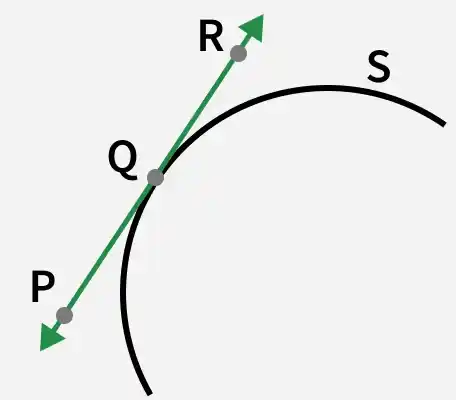
As shown in the figure above, PR is a tangent drawn from the external point P to the curve S. The line PR touches the curve S at exactly one point Q. Therefore, PR is the tangent to the curve S at point Q.
Concept of Tangent in a Circle
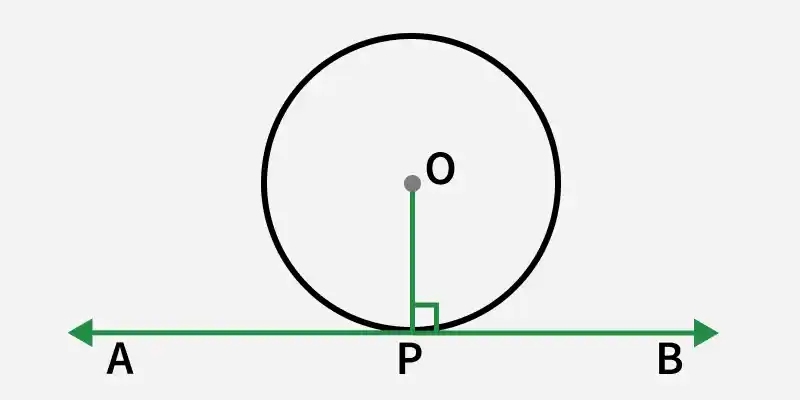
A tangent to a circle is a straight line that touches the circle at exactly one point, called the _point of tangency, and does not enter the interior of the circle. At any point on a circle, only one tangent can be drawn.
In the figure shown below, line L touches the circle at only one point P. Therefore, L is a tangent to the circle.
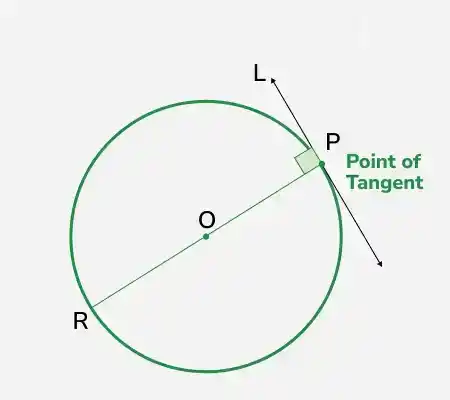
**Point of Tangency: The point of tangency is the single point at which a straight line touches a circle without cutting through it.
Equation of Tangent to a Circle
A tangent is a straight line. To write the equation of a tangent, we need the equation of the circle and a point or slope related to the tangent.
- Equation of tangent to a circle with equation x2+ y2 = a2 at point (x1, y1) is
xx1+yy1 = a2
- Equation of tangent to a circle with equation x2+ y2+2gx+2fy+c = 0 at point (x1, y1) is
xx1+yy1+g(x+x1)+f(y +y1)+c = 0
- Equation of a tangent to a circle with equation x2+ y2 = a2 at point (a cos θ, a sin θ ) is
x cos θ+y sin θ = a
- Equation of a tangent to a circle with equation x2+ y2 = a2 for the line y = mx +c to be tangent is
y = mx ± a √[1+ m2]
Condition of Tangency
A tangent is a line that touches a circle at exactly one point, while a line that cuts the circle at more than one point is called a secant (or intersecting line), not a tangent.
Based on the position of the point from which the tangent is drawn, the conditions for tangency are classified into three cases:
- If the point lies inside the circle, no tangent can be drawn because any line passing through that point will intersect the circle at two points, making it a secant rather than a tangent.
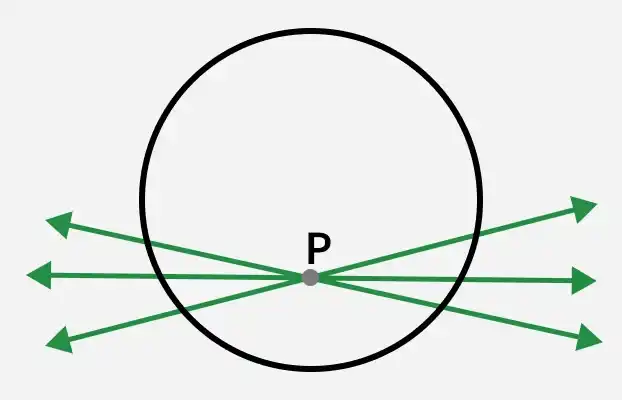
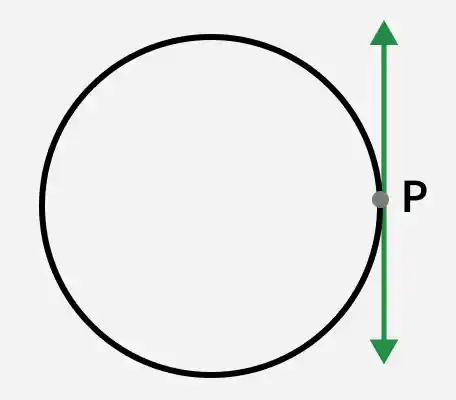
- If the point lies on the circumference of the circle, exactly one tangent can be drawn, and it touches the circle at that point only.
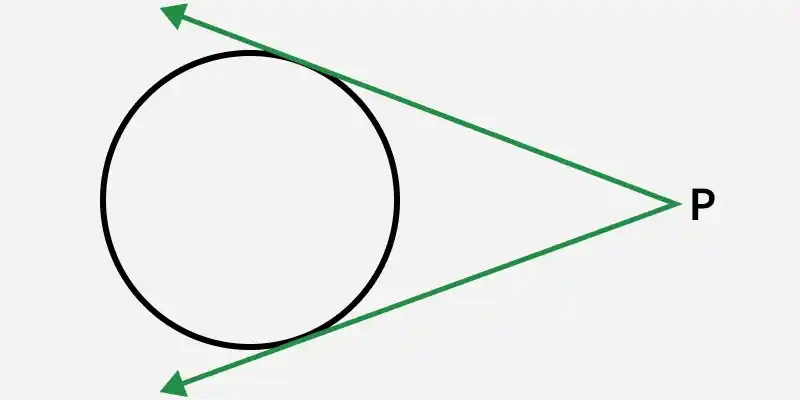
- If the point lies outside the circle, two tangents can be drawn, and both are equal in length, touching the circle at two different points.
Properties of Tangent
Various properties of the tangent to a circle are:
- A tangent only touches the curve at one point.
- Tangent never enters the circle’s interior and only touches the circumference of the circle once.
- The radius of the circle at the point of tangency is perpendicular to the tangent at that point.
- We can have two tangents to a circle from an exterior point, and both are equal in length.
Tangent Theorems
We have two important theorems on the tangent of a circle.
- Tangent Radius Theorem
- Two Tangents Theorem
Tangent Radius Theorem
**Statement: The tangent at any point of a circle is perpendicular to the radius through the point of contact.
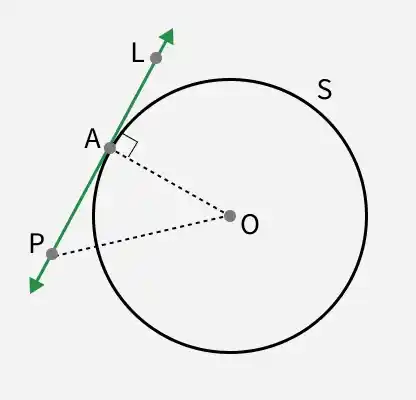
**Given: In the figure, PL is a tangent to circle S with centre O, touching the circle at point A.
**To prove: OA is perpendicular to the tangent PL(OA ⟂ PL).
**Proof:
Point A is the point of contact of the tangent PL with the circle.
Take any point P on the tangent PL, other than point A, and join OP.Since point P lies outside the circle, the distance **OP > OA, because OA is the radius of the circle.
Thus, among all the distances from O to the points on line PL, OA is the shortest distance.
The shortest distance from a point to a line is the perpendicular.
Therefore, **OA ⟂ PL
**Two Tangents Theorem
**Statement: If two tangents are drawn from an external point to a circle, then the lengths of the two tangents are equal.
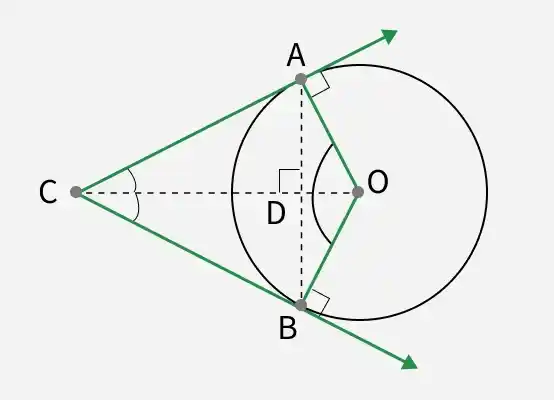
**Given: In the figure, a circle with centre O is shown. From an external point C, two tangents, CA and CB, are drawn to the circle, touching it at points A and B, respectively.
**To Prove: CA = CB
**Proof:
Join OA, OB, and OC.
Since OA and OB are radii of the same circle,
OA = OBAlso,
OC = OC (common side).The radius is perpendicular to the tangent at the point of contact.
Therefore,
∠OAC = ∠OBC = 90°.Thus, in triangles ΔCAO and ΔCBO:
- OA = OB (radii of the same circle),
- OC is common, and
- ∠OAC = ∠OBC = 90°.
Hence,
ΔCAO ≅ ΔCBO _(by RHS congruence).Therefore,
**CA = CB_(CPCT).Remark:
Since
∠ACO = ∠BCO, the line OC bisects the angle between the two tangents.Hence,
the centre of the circle lies on the bisector of the angle between the two tangents drawn from an external point.
Tangent Formula
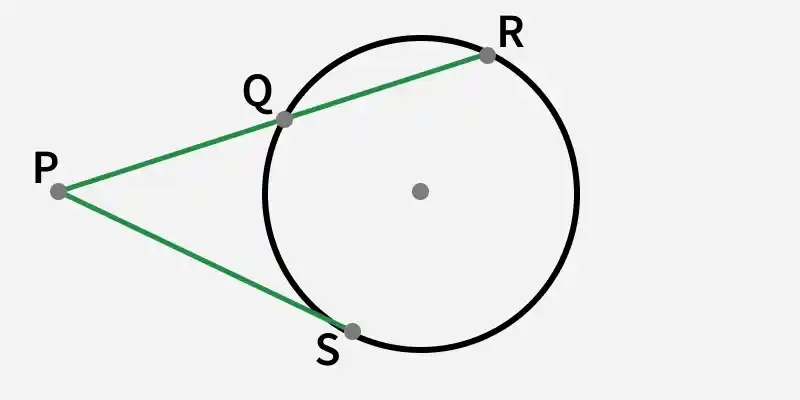
If we take any point P outside the circle and draw a tangent at point S on the circumference of the circle. Also, take a secant PQR such that QR is the chord of the circle, then,
PS2 = PQ.PR
This is also called the Tangent Secant theorem. We also write this theorem as,
(Tangent)2 = Whole Secant × External Secant
Related Articles
Solved Problems
**Example 1: In a circle with centre O, AB is a tangent at point P. If OP = 5 cm and OB = 13 cm, find the length of tangent AB.
**Solution:
Since the radius is perpendicular to the tangent at the point of contact,
OP ⟂ AB.So, in right triangle OPB:
OB² = OP² + PB²
13² = 5² + PB²
169 = 25 + PB²
PB² = 144
PB = 12 cmNow,
AB = 2 × PB = 2 × 12 = 24 cm
**Example 2: If PQ and PR are the two tangents to a circle with centre O such that ∠POQ = 110°, then find the value of ∠RPQ.
**Solution:
Given,
PQ and PR are tangents to the circle with centre O.
We know that radius is perpendicular to the tangent of the circle.
Thus, OQ is perpendicular to PQ and OR is perpendicular to PR
∠OQP = 90°
⇒ ∠ORP = 90°
Using angle sum property of quadrilaterals.
∠RPQ + ∠QOR + ∠OQP + ∠ORP = 360°
⇒ ∠RPQ = 360° - (110° + 90° + 90°)
⇒ ∠RPQ = 70°
Thus, the value of ∠RPQ is 70°.
Practice Problems
**1. Find the equation of the tangent to the circle x2 + y2 = 25 at the point (3, 4).
**2. Determine the equations of the tangents to the circle x2 + y2 = 9 that pass through the point (4, 1)
**3. Given the circle x2 + y2 = 16, find the equations of the tangents from the point (6, 0) to the circle.
**4. Find the equation of the tangent to the circle x2 + y2 - 6x + 8y = 0 at the point (3, 1).