Tangents and Normals (original) (raw)
Last Updated : 19 Jan, 2026
Tangents and normals are straight lines used to describe important geometric properties of curves.
- A tangent is a line that touches a curve at a specific point without crossing it at that point.
- A normal is the line drawn perpendicular to the tangent at the point of contact.
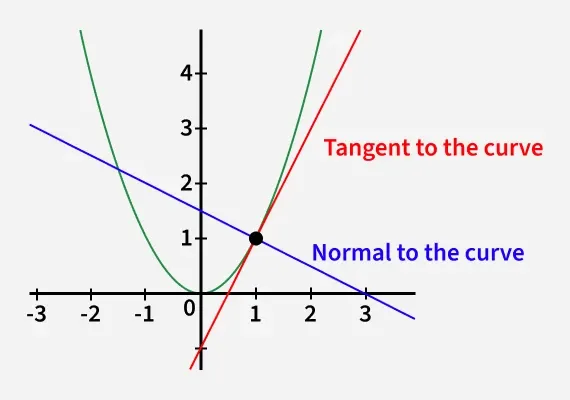
Using differentiation, we can determine the slopes and equations of both the tangent and the normal to a curve. Since both are straight lines, they are represented using the standard linear equation form, such as:
y − y1 = m(x − x1)
These ideas apply to many curves, including circles, ellipses, parabolas, hyperbolas, and other smooth curves.
Tangent
A tangent to a curve at a point is a straight line that just touches the curve at that point.
Mathematically, for any curve, F(x) the tangent at point (x1, y1) is defined at the line, y - y1 = m(x - x1) where m is the slope of the line.
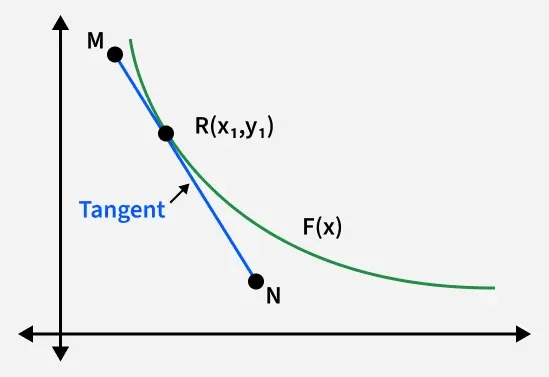
- It has the same slope as the curve at that point.
- It does not cross the curve at that point (though it may cross it elsewhere).
- In calculus, the slope of the tangent is given by the derivative.
A simple way to visualize this is with a circle: a tangent touches the circle at exactly one point.
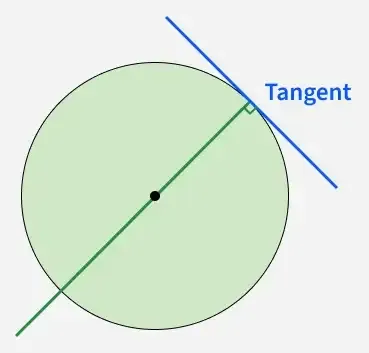
**Real-life example: A stone tied to a rope and rotated in a circle—if the rope is suddenly released, the stone moves in a straight line along the direction of the tangent at that point.
Properties of Tangent
The tangent to a curve has various properties and some of them are,
- Tangents touch the curve only at one point.
- If any tangent to a curve y = f(x) makes angle θ with the x-axis, then\frac{dy}{dx} = Slope of Tangent = tan θ.
- If the slope of the tangent is zero, then tan θ will be equal to 0 and so θ = 0 which implies that the tangent line is parallel to the x-axis.
- If the slope of the tangent is (θ) = π/2, then tan θ will approach ∞, i.e., the tangent line is perpendicular to the x-axis.
Normal
Normal to the curve at any given point is defined as the line passing through the curve which is perpendicular to the tangent of the curve at the point of tangency. This perpendicular line extends in both directions from the point where it meets the curve.
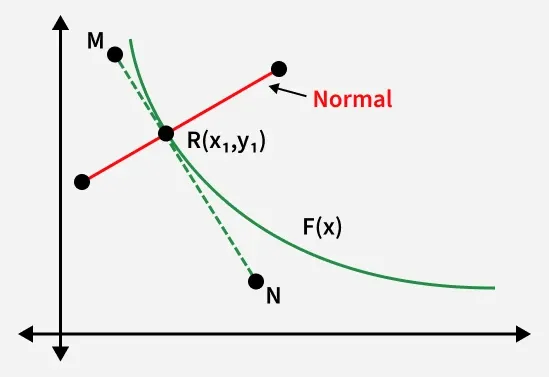
For any curve, F(x) the equation of normal at point (x1, y1) is defined at the line, y - y_1 = \frac{-1}{m(x-x_1)} where m is the slope of the tangent line passing through that point.
Properties of Normal
The normal line to the curve has various properties and some of them are,
- A normal line at any point of a circle will always pass through the center of the circle.
- The normal to any curve is always perpendicular to the tangent at any point on the curve.
How To Find Tangent and Normal?
To find the Tangents and Normal to a curve we require the equation of the curve and the point at which we have to find the tangent and normal. Suppose the point at which we require to find the equation of the Tangents and Normals to the curve is (x1, y1) and the equation of the curve is f(x) then we can easily find the equation of the tangent and normal to the curve.
We know that the tangents and the normal are perpendicular to each other and the slope of the curve y = f(x) at any point (x1, y1) is given using the formula,
m = \frac{dy}{dx} at (x1, y1)
We also know that if the slope of the tangent line is m1 and the slope of the perpendicular line is m2 then,
**m 1 × m 2 = -1
Using these we can easily find the tangent and normal to any curve of the circle.
Equation of Tangent and Normal to the Curve
We can calculate the equation of tangent and normal of the curve by various means that include.
- In Cartesian Coordinates System
- In Parametric Form
In Cartesian Coordinates System
At a point on the curve, the gradient of the curve is equal to the gradient of the tangent to the curve at that point. So, the equation of a tangent can be found by the gradient at that point to the curve and the given point as follows,
As we know that the equation of the straight line passes through point P (x0, y0) is
y - y 0 = m(x - x 0 )
Here, m is the finite slope of the line. Now the slope of the tangent to a curve given is y = f(x) at point P (x0, y0) is f'(x0). Then the equation of the **tangent to the curve at point P(x0, y0) is
**y - y 0 = f'(x 0 )(x - x 0 )
For the normal, as we already know that the normal is always perpendicular to the tangent line. Then the slope of the normal to the curve will be:
Slope of Normal = \frac{-1}{f'(x_0)}
So, the equation of **normal to the curve y = f(x) at the point (x0, y0) is,
**y - y 0 = [\frac{-1}{f'(x_0)}] (x - x 0 )
**f'(x 0 )(y - y 0 ) + (x - x 0 ) = 0
In Parametric Form
Let us assume the parametric form of the curve is
x = x(t) ....(i)
y = y(t) ....(ii)
Now we find the slope of the tangent to a curve at the point (x0, y0), by using the differentiation rule:
m = tan α = \frac {y'(t)}{x'(t)}
Hence, the equation of the tangent is:
y - y_0 = [\frac {y'(t)}{x'(t)}](x - x_0)
Accordingly, the equation of the normal is:
y - y_0 = -\frac{x'(t)}{y'(t)}(x - x0)
**y'(t)(y - y 0 ) + x'(t)(x - x 0 ) = 0
**Related Articles
Tangents and Normal for Various Curves
We can easily find the tangent and normal to various curves and some of the important curves and the equation of their tangent and normal are,
**Circle****:** For the circle represented using the equation x2 + y2 + 2gx + 2fy + c = 0 and at the point (x1, y1). The equations for Tangent and Normal for the circle are given as,
**Tangent: xx_1 + yy_1 + g(x + x_1) + f(y + y_1) + c = 0
**Normal: \frac{(y - y_1)}{(y_1 + f)} = \frac{(x - x_1)}{(x_1 + g)}
**Parabola****:** For the parabola represented using the equation y2 = 4ax, and at the point (x1, y1). The equations for Tangent and Normal for parabola are given as,
**Tangent: yy_1 = 2a(x + x_1)
**Normal: (y-y_1) = \frac{-y_1}{2a}(x - x_1)
**Ellipse****:** For the ellipse represented using the equation x2/a2 + y2/b2 = 1, and at the point (x1, y1). The equations for Tangent and Normal for ellipse are given as,
**Tangent: \frac {xx_1}{a_2} + \frac{yy_1}{b_2} = 1
**Normal: \frac{a_2x}{x_1} - \frac{b_2y}{y_1} = a_2 - b_2
**Hyperbola****:** For the hyperbola represented using the equation x2/a2 - y2/b2 = 1, and at the point (x1, y1). The equations for Tangent and Normal for hyperbola are given as,
**Tangent: \frac{xx_1}{a_2} - \frac{yy_1}{b_2} = 1
**Normal: (y - y_1) = \frac{-a_2y_1}{b_2x_1}(x - x_1)
Similarly the equation of the normal at the point (x1, y1), for each of the above-given curves, can be calculated by taking the negative of the inverse differentiation of the curve at the given point, as the slope of the curve and then forming the equation of the normal using the formula for the equation of the line passing through the given point and having slope m.
Tangents And Normal Solved Examples
**Example 1: Find the slope of the tangent and the normal to the curve y = 6x 2 **- 10x at x = 1.
**Solution:
Given Curve y = 6x2 - 10x
\frac{dy}{dx} = 12x − 10
Slope of tangent to the given curve at x = 1 is,
m1 = [\frac{dy}{dx}]x=1 = 12 × 1 – 10 = 2
We know that,
Slope of Tangent × Slope of Normal = m1 × m2 = -1
Slope of Normal = -1/2 = -0.5
**Example 2: Find The slope of the tangent and normal to the curve y = 3x 3 + 3sin(x) at x = 0.
**Solution:
The given curve is y = 3x3 + 3sin(x)
Now the gradient, \frac{dy}{dx} = 9x2 + 3cos(x)
So, the slope of the tangent to the given curve at x = 0 is,
[\frac{dy}{dx}]x=0 = 0 + 3 × 1 = 3
The slope of the normal will be:
= -1/3
**Example 3: Find the equation of the tangent to the curve y = 6x 2 **- 2x + 3 at P(1, 0).
**Solution:
The given curve is y = 6x2- 2x + 3
Now the gradient, \frac{dy}{dx} = 12x - 2
So, the slope of the tangent to the given curve at P(1,0) is
[\frac{dy}{dx}]1,0 = 12 - 2 = 10
The equation of the tangent will be:
y - 0 = 10(x - 1)
y = 10x - 10
**Example 4: Determine the point on the curve y = 6x 2 **- 8x + 1 where the tangent is parallel to the line y = 4x - 5.
**Solution:
Given curve is y = 6x2- 8x + 1
Now the gradient, \frac{dy}{dx} = 12x - 8
Tangent is parallel to y = 4x - 5
so,
12x0 - 8 = 4
or x0 = 1
Putting x = 1 in equation of the curve
We get,
y0 = 6 - 8 + 1
y0 = -1
So the point is (1, -1)
**Example 5: Find the slope of the tangent to the curve given by:
**x = psin 3 u, y = qcos 3 u at point where u = π/2.
**Solution:
Given,
x = psin3u ...(i)
y = qcos3u ...(ii)
Value of u = π/2
On differentiating eq(i) and (ii), w.r.t u, we get
\frac{dy}{du}= 3psin2u.cosu ...(iii)
\frac{dy}{du}= -3qcos2u.sinu ...(iv)
Now we find the slope of the tangent at point u = π/2
\frac{dy}{dx}=\frac{\frac{dy}{du}}{\frac{dx}{du}} = -\frac{q3cos^2u.sinu}{p3sin^2u.cosu}
\frac{dy}{dx} = \frac{-qcosu}{psinu}
[\frac{dy}{dx}]u=π/2 = \frac{-qcos(π/2)}{psin(π/2)} = 0
Hence, slope of tangent is m = 0
Practice Problems on Tangents and Normal
1. Find the equation of the tangent line to the curve f(x) = x2 at x = 3.
2. Find the equation of the normal line to the curve g(x) = 3x3 at x = 1.
3. If _h(_x) = x1/2, calculate the slope of the tangent and the normal at x = 4.
4. Determine the points on the curve y = x2 - 4x + 4 where the tangent is horizontal.
5. Find the equations of both the tangent and the normal to the curve y = x3 - 6x2 + 11x - 6 at x = 2.