Trapezium: Types | Formulas |Properties & Examples (original) (raw)
Last Updated : 23 Jul, 2025
A T**rapezium or Trapezoid is a quadrilateral (shape with 4 sides) with exactly one pair of opposite sides parallel to each other. The term "trapezium" comes from the Greek word "trapeze," meaning "table." It is a two-dimensional shape with four sides and four vertices.
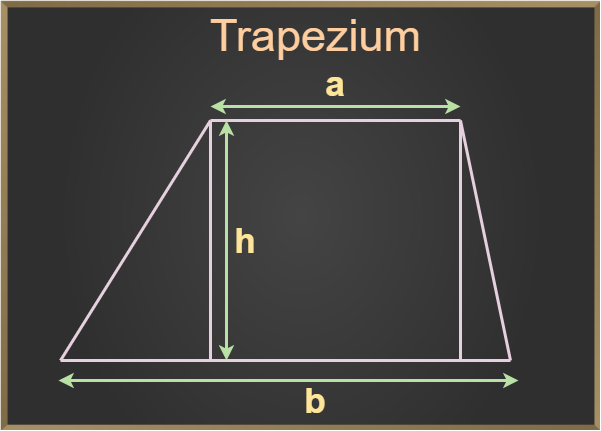
In the figure below, a and b are the bases of the trapezium, and h is the height of the trapezium:
**Note: Trapezium vs. Trapezoid
The terms **Trapezium and **Trapezoid refer to the same shape but differ in usage based on region:
- **Trapezium (British English): A four-sided shape with one pair of parallel sides.
- **Trapezoid (American English): Same as Trapezium, but used in American English.
Table of Content
**Types of Trapezium
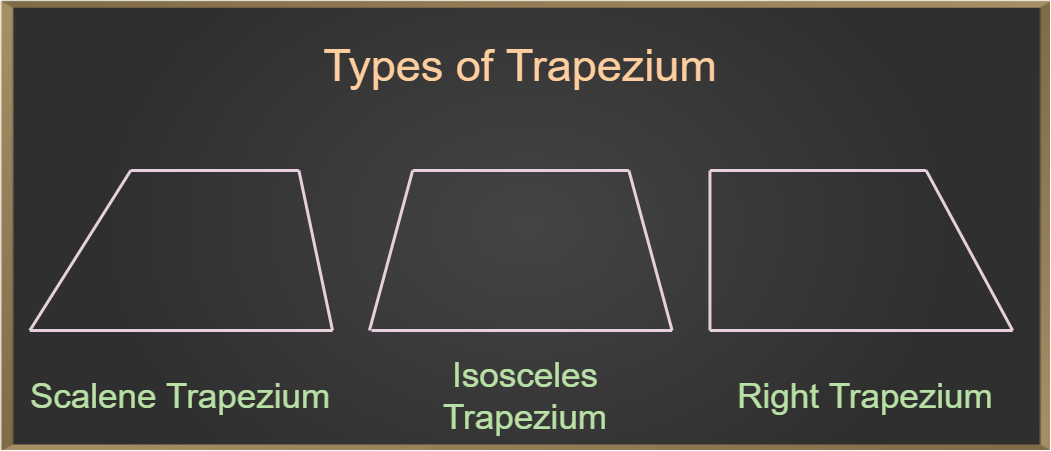
Based on the sides and the angles, the trapezium is of three types:
- **Isosceles Trapezium: The trapezium that has an equal length of legs is called an isosceles trapezium, i.e., in an Isosceles Trapezium, the two non-parallel sides are equal.
- **Scalene Trapezium: A trapezium with all the sides not equal is called a scalene trapezium. In a scalene trapezium, no two angles are equal.
- **Right Trapezium: A trapezium that has a right angle pair, adjacent to each other, is known as a right trapezium.
**Irregular Trapezium: A trapezium has one pair of parallel sides and the other two sides are non-parallel. In a regular trapezium, the other two non-parallel sides are equal, but in the case of an irregular trapezium the two non-parallel opposite sides, are unequal.
Trapezium Formula
Important formulas of a Trapezium are:
- **Area of Trapezium = ½ (Sum of Parallel Sides) × (Distance between Parallel Sides)
- **Perimeter of Trapezium = Sum of all Four Sides
**Area of a Trapezium Formula
A Trapezium has two parallel sides, a and b units respectively, and its altitude is h.
Now area of the trapezium can be calculated by finding the average of the bases and multiplying its result by the altitude. Hence,
**Area of Trapezium = ((a + b)/2) × h
Where,
- **a and **b are Bases of the Trapezium.
- **h is Altitude.
Area of Isosceles Trapezium
The area of the Isosceles Trapezoid/Trapezium can be calculated by adding the lengths of two parallel sides (bases) and dividing this by 2, and multiplying the result by the height of the trapezium to get the area. The area formula is given by:
**Area = ((a + b)/2) × h
Where,
- a, b are the lengths of parallel sides.
- And h is the height.
**➣ Read More: **Isoceles Trapezoid
**Perimeter of a Trapezium Formula
The perimeter of a trapezium is given by calculating the sum of all its sides. Hence,
**Perimeter of trapezium = AB + BC + CD + AD
Where **AB, BC, CD, and AD are the Sides of a Trapezium.
Perimeter of Isosceles Trapezium
If in an Isosceles trapezium, a and b are the lengths of parallel sides, i.e., the bases, and c is the length of two equal non-parallel sides, then the perimeter is given by:
**Perimeter = a + b + 2c
Where,
- **a, b are Bases of Trapezium
- **c is Equal Side of Trapezium
Angles of a Trapezium
Trapezium is a quadrilateral and the sum of all the angles of a quadrilateral is 360 degrees. So the sum of all the interior angles of the trapezium is 360 degrees.
For any regular trapezium, i.e., the trapezium in which non-parallel sides are equal to the adjoining angles formed between the parallel line and the non-parallel line, is equal. Thus, the sum of these two angles is supplementary.
Let's take an example to support this concept for an isosceles trapezium ABCD, if AB is parallel to CD and AD is equal to CD, then we know that ∠A = ∠B and ∠C = ∠D, then,
∠A + ∠B + ∠C + ∠D = 360°
Here, ∠A = ∠B and ∠C = ∠D
∠A + ∠A + ∠C + ∠C = 360°
2(∠A + ∠C) = 360°
(∠A + ∠C) = 180°
Similarly, (∠B + ∠D) = 180°
Diagonal of Trapezium
Trapezium is a special type of quadrilateral; thus, trapezium also have two diagonals. The diagonals of a trapezium do not have equal lengths, unlike in some other quadrilaterals such as rectangles or parallelograms. Diagonals of trapezium do not have equal lengths and the lengths of the diagonals depend on the lengths of the bases and the angles of the trapezium.
**Example: For an isosceles trapezium ABCD, the base angle ∠A is 80° then find the other angle ∠C.
We know that for an Isosceles Trapezium ABCD,
(∠A + ∠C) = 180°
Given, ∠A = 80°
Now, 80° + ∠C = 180°
∠C = 180 - 80
∠C = 100°Thus, Required Angle ∠C is 100°
**Properties of Trapezium
There are various properties of a trapezium, some of which are as follows:
- **Parallel Sides: A trapezium has two parallel sides, which are called bases.
**Example: Sides AB and CD are parallel to each other, as shown in the figure. - **Non-Parallel Sides: Non-parallel sides of a trapezium are called the legs, and the legs of a trapezium are not equal in length.
**Example: Sides AD and BC are non-parallel sides of the trapezium. - **Height or Altitude: The Perpendicular distance between the bases is called the height or altitude of the trapezium. In the above diagram, h is the height of the trapezium.
- **Sum of Angles
- Adjacent interior angles in a trapezium sum up to 180°.
**Example: There are two pairs of co-interior angles. One pair is ∠ A and ∠ D, whereas the other pair is ∠ B and ∠ C. The sum of each pair of co-interior angles is 180°. - The sum of all the interior angles in a trapezium is always 360°.
**Example: In the figure ∠A + ∠D is 180° and ∠B + ∠C is 180°. Therefore ∠A + ∠D + ∠B + ∠C = 360°.
- Adjacent interior angles in a trapezium sum up to 180°.
- **Median: The median of a trapezium is the line segment that connects the midpoints of the legs. The median is parallel to the bases and its length is the average of the lengths of the bases.
- The trapezium has exactly one pair of parallel opposite sides.
**People Also Read:
Solved Examples on Trapezium
**Example 1: Find the fourth side of the trapezium if the other three sides are 8 cm, 12 cm, and 16 cm, and the perimeter is 40 cm.
**Solution:
Perimeter is given as the sum of all its sides. Let the length o unknown be 'x' units.
Perimeter = 40
40 = 8 + 12 + 16 + x
x = 40 - (8 + 12 + 16)
= 4 cmThus, length of the unknown side is 4 cm
**Example 2: A trapezium has parallel sides of lengths 15 cm and 11 cm, and non-parallel sides of length 5 cm each. Calculate the perimeter of the trapezium.
**Solution:
It is a Isosceles Trapezium because it is clearly mentioned that non parallel sides of length 5 cm each are equal.
According to Isosceles Trapezium if two non-parallel sides of Trapezium are of equal length then it is known as Isosceles Trapezium.
Given,
- a = 15 cm
- b = 11 cm
- c = 5 cm
Perimeter = a + b + 2c
P = 15 + 11 + 2(5)
P = 15 + 11 + 10
P = 36 cm
**Example 3: Find the Perimeter of a Trapezium whose sides are 12 cm, 14 cm, 16 cm, and 18 cm.
**Solution:
P = Sum of all Sides
P = 12 + 14 + 16 + 18
P = 60 cmHence, perimeter of trapezium is 60 cm
**Example 4: Find the Area of the Trapezium, in which the sum of parallel sides is 60 cm, and its height is 10 cm.
**Solution:
Given,
- Sum of Parallel sides 60 cm
- height, h = 10 cm
Area of Trapezium, A = 1/2 × Sum of parallel sides × Distance between Parallel Sides
Substituting Given Values,
A =1/2 × 60 × 10
A = 30 × 10
A = 300 cm 2Therefore, Area of Trapezium =300 cm 2