Triangle Law of Vector Addition (original) (raw)
Last Updated : 28 May, 2026
A vector quantity is a physical quantity that has both magnitude and direction, and the procedure of adding two or more vectors is called vector addition. The Triangle Law of Vector Addition is a method used to add two vectors.
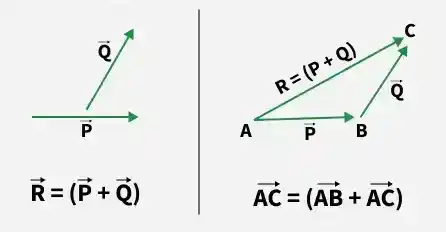
Triangle law of vector addition states that when the two vectors are represented by the two sides of the triangle, then the third side of the triangle represents the resultant vector of addition .
If \overrightarrow{\rm A} and \overrightarrow{\rm B} are two vectors. We have to add these two vectors, then the resultant vector \overrightarrow{\rm R} according to triangle law of vector addition is given by:
\bold{\overrightarrow{\rm R}=\overrightarrow{\rm A}+\overrightarrow{\rm B}}
From the two given vectors, to form a triangle, we arrange these two vectors in such a way that the tail of one vector is joined to the head of the other vector.
The formula for the magnitude of the resultant of any two vectors is given by
|R| = √(A2+ B2 + 2ABcosθ)
- R is the Resultant of A and B
- A and B are two vectors
- θ is the angle between A and B
The formula for the direction of the resultant vector of A and B i.e., Φ is given by:
Φ = tan-1[Bsinθ /(A + Bcosθ)]
- Φ is the angle of the Vector from positive x-axis
- A and B are two vectors
- θ is the angle between A and B
Derivation
Consider two vectors A and B representing the two sides of the triangle OP and PQ respectively. Let vector R (OQ) be the resultant vector of the addition of A and B.
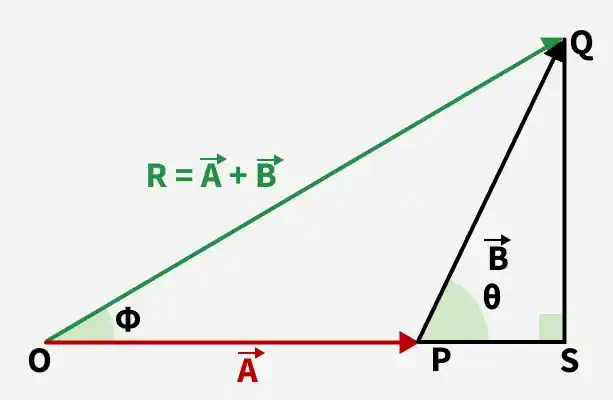
Since triangle OSQ is a right-angled triangle
OQ2 = OS2 + QS2
OQ2 = (OP +PS)2 + QS2 ------(1)
In triangle PSQ with θ as the angle between A and B
cos θ = PS / PQ
PS = PQ cosθ = B cosθ
sin θ = QS / PQ
QS = PQ sinθ = B sinθ
Substituting the values of PS and QS in equation (1), we get
R2 = (A + Bcosθ)2 + (Bsinθ)2
R2 = A2 + 2ABcosθ + B2cos2θ + B2sin2θ
R2 = A2 + 2ABcosθ + B2
Therefore,
R = √(A2+ B2 + 2ABcosθ)
The above equation represents the magnitude of resultant vector.
To find the direction of the resultant vector R, let Φ be the angle between vectors A and R.
From triangle, OQS
tanΦ = QS / OS
tanΦ = QS / (OP + PS)
tanΦ = Bsinθ / (A + Bcosθ)
therefore,
Φ = tan-1[Bsinθ / (A + Bcosθ)]
The above equation gives the direction of the resultant vector R.
Solved Examples
**Example 1: Two vectors P and Q have magnitudes of 9 units and 16 units and make an angle of 30° with each other. Using triangle law of vector addition, find the magnitude and direction of resultant vector.
According to the triangle law of vector addition
|R| = √(A2+ B2 + 2ABcosθ)
Φ = tan-1[Bsinθ /(A + Bcosθ)]
The magnitude of R :
|R| = √[92 + 162 + 2(9)(16)cos 30]
|R| = √[81 + 256 + 288(√3 / 2)]
|R| = √[337 + 144√3]
|R| = 24.21 units
The direction of R:
Φ = tan-1[16sin30 /(9 + 16cos30)]
Φ = tan-1[16(1/2) /(9 + 16(√3/2))]
Φ = tan-1[8 /(9 + 8√3)]
Φ = 19.29°
**Example 2: Two vectors have magnitudes 3 and √3 units. The resultant vector has the magnitude √21 units. Find the angle between the two vectors.
According to the triangle law of vector addition
R2 = (A2+ B2 + 2ABcosθ)
(√21)2 = [32+ (√3)2 + 2(3) (√3)cosθ]
21 = [9 + 3 + 2(3) (√3)cosθ]
21 = [12 + 6√3cosθ]
21 - 12 = 6√3cosθ
9 = 6√3cosθ
cosθ = √3 / 2
θ = cos-1(√3 / 2)
θ = 30°
The angle between two vectors is θ = 30°.
**Example 3: Consider two vectors A and B where, \overrightarrow{\rm A}= 3\hat{i} + 5\hat{j}, \overrightarrow{\rm B}= 6\hat{i} - 2\hat{j}. Find the resultant vector \overrightarrow{\rm R} after the addition of two vectors.
\overrightarrow{\rm A}= 3\hat{i} + 5\hat{j}, \overrightarrow{\rm B}= 6\hat{i} - 2\hat{j}
According to triangle law of vector addition
\overrightarrow{\rm R}=\overrightarrow{\rm A}+\overrightarrow{\rm B}\\\overrightarrow{\rm R} = (3\hat{i} + 5\hat{j}) +(6\hat{i}-2\hat{j})\\\overrightarrow{\rm R} = (9\hat{i} + 3\hat{j})
The resultant vector is \overrightarrow{\rm R} = (9\hat{i} + 3\hat{j})
**Example 4: Find the magnitude of the vector P, given that magnitude of vector Q and resultant vector R is 4 and 6 units respectively. The angle between two vectors is 60°.
According to triangle law of vector addition, the magnitude of R is given by:
R2 = [P2 + Q2 + 2PQcosθ]
Here, R = 6, Q = 4 and θ = 60°
Putting above values in the formula to find the magnitude of vector P.
62 = P 2+ 42 + 2P(4)cos 60]
36 = P 2 + 16 + (8P/ 2)
36 = P 2+ 16 + 4P
P 2 + 4P -20=0
Solving using quadratic formula: P = \frac{-b \pm \sqrt{b^2 - 4ac}}{2a}
Substituting the values , we get
P = \frac{-4 \pm \sqrt{4^2 - 4(1)(-20)}}{2(1)}
P = -2 \pm 2\sqrt{6}
Since magnitude cannot be negative, P = -2 + 2\sqrt{6}\\[3pts]P \approx 2.90
The magnitude of vector P ≅ 2.90 units.
**Example 5: Find the magnitude of vector A, if the magnitude of vector B is 10 units, angle between two vectors is 60° and the angle between vector A and the resultant vector is 45°.
According to the triangle law of vector addition
Φ = tan-1[Bsinθ /(A + Bcosθ)]
tanΦ = [Bsinθ /(A + Bcosθ)]
Here, B = 10 units, θ = 60° and Φ = 45°
Putting these values in the above formula to obtain the magnitude of vector A.
tan 45 = [10sin60 /(A + 10cos60)]
1 = [10(√3 / 2)] / [A + 10(1/2)]
1 = 5√3 / [A + 5]
A + 5 = 5√3
A = 5√3 - 5
A = 5(√3 - 1)
A = 3.66 units
The magnitude of vector A is 3.66 units.
Practice Problems
**Problem 1: Car travelling 40 km West and 30 km South. Calculate the resultant displacement using Triangle Law of Vector Addition.
**Problem 2: A man walks 8 km at an angle of 60 degrees South of West and then 8 km West. Determine the resultant displacement.
**Problem 3: An airplane travelling 800 km North and then 500 km due West. Find the resultant of displacement of airplane.
**Problem 4: A boat travels 10 km north-east and then 16 km east. Find the resultant displacement.