Triangular Number Sequence (original) (raw)
Last Updated : 23 Jul, 2025
**Triangular Number is a sequence of numbers that can be represented in the form of an equilateral triangle when arranged in a series. The triangular numbers list includes numbers 1, 3, 6, 10, 15... They are a type of figurative numbers.
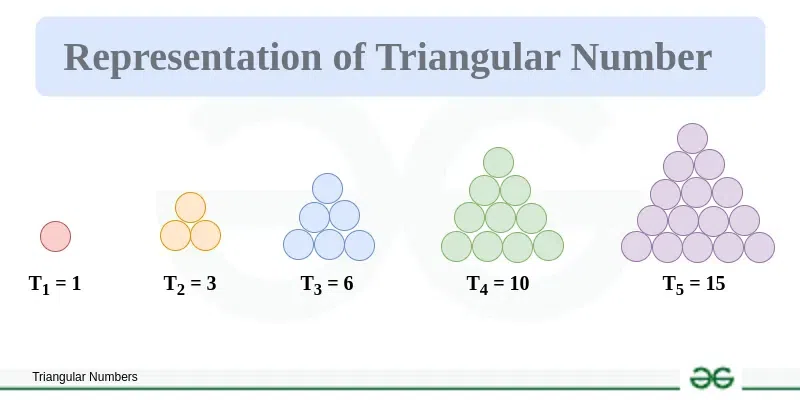
First triangular number is **T 1 **= 1.
To obtain the second number, add 2 to T1. Thus the second number becomes 3. Subsequently, to obtain the third number, we add 3 to T2 to arrive at number 6. For the ease of understanding, it can be represented as below:

Table of Content
- Properties of Triangular Numbers
- Triangular Number Formula
- Sum of Triangular Numbers
- How to Find Next Triangular Number from Previous 2
- Triangular Number List
- Triangular Numbers Solved Examples
- Triangular Number Practice Questions
- Triangular Numbers FAQs
**Properties of Triangular Numbers
- The nth triangular number is equal to sum of first n natural numbers, .i.e., n x (n + 1)/2 (see the proof below]
- The sum of two consecutive triangular numbers always gives a perfect square.
- They are well known for their application in solving handshake problems.
Please refer Interesting Facts about Triangular Numbers for more such facts.
Triangular Number Formula
We know Tn = 1
We can recursively define other riangular numbers. We can see that we get nth triangular number by adding n to (n-1)the triangular number
Tn = Tn-1 + nLet us use the above recursive to find the formula by replacing Tn-1 with Tn-2 + (n-1)
Tn = Tn-2 + (n - 1) + nIf we keep doing this, we get
Tn = Tn-3 + (n-2) + (n - 1) + n
......................................................
Tn = 1 + 2 + ............. (n-1) + nWhich is sum of first n natural numbers
Therefore the following formula can be used to calculate the triangular numbers:
**T n = n(n+1)/2
In the above formula, (n+1)/2 is binomial coefficient.
Sum of Triangular Numbers
We can compute the sum as **n*(n+1)*(n+2) / 6
**How does this work?
We mainly need to compute sum of i*(i + 1)/2 from i = 1 to n
Which is equal to 1/2 x Sum(i2) + 1/2xSum(i) where i goes for 1 to n in both sums
We can use formulas of sum of n natural numbers and sum of natural number squares and get the expression as
1/2 x [n x (n+1)/2] + 1/2 x [n x (n + 1) x (2n + 1) / 6[
= n x (n + 1)/4 [ 1 + (2n + 1)/3]
= n x (n + 1)/4[ (2n + 4)/3]
= n x (n + 1) x (n + 2) / 6
How to Find Next Triangular Number from Previous 2
If we are given a sequence of triangular numbers, to determine the next number in the series, follow the below given steps:
- Calculate the difference between the two consecutive numbers.
- Increase the difference obtained by 1.
- Determine the next number in the sequence.
Let us find the next triangular number of 6 and 10.
- **Step 1: Calculate the difference between two consecutive numbers. In this case it is 10-6 = **4.
- **Step 2: Increment the difference obtained by 1. In our example the difference obtained is 4. thus it becomes 5 after increment.
- **Step 3: Next number in the series is thus 10 + 5 = **15.
| Prime Numbers | Whole Numbers |
|---|---|
| Co-prime Numbers | Sequence and Series |
| Square Numbers | Real Numbers |
Triangular Number List
Triangular number list has the following numbers:
**1, 3, 6, 10, 15, 21, 28, 36, 45, 55, 66, 78, 91, 105, 120,136, 153, 171, 190, 210, 231, 253, 276, 300, 325, 351, 378, 406, 435, 465, 496, 528, 561, 595, 630, 666, 703, 741, 780, 820, 861, 903, 946, 990, 1035, 1081, 1128, 1176, 1225, 1275, 1326, 1378, 1431...and so on.
Triangular Numbers Solved Examples
**Example 1: Find out 10 th Triangular Number.
**Solution:
To find out T10, we use the formula as mentioned below,
Tn = n(n+1)/2
T10 = 10(10+1)/2
T10 = 10(11)/2
T10 = 55.
**Example 2: The first four triangular numbers are 1,3,6 and 10. Find out the position of number 55 in the sequence.
**Solution:
Here, Tn = 55.
We know that Tn= n(n+1)/2
⇒ n(n+1)/2 = 55
⇒ n2 + n = 55 × 2
⇒ n2 + n -110 = 0
⇒ n2 + 11n - 10n - 110=0
⇒ (n+11)(n-10)=0
⇒ n = -11 or n = 10
Since, a negative number can't be the position in the sequence, therefore n = 10 is a valid solution.
Thus, 55 is at the position 10th
Triangular Number Practice Questions
Try out the following questions on Triangular Numbers.
**Q1. Find the 20th Triangular Number
**Q2. Check if sum of first 10 natural numbers is equal to the tenth triangular number is the list
**Q3. Find the position of 66 in Triangular Number Sequence
**Q4. Find the sum of first five triangular numbers