Sum of First n Natural Numbers (original) (raw)
Last Updated : 23 Jul, 2025
**Sum of n Natural Numbers is simply an addition of 'n' numbers of terms that are organized in a series, with the first term being 1, and n being the number of terms together with the nth term. The numbers that begin at 1 and terminate at infinity are known as natural numbers. Sum of the first n natural numbers formula is given by [n(n+1)]/2.
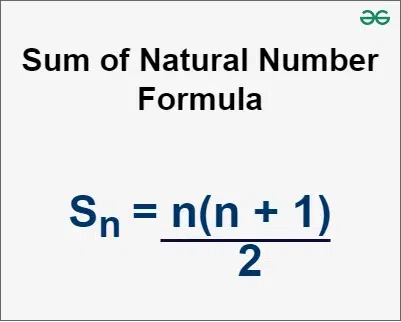
Sum of Natural Numbers
Let us check the above formula with some examples.
n = 1, S1 = 1 * (1 + 1) / 2 = 1. The first natural number is 1 only, so sum would be 1.
n = 2, S2 = 2 * (2 + 1)/ 2 = 3. The first two natural numbers are 1 and 2. If we sum them we get 3 only
n = 3, S2 = 3 * (3 + 1)/ 2 = 6 The first two natural numbers are 1, 2 and 3. If we sum them we get 6 only
Poof of Sum of Natural Numbers Formula
All natural numbers continue till infinity and so on. If students examine closely, they can find an arithmetic progression by using a formula in the following ways:
**Let's derive the formula for finding the number of terms (n) in an arithmetic series using the given formula
where, n is the number of terms, A1 is the first term, An is the last term.
- So, Let's see the form of an arithmetic series is:
An = A1 + (n - 1) × Common difference
- Now, to find the number of terms (n). Let's rearrange the formula for An to solve for n]:
**n = (A n - A 1 / common difference) + 1
**Let's see the simple formula derivation of the Sum of natural numbers
In, the very first step Consider the Sum
**S n = 1 + 2 + 3 + … + (n−2) + (n−1) + n
Now, Let's pair the terms each pair sums to n+1:
**S n = (1 + n) + (2 + (n−1)) + (3 + (n−2)) +…
**Number of Pairs: There are n terms in the sum, and each pair contributes n+1. Therefore, the number of pairs is n/2.
**Write the Sum as Products: Express the sum as the product of the number of pairs and the constant sum of each pair:
**S n = n/2 × (n+1)
At last, let's simplify it, Sn = n/2 × (n+1). If you multiply n/2 by (n+ 1) you get n × (n + 1) /2
Then, we get the sum of natural number formula:
**S n = n × (n + 1) /2
Sum of Natural Numbers 1 to 100
To find the sum of natural numbers from 1 to 100, you can use the formula for the sum of an arithmetic series. The formula is:
**S n = n/2 × (A 1 + A n )
Here,
- Sn is a Sum of Series
- n is Number of Terms in Series = 100
- A1 is First Term= 1
- An is Last Term= 100
In this case, you want the sum of natural numbers from 1 to 100, so n= 100, A1 = 1, and An = 100. Let's use the formula, and put these values in it:
Sn = 100/2 × (1+100)
Sn= 50 × 101
Sn= 5050
Therefore, the sum of natural numbers from 1 to 100 is 5050.
Sum of Natural Numbers Starting from 1
The sum of natural numbers starting from 1 formula is given by:
Sn = n/2 × (A1+ An)
putting A1 = 1
**S n = n/2 × (1 + A n )
Sum of Natural Numbers Not Starting from 1
The sum of natural numbers not starting from 1 formula is given by:
**S n = n/2 × (A 1 + A n )
**Articles Related to Sum of Natural Numbers,
- Program for Sum of Natural Numbers
- Triangular Number Sequence
- Sum in Maths
- Arithmetic Operations
- Arithmetic Progression and Geometric Progression
Examples on Sum of Natural Numbers
**Example 1: Determine the sum of natural numbers between 100 and 150.
**Solution:
Sum in arithmetic Series: Sn is the sum of the series; n is the number of terms in the series that can be used by using formula:
**n = (A n - A 1 / common difference) + 1
A1 is the first term = 101
An is the last term = 149
Common difference = 1
Let's calculate the value of n by using formula:
**n = (A n - A 1 / common difference) + 1
n = (149- 101 / 1) + 1
n = 49 + 1
n = 50
Now, we will calculate the sum of natural numbers:
**S n = n/2 × (A 1 + A n )
Sn = 50/2 × (101 + 149)
Sn = 25 × 250
Sn = 6250
Therefore, the sum of natural numbers between 100 and 150 using the formula is 6250.
**Example 2: Add any two Consecutive natural numbers, which is always an odd number. Justify this statement.
**Solution:
When you add any two consecutive natural numbers, n and n+1, the sum is 2n+1. The term 2n represents an even number since it's divisible by 2, and adding 1 to an even number always results in an odd number. Therefore, the sum of consecutive natural numbers is consistently an odd number.
For Example:
Let's add any two consecutive natural numbers: 3 and 4
3+4 = 7
Now, using the formula 2n + 1, where n is the first natural number: 2 × 3 + 1 = 7
Hence, adding the consecutive natural numbers 3 and 4 results in the sum 7, which is an odd number.
**Example 3: Find the sum of the first 5 natural odd numbers using the formula Sn = n/2 × (A 1 + A n ).
**Solution:
Sum in arithmetic Series:
Sn is a Sum of the series; n is the number of terms in the series = 5
A1 is the first term = 1
An is the last term = 9
In this case, you want the sum of the first 5 natural odd numbers so n= 5, A1 = 1, and An = 9. Let's use the formula, and put these values in it:
Sn = 5/2 × (1+9)
Sn = 5/2 × 10
Sn = 25
Therefore, the sum of the first 5 natural odd numbers is 25.
**Example 4: Find the sum of the first 30 natural numbers.
**Solution:
Let's see the sum of first 30 natural numbers
S = [n(n+1)]/2
S = [30 (30+1)]/2
S = 465
Sum of Natural Numbers - Practice Questions
**Q1. Find the sum of the first 5 even natural numbers.
**Q2. Find the sum of the first 5 odd natural numbers.
**Q3. Find the sum of the first 20 natural numbers.
**Q4. Name some of the common points based on the Sum of natural numbers.