Trigonometric Ratios of Some Specific Angles (original) (raw)
Last Updated : 25 Feb, 2026
**Trigonometry is all about triangles or to be more precise the relationship between the angles and sides of a triangle (right-angled triangle). In this article, we will be discussing the ratio of sides of a right-angled triangle concerning its acute angle called trigonometric ratios of the angle and find the trigonometric ratios of specific angles: 0°, 30°, 45°, 60°, and 90°.
Consider the following triangle,
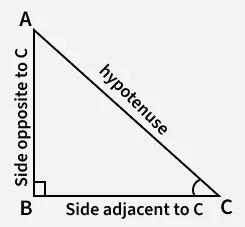
The side BA is opposite to the angle ∠BCA so we call BA the opposite side to ∠C and AC is the hypotenuse; the other side BC is the adjacent side to ∠C.
Trigonometric Ratios of Angle C
**Sine: Sine of ∠C is the ratio of the side opposite to C (BA) to the hypotenuse (AC).
sin\, C = \frac{BA}{AC}
**Cosine: Cosine of ∠C is the ratio of the side adjacent to C (BC) and the hypotenuse (AC).
cos\, C = \frac{BC}{AC}
**Tangent: The tangent of ∠C is the ratio between the side opposite (BA) and adjacent to C (BC).
tan\, C = \frac{BA}{BC}
**Cosecant: Cosecant of ∠C is the reciprocal of sin C therefore it is the ratio of the hypotenuse (AC) to the side opposite to C (BA).
cosec\, C = \frac{AC}{BA}
**Secant: Secant of ∠C is the reciprocal of cos C therefore it is the ratio of the hypotenuse (AC) to the side adjacent to C (BC).
sec\, C = \frac{AC}{BC}
**Cotangent: Cotangent of ∠C is the reciprocal of tan C that is the ratio of the side adjacent to C (BC) to the side opposite to C (BA).
cot\, C = \frac{BC}{BA}
Finding Trigonometric Ratios for Angles 0°, 30°, 45°, 60°, 90°
Considering the length of the hypotenuse AC = a, BC = b and, BA = c.
**For angles 0° and 90°
If angle A = 0°, the length of the opposite side would be zero and hypotenuse = adjacent side, and if A = 90°, the hypotenuse = opposite side. So, with the help of the above formulas for the trigonometric ratios we get -
**if A = 0° \\ sin A = \frac{BC}{AC} = \frac{b}{a} = 0 \\\quad\\ cos A = \frac{AB}{AC} = \frac{c}{a} =1 \\\quad\\ tan A = \frac{BC}{AB} = \frac{b}{a} = 0 \\\quad\\ cosec A = \frac{AC}{BC} = \frac{a}{b} = not\, defined \\\quad\\ sec A = \frac{AC}{AB} = \frac{a}{c}= 1 \\\quad\\ cot A = \frac{AB}{BC} = \frac{a}{b}= not\, defined \\\quad\\
**if A = 90° \\ sin A = \frac{BC}{AC} = \frac{b}{a} = 1 \\\quad\\ cos A = \frac{BA}{AC} = \frac{c}{a} = 0 \\\quad\\ tan A = \frac{BC}{BA} = \frac{b}{c} = not\, defined \\\quad\\ cosec A = \frac{AC}{BC} = \frac{b}{a}= 1 \\\quad\\ sec A = \frac{AC}{BA} = \frac{a}{c}= not\, defined \\\quad\\ cot A = \frac{BA}{BC} = 0
Here some of the trigonometric ratios result as **not defined as at the particular angle it is divided by 0 which is undefined.
**For angles 30° and 60°
Consider an equilateral triangle ABC. Since each angle in an equilateral triangle is 60°, therefore,
∠A = ∠B = ∠C = 60°.
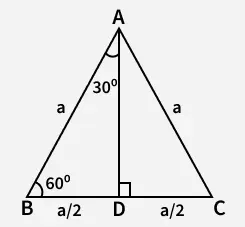
∆ABD is a right triangle, right-angled at D with ∠BAD = 30° and ∠ABD = 60°,
Here ∆ADB and ∆ADC are similar as they are **Corresponding parts of Congruent triangles (CPCT).
In\, \Delta ABD\;,AB=a\,,BD=\frac{a}{2} \\and\,AB^2=BD^2+AD^2\\ \quad\\\implies AD^2=AB^2-BD^2 \\ \quad\\\implies AD^2=a^2-(\frac{a}{2})^2\\ \quad\\ \implies AD^2=a^2-\frac{a^2}{4} \\ \quad\\ \implies AD^2=\frac{3a^2}{4} \\\quad\\ \implies AD= \frac{\sqrt{3} a}{2}
Now we know the values of AB, BD, and AD, So the trigonometric ratios for angle 30° are,
sin\ 30=\frac{BD}{AB}= \frac{a/2}{a}=\frac{1}{2} \\ \quad\\cos\ 30=\frac{AD}{AB}=\frac{\sqrt{3}a/2}{a} =\frac{\sqrt{3}}{2} \\ \quad\\tan\ 30=\frac{BD}{AD}=\frac{a/2}{\sqrt{3}a/2}=\frac{1}{\sqrt{3}} \\\quad\\cosec\ 30=\frac{AB}{BD}=\frac{a}{a/2}=2 \\\quad\\sec\ 30=\frac{AB}{AD}=\frac{a}{\sqrt{3}a/2} =\frac{2}{\sqrt{3}} \\\quad\\cot\ 30=\frac{AD}{BD}=\frac{\sqrt{3}a/2}{a/2}= \sqrt{3}
**For angle 60°
sin\ 60=\frac{AD}{AB}= \frac{\sqrt{3}a/2}{a}=\frac{\sqrt{3}}{2} \\ \quad\\cos\ 60=\frac{BD}{AB}=\frac{a/2}{a}=\frac{1}{2} \\\quad\\tan\ 60=\frac{AD}{BD}=\frac{\sqrt{3}a/2}{a/2}=\sqrt{3} \\\quad\\cosec\ 60=\frac{AB}{AD}=\frac{a}{\sqrt{3}a/2}=\frac{2}{\sqrt{3}} \\\quad\\sec=\frac{AB}{BD}=\frac{a}{a/2}=2 \\\quad\\cot\ 60=\frac{BD}{AD}=\frac{a/2}{\sqrt{3}a/2}=\frac{1}{\sqrt{3}}
**For angle 45°
In a right-angled triangle if one angle is 45° then the other angle is also 45° thus, making it an isosceles right-angle triangle.
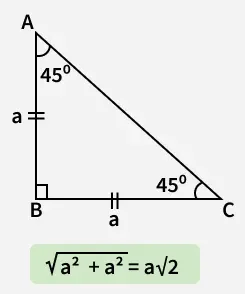
If the length of side BC = a then length of AB = a and length of AC(hypotenuse) is a√2 using Pythagoras Theorem, then
sin\ A = \frac{BC}{AC} = \frac{a}{a\sqrt2} = \frac{1}{\sqrt2}\\ \quad\\ cos\ A = \frac{AB}{AC} = \frac{a}{a\sqrt2} = \frac{1}{\sqrt2}\\ \quad\\ tan\ A = \frac{BC}{AB} = \frac{a}{a} = 1\\ \quad\\ cosec\ A = \frac{1}{sin\ A}= \sqrt2\\ \quad\\ sec\ A = \frac{1}{cos\ A} = \sqrt2\\ \quad\\ cot\ A = \frac{1}{tan\ A} = 1\\
All Values of Trigonometric Ratios [Some Specific Angles]
Some of the common values of trigonometric ratios are listed in the following table:
| ∠A | 0° | 30° | 45° | 60° | 90° |
|---|---|---|---|---|---|
| sin A | 0 | 1/2 | 1/√2 | √3/2 | 1 |
| cos A | 1 | √3/2 | 1/√2 | 1/2 | 0 |
| tan A | 0 | 1/√3 | 1 | √3 | Not defined |
| cosec A | Not defined | 2 | √2 | 2/√3 | 1 |
| sec A | 1 | 2/√3 | √2 | 2 | Not defined |
| cot A | Not defined | √3 | 1 | 1/√3 | 0 |
**Related Articles
- Trigonometry in Maths
- Trigonometric Ratios
- Trigonometry Table
- Trigonometry Formulas and Identities
- Some Applications of Trigonometry
Practice questions:
Problem 1: If sin A = 1/2 and A is an acute angle, find:cos A and tan A.
**Problem 2: If cos θ = √3/2, where 0° < θ < 90°, find all other trigonometric ratios of θ.
**Problem 3: Find sin A − cos A when A = 45°.