Types of Quadrilaterals and Their Properties (original) (raw)
Last Updated : 15 Apr, 2026
A quadrilateral is a polygon with four sides, four vertices, and four angles. The sum of its interior angles is always 360°. Quadrilaterals come in different shapes, each with its own unique properties and characteristics.
The most common types of quadrilaterals are:
1. Square
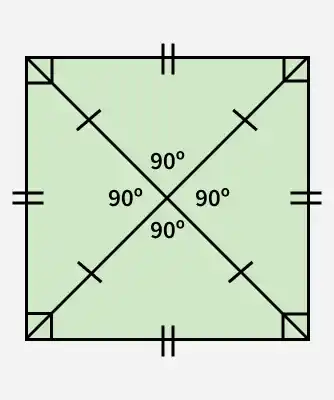
A quadrilateral that has all sides equal, opposite sides parallel, and all interior angles equal to 90° is called a Square.
**Properties
- All the sides of a square are equal to each other.
- All the angles of a square are equal and of 90° each.
- Opposite Sides are parallel to each other.
- Diagonals are perpendicular bisectors of each other and are equal.
- The perimeter of a square is equal to the sum of the lengths of all its sides, i.e., 4a (where a is the side of the square).
- The area of a square is equal to the length of one side squared, i.e., a2 (where a is the side of the square).
All squares are rhombuses but not all rhombuses are squares.
**2. Rectangle
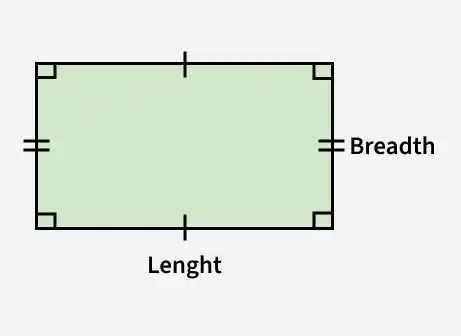
A rectangle is a quadrilateral in which there are two pairs of equal and parallel sides with all the interior angles right angles, i.e., 90°.
**Properties
- Opposite Sides are parallel to each other.
- Opposite Sides of a rectangle are equal.
- Diagonals bisect each other.
- Diagonals of the rectangle are equal.
- Each interior angle of a rectangle is equal, i.e., 90°
- The perimeter of a rectangle is equal to the sum of the lengths of all its sides, i.e., 2(l + b) (where l and b are the length and breadth of the rectangle, respectively).
- The area of a rectangle is equal to the product of its length and width, i.e., l × b (where l and b are the length and breadth of the rectangle, respectively).
All rectangles are parallelogram, but all parallelograms are not rectangle.
**3. Rhombus
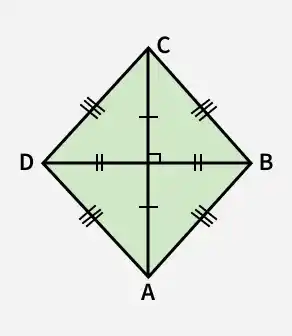
A quadrilateral that has all sides equal and opposite sides parallel is called **Rhombus.
**Properties
- All the sides of a rhombus are equal to each other.
- Opposite Sides are parallel to each other.
- Opposite angles of a rhombus are equal.
- The diagonals of a rhombus bisect each other.
- The diagonals of a rhombus are perpendicular bisectors of each other.
- The area of a rhombus can be calculated using the formula A = 1/2(d1 × d2) (where d1 and d2 are the lengths of the diagonals.)
Rhombus is a parallelogram with all side equal, but parallelogram is not rhombus.
4. Parallelogram
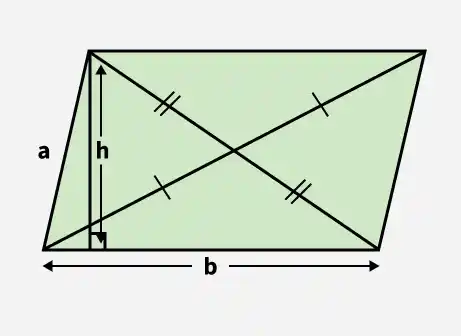
A parallelogram is a special type of quadrilateral whose opposite sides are equal and parallel.
**Properties
- Opposite sides of the Parallelogram are parallel and equal in length.
- Opposite angles of the Parallelogram are also equal.
- Any two consecutive or adjacent angles in a parallelogram are supplementary, i.e., the sum of any two adjacent angles is 180°.
- Diagonals of Parallelogram bisect each other.
- A diagonal of a parallelogram divides it into two congruent triangles.
5. Trapezium
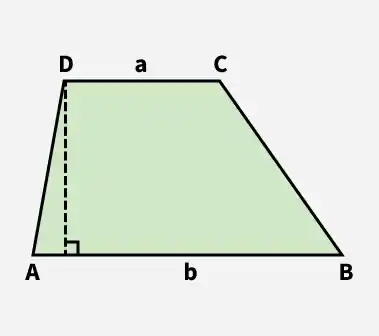
A trapezium is a quadrilateral that has one pair of opposite sides parallel. The following illustration shows the general diagram of a trapezium:
**Properties
- The parallel sides of a trapezium are called bases, and the non-parallel sides are called legs.
- The angles on the same side of the leg are called adjacent angles, and they add up to 180 degrees.
- The diagonals of a trapezium intersect each other.
- The length of the diagonal can be calculated using the formula d = \sqrt{(a-b)^2 + h^2}, (where a and b are the lengths of the bases and h is the distance between the bases.)
- The area of a trapezium can be calculated using the formula A = \frac{1}{2}\times(a+b)\times h, (where a and b are the lengths of the bases and h is the distance between the bases.)
6. Kite
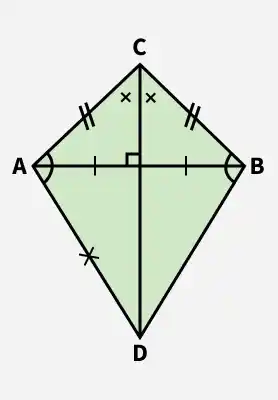
A kite is a quadrilateral that has two pairs of adjacent sides that are equal in length.
**Properties
- Kite has two pairs of adjacent sides that are equal in length.
- The diagonals of a kite are perpendicular to each other.
- Diagonals of a kite bisect each other.
- The longer diagonal of a kite bisects the angle between the unequal sides, while the shorter diagonal bisects the angle between the equal sides.
- The area of a kite can be calculated using the formula A = 1/2(d1 × d2) (where d1 and d2 are the lengths of the diagonals).
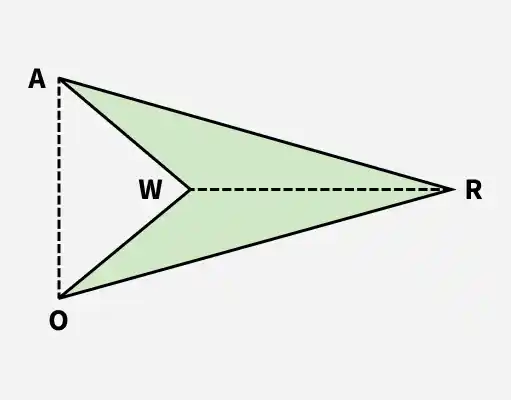
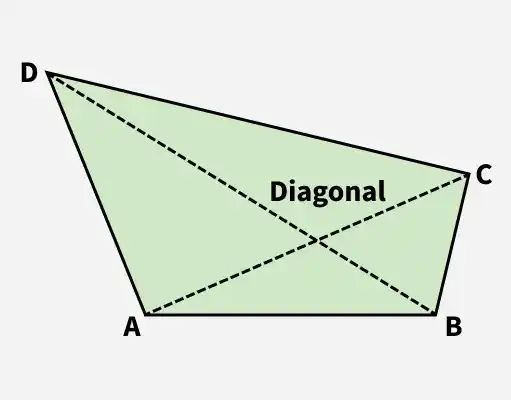
Based on the value of internal angles, quadrilaterals or any other polygon can be classified as concave or convex.
Concave Quadrilaterals
Those quadrilaterals that have at least one of the interior angles greater than 180° are called concave quadrilaterals. We can also define concave quadrilaterals as those quadrilaterals for which any one of its diagonals lies outside the area bounded by the sides of the quadrilateral.
Convex Quadrilaterals
Those quadrilaterals in which all the interior angles are less than 180° are called convex quadrilaterals. We can also define convex quadrilaterals as those quadrilaterals for which none of its diagonals lie outside the area bounded by the sides of the quadrilateral.
Solved Examples
**Problem 1: All rhombuses are squares, or all squares are rhombuses. Which of these statements is correct and why?
Square and rhombus both have all sides equal, but a rhombus is called square if each of its angle is 900. So all squares can be called rhombus, but converse is not true.
**Problem 2: In the figure ROPE is a square. Show that diagonals are equal.
In Δ REP and Δ OEP
RE = OP (sides of square
∠E = ∠P (each 90°)
EP = EP (common)
Therefore, triangles are congruent by SAS criteria.
Therefore, RP = OE (c.p.c.t)
Therefore, diagonals of square are equal.
**Problem 3: In rectangle ABCD, AO = 5cm. Find the length of diagonal BD. Also, find the perimeter of the rectangle if AB = 8 cm and AD = 6 cm.
AO = OC = 5cm (diagonals bisect each other)
Therefore, AC = 10cm
BD = AC =10cm (diagonals of rectangle are equal)
Perimeter = AB + BC + CD + DA
Perimeter = 8 + 6 +8 +6 (opposite sides are equal) = 28cm
**Problem 4: In rectangle ABCD, ∠ABD = 3x - 7 and ∠CBA = 6x - 2. Find the value of x.
Each angle of rectangle is 90°
Therefore,
∠ABD + ∠CBA = 90°
3x - 7 + 6x - 2 = 90
9x - 9 = 90
9x = 99
x = 11
**Problem 5: In rectangle ABCD AO = 2x - 10 cm and OB = x + 4 cm. Find the length of diagonal BD.
In rectangle diagonals bisect each other and are equal.
Therefore, AO = OB
2x - 10 = x + 4
x = 14
OB = 14 + 4 = 18 cm
OD = 18 cm (as diagonals bisect each other)
Therefore, BD = 36 cm
**Problem 6: Diagonals of the rhombus are 24cm and 10cm. Find the side of the rhombus.
AC = 24cm
BD = 10cm
Therefore, AO = 12cm and OB = 5cm (diagonals bisect each other)
In right-angled triangle AOB, (diagonals of rhombus are perpendicular)
AB2 = OA2 + OB2
AB2 = 122 + 52
AB2 = 144 + 25
AB2 = 169
AB = 13cm
Therefore, side of rhombus is 13cm.