Types of Vectors (original) (raw)
Last Updated : 20 Feb, 2026
A vector is a physical quantity that has both magnitude and direction. It tells us not only how strong a quantity is but also the direction in which it acts. The term _vector comes from the Latin word meaning “carrier,” as a vector carries a quantity from one point to another.
Vectors can be classified in various ways based on their position, direction, and magnitude. Each type of vector has distinct properties and plays a specific role in vector operations.
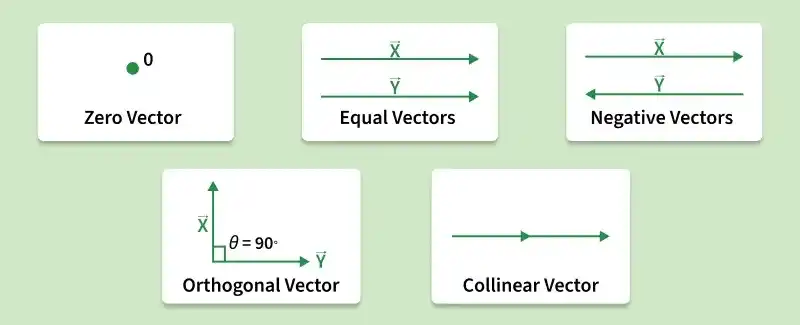
Types of Vectors based on Direction
Each vector has its own properties and is unique. As one of the vital features of vectors is their direction, based on direction, the different types of vectors are-
Unit Vector
If the magnitude of a vector is 1, it is known as a unit vector. It is used to indicate the direction of a vector. It is denoted by '^', which is known as a cap. It is also known as Directional Vector. In the Cartesian plane, i, j, and k are unit vectors along the direction of the x-axis, y-axis, and z-axis respectively.
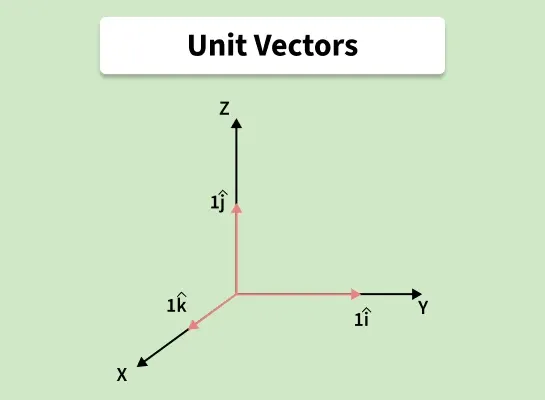
If x is a unit vector then, |x| = 1.
Formula to Find Unit Vector Along any Vector
To find a unit vector in the direction of a vector, we divide the vector by its magnitude.
If \vec V is a vector and |\vec V| is its magnitude then, the unit vector \hat V is
\hat V = \frac{\vec V}{|\vec V|}
Orthogonal Vector
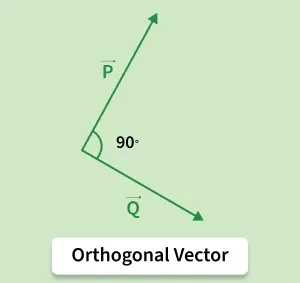
In mathematics, orthogonal simply means perpendicular and so Orthogonal vector also means perpendicular vectors, i.e. two vectors are said to be orthogonal if they are perpendicular to each other. Also in other words two vectors are orthogonal if there dot product is 0 (zero).
**For example, if \vec P.\vec Q = 0 then P and Q are orthogonal vectors.
Parallel Vector
Two vectors are said to be parallel vectors if they are in the same direction and the angle between them is 0°. They are also called Collinear-vectors. These vectors never intersect each other.
In parallel vectors the distance between them is always constant i.e. the distance between them never changes.
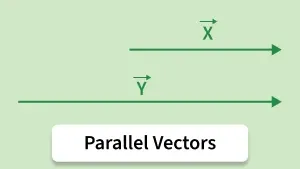
Some properties of parallel vectors:
- The cross product of two parallel vectors is always 0.
- The dot product of two parallel vectors x and y is equal to |x| |y|.
- Two vectors x and y, are only parallel if x = ay, where 'a' is scalar.
Anti-Parallel Vector
Two vectors are said to be Anti-parallel vectors if they are in exactly opposite directions and the angle between them is 180°. They are the opposite of parallel vectors in terms of the direction. If 'x' is a vector, then '-x' is its anti-parallel vector.
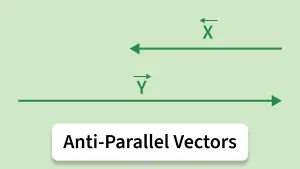
Some properties of anti-parallel vectors:
- The cross product of two anti-parallel vectors is always 0.
- The dot product of two anti-parallel vectors x and y is equal to - |x| |y|.
- Two vectors x and y, are only anti-parallel if x = ay, where 'a' is non scalar.
Zero Vector
In a zero vector, the magnitude of the vector is always 0 and its direction is not defined, i.e. it points nowhere. It is also known as a **null vector. All the components of these vectors are 0 always.
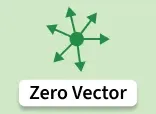
In cartesian plane a zero vector, \vec 0 = (0,0,0)
Negative of a Vector
A negative of a vector means the vector is in exactly the opposite direction of that vector. The magnitude of the negative vectors always remains the same but the direction is reversed.
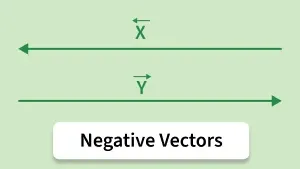
If y is a negative vector of x then:
- y = -x
- |y| = |x|
Types of Vectors Based on Magnitude
Based on the magnitude, the vectors are mainly classified into 3 types namely:
Equal Vectors
If both the direction and magnitude of two or more vectors are the same, then they are known as equal vectors. The starting point of equal vectors can be different but their magnitude and direction should be the same.
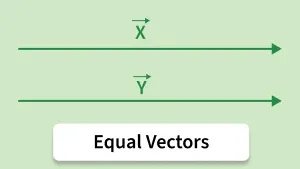
The cartesian coordinates of equal vectors are also the same. If a(x1 , y1) is equal to b(x2 , y2) then:
x1 = x2
y1 = y2
Collinear Vectors
Vectors are said to be Collinear Vectors if they lie on the same line or are parallel to the same line. They are also known as parallel vectors. All parallel and antiparallel vectors are collinear vectors.
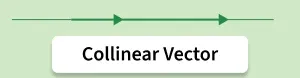
Some properties of collinear vectors:
- The cross product of two collinear vectors is always 0.
- Two vectors x and y, are collinear only if x = ay, where 'a' is scalar.
- In collinear vectors, the relation of their coordinates are equal, i.e. x1 / x2 = y1 / y2 = z1 / z2 , with a condition that each component is non-zero.
Coplanar Vectors
A set of vectors is said to be Coplanar vectors if they lie on the same plane. These vectors can be perpendicular to each other, can be parallel, or can be any random vector on the same plane.
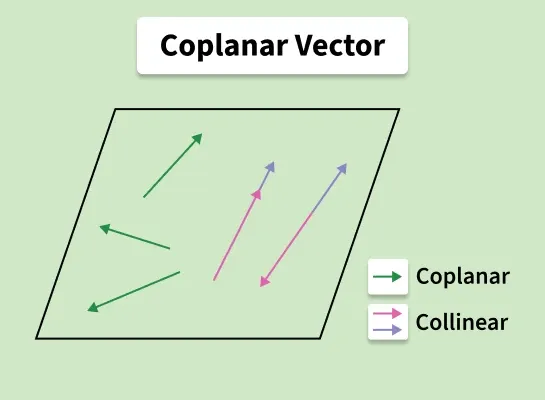
Three vectors are said to be Coplanar Vectors, if their scalar triple product is zero.
Types of Vectors Based on Position
Based on the position, the different types of vectors are Position Vectors, Displacement Vectors, Localized Vectors, and Non-localized Vectors.
Position Vectors
The position vector represents the position of an object in a space relative to a reference position, which is the origin in general. These vectors point towards the location of a vector in the cartesian plane. The position vector has a fixed point which is the reference point, from here it points towards the position of the vector in space. It has a magnitude as well as a direction.
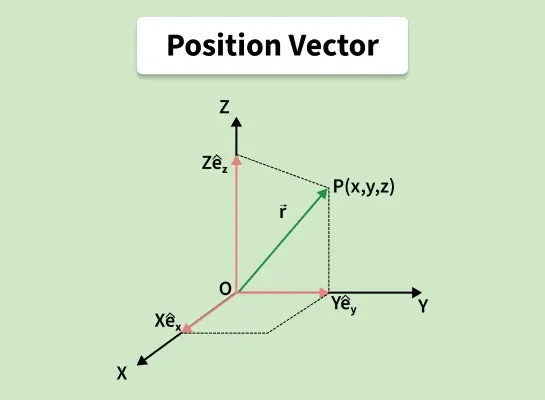
The position vectors are represented by the coordinates pair. It is denoted by '\vec r'. It can be derived by using the formula:
\vec r= (x_2 - x_1) \hat i + (y_2 - y_1)\hat j + (z_2-z_1)\hat k
If XY is a position vector with its reference position (X) at the origin and the coordinates of Y are (x,y,z), then it is represented as:
\vec r= (x - 0) \hat i + (y - 0)\hat j + (z-0)\hat k
\vec r= x \hat i + y\hat j + z\hat k
Displacement Vectors
If a vector moves from point A to point B then its change in position along the particular direction (that provides the least distance between A and B) is given by displacement vector. A displacement vector describes the change in location of a moving object along the least distance (magnitude) between its initial and its final position.
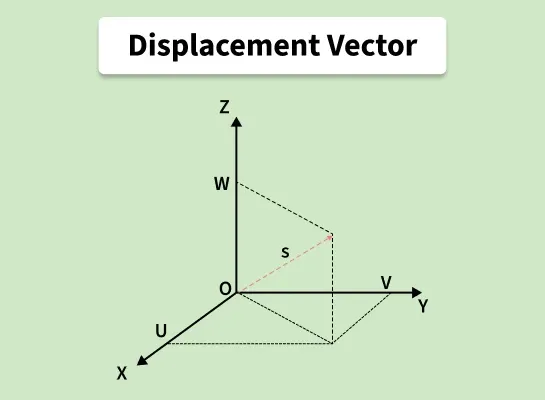
To find the displacement vector between point A and point B, we find the difference between position vectors at A and B.
For example if, \overrightarrow{r}_A = 3i + 2j + 7k and \overrightarrow{r}_B = 4i + j + 5k, then the displacement vector from A to B will be:
\overrightarrow{r}_B - \overrightarrow{r}_A= \hat{i}-\hat{j} - 2\hat{k} = i - j - 2k
where \overrightarrow{r}_A and \overrightarrow{r}_B are position vectors at A and B respectively.
Localized Vector
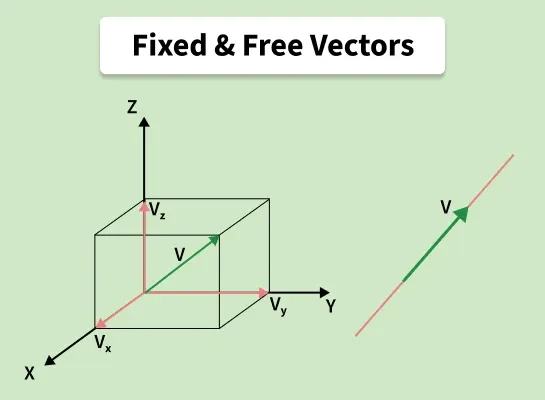
Localized vectors ( also known as Fixed vectors) are those vectors in which either the initial or final position is fixed. The term localized here simply means a specific location or position in space. They represent quantities related to specific positions, for example, displacement and force. A vector drawn parallel to a given vector with a specific position is also known as a localized vector.
Non-Localized or Free Vector
Non-localized or Free vectors have fixed magnitude and direction but are not tied to a particular position. They do not have any fixed position and are free in space. They can be applied to any arbitrary point in space without changing its properties. These vectors are independent of their position and can be applied anywhere. Velocity and momentum are examples of non-localized vectors.
Some other Types of Vectors
Apart from the above-classified vectors, there exist some other types of vectors which are discussed below:
Co-Initial Vectors
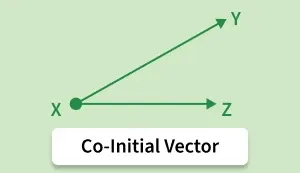
Co-initial vectors refer to the vectors that have a common initial point. In simple words, two or more vectors are said to be co-initial vectors, if their starting point is the same.
XY and XZ are Co-Initial vectors with the same starting point X.
Like and Unlike Vectors
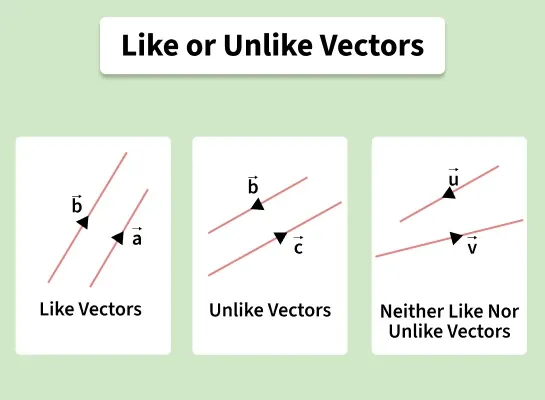
Like and unlike vectors depend on the direction of the other vector. If two or more vectors are in the same direction then they are said to be like vectors. But if the vectors are in opposite directions they are said to be unlike vectors.
Related Articles:
Solved Examples based of Vector Types:
**Example 1: Find the magnitude of the vector \overrightarrow {v} = 3\hat{i} + 4\hat{j}.
**Solution:
Magnitude|\overrightarrow {v}| = \sqrt{3^2 + 4^2} = \sqrt{9 + 16} = \sqrt{25} = 5\\ |\overrightarrow {v}| = 5 .
**Example 2: Find the unit vector in the direction of \overrightarrow {a} = -2\hat{i} + 2\hat{j} - \hat{k}.
**Solution:
First compute |\overrightarrow{a}|:
|\overrightarrow {a}| = \sqrt{(-2)^2 + 2^2 + (-1)^2} = \sqrt{4 + 4 + 1} = \sqrt{9} = 3\boxed{|\vec{a}| = 3}
Unit vector \overrightarrow {a} = \frac{\overrightarrow{a}} {|\overrightarrow{a}|}= \frac{-2\hat{i} + 2\hat{j} - \hat{k}}{3}.
\hat{a} = -\frac{2}{3}\hat{i} + \frac{2}{3}\hat{j} - \frac{1}{3}\hat{k}.
**Example 3: Find the displacement vector from A(1, 2, 3) to B(4, 0, −1), then give its magnitude.
**Solution:
Position vectors: \overrightarrow {r}_A = 1\hat{i} + 2\hat{j} + 3\hat{k}, \quad\overrightarrow {r}_B = 4\hat{i} + 0\hat{j} - \hat{k}.
Displacement \overrightarrow {AB} = \overrightarrow{r}_B - \overrightarrow{r}_A = (4-1)\hat{i} + (0-2)\hat{j} + (-1-3)\hat{k}
\overrightarrow {AB} = 3\hat{i} - 2\hat{j} - 4\hat{k}.
|\overrightarrow{AB}| = \sqrt{3^2 + (-2)^2 + (-4)^2} = \sqrt{9 + 4 + 16} = \sqrt{29}\\ |\overrightarrow{AB}| = \sqrt{29}
**Example 4: Check whether \overrightarrow {p} = 2\hat{i} - \hat{j} + 0\hat{k} and \overrightarrow {q} = \hat{i} + 2\hat{j} + 3\hat{k} are orthogonal. If not, give the angle between them.
**Solution:
Compute dot product: \overrightarrow p\cdot\overrightarrow q = (2)(1) + (-1)(2) + (0)(3) = 2 - 2 + 0 = 0.
Since \overrightarrow p\cdot\overrightarrow q = 0, the vectors are orthogonal and the angle between them is **90 ∘.
They are **orthogonal; angle = 90∘.