Volume of Combination of Solids (original) (raw)
Last Updated : 19 Feb, 2026
In geometry, many real-life objects are not made from a single solid but from a combination of two or more basic solids. Such shapes are called combined (or composite) solids. For example, a cylinder is seen in pipes, a sphere in balls, a cuboid in books, and a cone in tents. When these solids are joined together, they form new shapes found in daily life. These combined solids have the properties of each individual shape used.
**Examples
The volume of any combination of solid is nothing but the summation of separate solids that are combined to form that shape, For example, ice cream is a combination of a cone and a hemisphere, therefore, the volume of the ice cream will be the combined volume of cone and the hemisphere., that is, \frac{2}{3}\pi r^3+\frac{1}{3}\pi r^2h
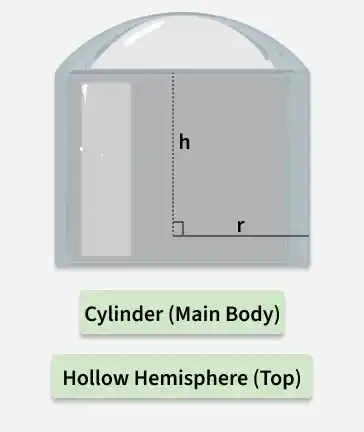
Another common practical example is a water storage tank that consists of a cylindrical body with a hollow hemispherical top.
Understanding the Shape
The object is made up of:
- a cylinder, which forms the main body of the tank, and
- a hollow hemisphere, which forms the curved top.
Both parts have the same radius, so they fit perfectly together.
Since the hemisphere is hollow, it does not include any solid material inside; it only adds storage space.
Finding the Volume
To find the total volume of this combined solid, we calculate the volume of each part separately and then add them.
- Volume of the cylinder = \pi r^2 h
- Volume of the hollow hemisphere = \frac{2}{3}\pi r^3
The total volume of the tank is obtained by adding these two volumes:
Total Volume= \pi r^2 h + \frac{2}{3}\pi r^3
Related Articles:
Sample Problems on Combinations of solids
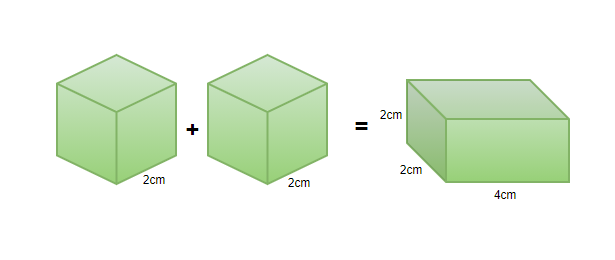
**Question 1: Two cubes of equal edges, 2cm, are joined side by side to form a cuboid. What is the Volume of this new cuboid formed?
**Solution:
When two cubes are joined side by side, the length will double but the height and the breadth of the cuboid will be equal to the side of the cube.
Therefore, Volume of the cuboid will be,
Volume = L× B× H
= 2 × 2 × 4 = 16cm3
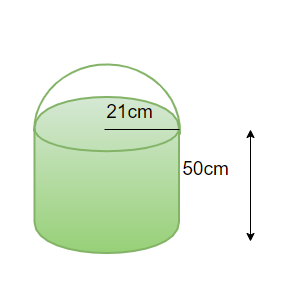
**Question 2: A container is in the shape of a cylinder and the container's lid is in the shape of a hollow hemisphere which fits the container perfectly. The radius of the base of the cylinder is 21cm and the height of the cylinder is 50 cm. Find out the volume of the container when the lid is closed.
**Solution:
The shape of the container with the lid closed shall look something like this,
The radius of the base of hemisphere will be equal to the radius of the cylinder.
The volume of container = Volume of Hemisphere+ Volume of cylinder
= \frac{2}{3}\pi r^3+\pi r^2h
= (\frac{2}{3})(\frac{22}{7})(21)^3+\frac{22}{7}(21)^2(50)
=(2)(21)(21)(22)+(21)(3)(50)(22)
= 88704cm3
**Question 3: There are multiple smaller cube, each having an edge of 2cm are placed together to form a bigger cube of side length 8cm, How many smaller cubes are required to form the bigger cube?
**Solution:
lets say that there are n number of cubes required to form the bigger cube, the volume of the bigger cube and n number of cubes will remain same.
n (2)3 = (8)3
n (2 × 2 × 2) = 8 × 8 × 8
n = 64 cubes.
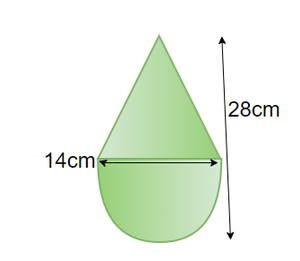
**Question 4: A Toy is in the shape of a hemisphere with a cone on top of it, the diameter of the hemisphere is equal to the diameter of the base of cone, d= 14cm. The height of the toy is 28cm. Find the Volume of the toy.
**Solution:
The toy should look something like this,
The radius of the cone and hemisphere = 7cm
The height of the Cone = 28 - 7 = 21cm
Volume of the Toy = Volume of the hemisphere + Volume of the Cone
= \frac{2}{3}\pi r^3+\frac{1}{3}\pi r^2h
=\frac{2}{3}\pi (7)^3+\frac{1}{3}\pi (7)^2(21)
= 718.37 + 1077.56
= 1795.93 cm3
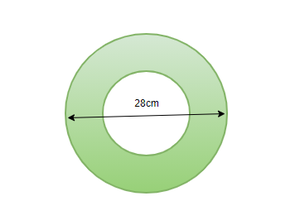
**Question 5: A Sphere has hollowed by embedding another sphere of half the radius, Find the volume of the remaining sphere. The figure is shown below.
**Solution:
The larger sphere has the diameter = 28cm check is t
Radius of the Larger sphere (R) = 28/2 = 14cm
Radius of the smaller sphere (r) = 14/2 = 7cm
Volume of the remaining Hollow sphere= Volume of larger sphere- Volume of smaller sphere.
= \frac{4}{3}\pi R^3-\frac{4}{3}\pi r^3
=\frac{4}{3}\pi (14)^3-\frac{4}{3}\pi (7)^3
= 10060cm3
Practice Problems on Volume of Combination of Solids
**1. Calculate the volume of a solid formed by attaching a cone (height 5 cm, radius 3 cm) to the top of a cylinder (height 10 cm, radius 3 cm).
**2. Find the volume of a shape consisting of a cylinder (height 7 cm, radius 4 cm) with a hemisphere of the same radius on top.
**3. Determine the volume of a cuboid (length 8 cm, width 5 cm, height 3 cm) with a cylindrical hole (radius 2 cm, height 3 cm) drilled through its center.
**4. A solid consists of a hemisphere (radius 6 cm) mounted on a cone (height 10 cm, radius 6 cm). Compute the total volume.
**5. Calculate the volume of a cylinder (height 15 cm, radius 7 cm) with a conical hole (height 7 cm, radius 7 cm) drilled from the top.
**6. Find the volume of a shape formed by combining a sphere (radius 9 cm) and a cylinder (height 12 cm, radius 9 cm) placed inside it.
**7. Determine the volume of a composite solid formed by joining a cone (height 6 cm, radius 4 cm) to a hemisphere (radius 4 cm).
**8. A shape consists of a cuboid (length 10 cm, width 6 cm, height 8 cm) with a hemispherical cavity (radius 3 cm) carved out from one side. Compute the remaining volume.
**9. Calculate the total volume of a solid formed by placing a cylinder (height 5 cm, radius 2 cm) on top of a sphere (radius 2 cm).
**10. Find the volume of a combined solid with a cylindrical base (height 10 cm, radius 5 cm) and a conical top (height 7 cm, radius 5 cm).