What are the Properties of Parallel Lines? (original) (raw)
Last Updated : 23 Jul, 2025
Parallel lines are those lines that lie on the same plane and are always equidistant from each other. Parallel lines are non-intersecting lines, parallel lines have equal slopes, and they meet at infinity.
Let's learn in detail about the properties of parallel lines, along with examples and FAQs in this article.
Table of Content
What are Properties of Parallel Lines?
When two lines moving in a straight direction don't meet or intersect each other, they are called **Parallel Lines. Some real-life examples of parallel lines are railway tracks, edges of sidewalks, zebra crossings, railings, etc. The significance of parallel lines is not only seen in maths but also in real life. Two straight lines are parallel when the distance between parallel lines is equal. The important properties of the parallel lines are given below:
Transitive Properties of Parallel Lines
The transitive property of parallel lines says that the lines that are parallel to the same line are also parallel to each other. The property can be applied for more than 2 lines as well.
For example, in the below-given diagram, if line a is parallel to b and b is parallel to c, then line a is parallel to c.

Symmetric Property of Parallel Lines
The symmetric property of parallel lines states that parallel lines follow symmetry.
If line a is parallel to line b in the above diagram, then line b is also parallel to line a. So, we can say, if a || b, then b || a.
Properties of Parallel Lines Cut by a Transversal
When the parallel lines are cut by a transversal. The following properties can be observed:
- Two lines that are cut by a transversal are parallel to each other if the corresponding angles are equal to each other. Corresponding angles are the angles that lie along the same side of the transversal.
- Two lines that are cut by a transversal are parallel to each other if the alternate interior angles are equal to each other. Alternate interior angles are the angles that are formed on the inner opposite side of each other. When creating a symbol "Z", the interior angles formed are alternate interior angles.
- Two lines that are cut by a transversal are parallel to each other if the alternate exterior angles are equal to each other. Alternate exterior angles are the angles that are formed on the outer side and are on opposite sides of each other.
Angles in Parallel Lines
Angles on parallel lines are created by parallel lines and transversals. Below are the different types of angles in parallel lines:
- **Alternate Interior Angles****:** Alternate interior angles are created by the transversal on parallel lines, and they are equal in nature. The angles formed by the Z are the alternate interior angles and are equal to each other.
- **Alternate Exterior Angles****:** Alternate exterior angles are also equal in nature.
- **Consecutive Interior Angles****:** Consecutive interior angles are also known as co-interior angles. They are the angles formed by the transversal on the inside of parallel lines, and they are supplementary to each other.
- **Vertically Opposite Angles****:** Vertically opposite angles are formed when two lines intersect each other. The opposite angles are called vertically opposite angles and are parallel to each other.
- **Corresponding Angles: Corresponding angles in parallel lines are equal to each other.

Notes:
- Pairs of vertically opposite angles are equal.
- Pairs of corresponding angles are equal.
- Pairs of alternate exterior angles are equal.
- Pairs of alternate interior angles are equal.
- Pair of interior angles lying on the same side of the transversal are supplementary.
**Read More,
Examples on Parallel Lines
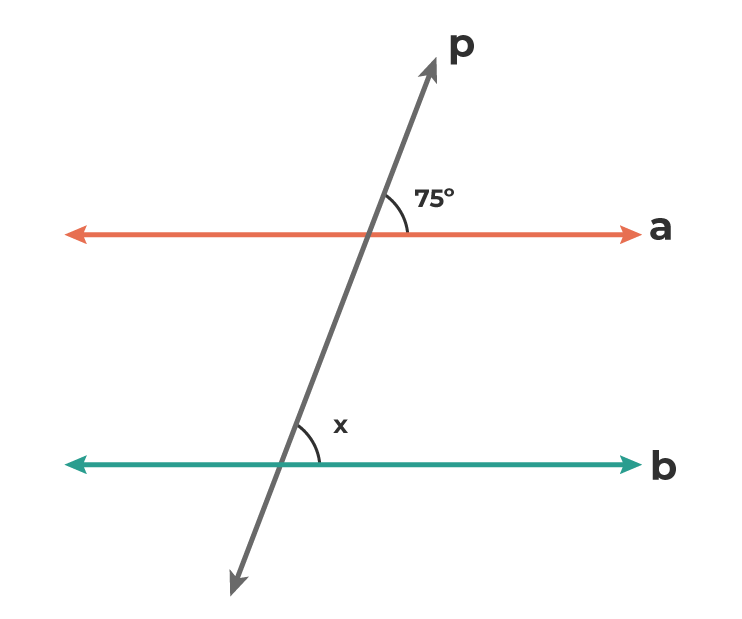
**Example 1: In the given figure, what is the value of the angle x?
**Solution:
According to the property of parallel lines, the corresponding angles are equal.
Therefore, ∠x = 70°.
**Example 2: Determine if the lines a, b, and c are parallel to each other.

**Solution:
According to the property of parallel lines if the corresponding angles are equal then lines are parallel to each other. Therefore, lines a and b, both have corresponding angles of 60o, and therefore lines a and b are parallel to each other.
Further, according to the property of parallel lines, two lines are parallel lines if their alternative interior angles are equal. Therefore, lines a and c, both have alternative interior angles equal to 120o, therefore lines a and c are parallel.
Now using the transitive property of the parallel lines, if lines a and b are parallel, and lines a and c are parallel, that means lines a and c are parallel to each other.