ZScore Table (original) (raw)
Z-Score Table
Last Updated : 10 Jun, 2026
A Z-score table helps you find the probability of a value in a standard normal distribution. It shows how much area lies to the left of a particular z-value. The distribution is bell-shaped with a mean 0 and standard deviation 1.
- The rows and columns of the table define the z-score, and the table cells represent the area.
- For example, the z-score 1.50 corresponds to the area 0.9332, which is the probability that a random variable from a standard normal distribution will fall below 1.50.
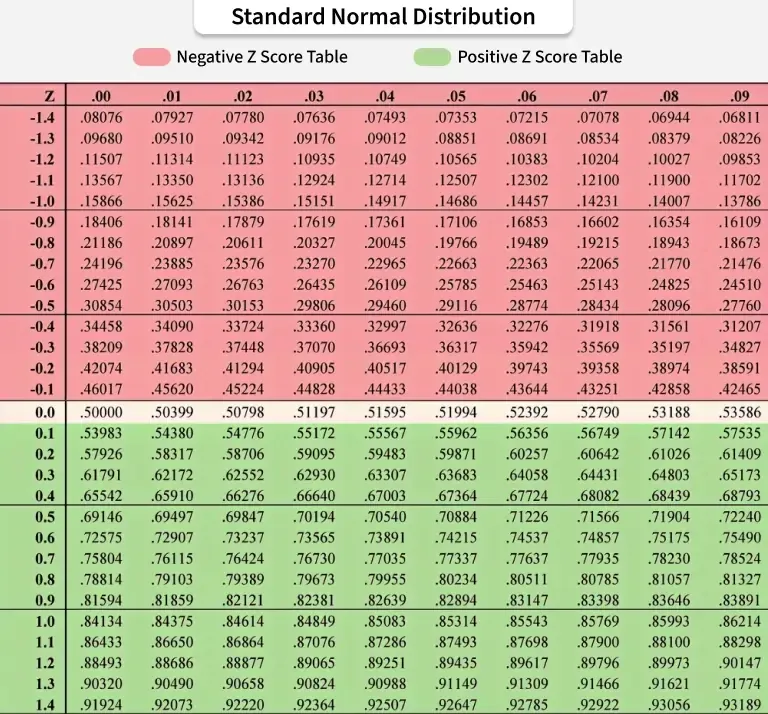
**Note: The negative z-scores are below the mean, while the positive z-scores are above the mean.
The z-score table is divided into two sections:
**1. Positive Z-Score Table: A data point is above the median if its Z-score is positive (greater than 0), with a higher value denoting a larger divergence from the mean.
**2. Negative Z-Score Table: A negative Z-score indicates that the data points are nearer the mean.
**How to Use a Z-Score Table
**Step 1: Calculate the Z-score: Use the formula to find how many standard deviations X is from the mean.
**Step 2: Open the Z-score table: Z-values appear up to two decimals (0.00, 0.01, 0.02, ...).
**Step 3: Locate the Z-score: Find the row for the first decimal and the column for the second decimal.
The table value gives P(Z ≤ z).
**Example: A school has a normally distributed test score with a mean (μ) of 75 and a standard deviation (σ) of 10. A student wants to know the probability of scoring less than 80 on a test.
**Solution:
Calculate the Z-score:
Z = 80 −75/10
⇒ Z = 0.5Look at the Z-scores in the Z-score table to find the corresponding cumulative probability. Let’s say 0.6915.
Thus, the probability of a student scoring less than 80 would be 0.6915 or 69.15%.
**How to Interpret Z-Score
**Positive z-score -> value is above the mean.
Example: Z = 2 -> 2 standard deviations above the mean.
**Negative z-score -> value is below the mean.
Example: Z = −1.5 -> 1.5 standard deviations below the mean.
Applications of Z Score
Z-scores are widely used in many areas, such as:
- Comparing data in statistics and detecting outliers
- Financial analysis (e.g., Altman Z-score for bankruptcy prediction)
- Medical and growth assessments using reference charts
- Performance comparison in sports and academics
- Hypothesis testing, confidence intervals and general data analysis
Solved Examples
**Example 1: If the Z-score is 1.5. Find the probability that a randomly selected data point falls below this Z-score.
**Solution:
To determine the probability that a randomly selected data point falls below the Z score, we can do the following.
Using a Z-score table or calculator, look for a Z-score of 1.5 and get a corresponding probability of about 0.9332. This means there is a 93.32% probability that the data point falls below a Z-score of 1.5 in the standard normal distribution.
**Example 2: Find the probability that the Z score is greater than -1.2
**Solution:
To determine the probability that the Z-score is greater than -1.2.
Using the Z-score table, find the cumulative probability associated with -1.2, which would be 0.1151. Subtract this value from 1 to find the probability of greater than -1.2:
1 − 0.1151 = 0.8849
Thus, the probability that the Z-score is greater than -1.2 is approximately 0.8849 or 88.49%.
Practice Questions
- A class of 100 students took a math test. The mean score is 75, with a standard deviation of 10. What is the Z-score of a student who scored 85 on the test?
- In applied physics, students measure the time it takes for a ball to fall from a certain height. It is 3 seconds with a standard deviation of 0.5 seconds. If a student measures a fall time of 2.2 seconds, what is the Z-score for this measurement?
- A company is conducting an employee compensation audit. The average salary is 50,000 with a standard deviation of 8,000. What is the Z-score of an employee with a salary of 56,000?
- A doctor is measuring the height of a child to compare it with a group of children of the same age. The height of this group is 120 cm and the standard deviation is 5 cm. If the child is 130 cm tall, what is the Z-score for this measurement?
- In a study of test anxiety among students, the average test anxiety score was 60, with a standard deviation of 10. If a student scores a test anxiety score of 75, what is the Z-score of this score?