What is RestFul API? (original) (raw)
Last Updated : 23 Jul, 2025
APIs play an important role in the communication between different software systems. Traditional methods of doing this were often complicated, slow, and hard to grow. RESTful APIs solve these problems by offering a simple, fast, and scalable way for systems to communicate using standard web protocols like HTTP.
A **RESTful API (Representational State Transfer) is a type of web service that follows the principles of REST. It allows communication between a client and a server over HTTP. RESTful APIs are widely used in web development to build scalable and efficient systems. They are designed around stateless operations, allowing clients and servers to interact.
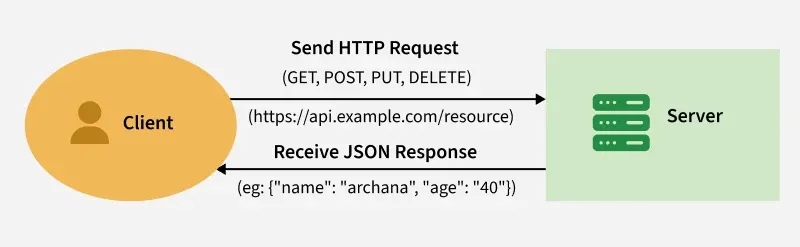
Understanding REST
REST, or Representational State Transfer, is an architectural style for designing networked applications. It was introduced by Roy Fielding in his doctoral dissertation in 2000. RESTful APIs are based on constraints, which focus on stateless communication, resource-based design, and uniform interfaces.
The core concept of REST is that the communication between the client and server occurs through standard HTTP methods, and all interactions are based on the concept of resources. Resources represent objects or data that can be accessed via a unique URL.
Core Principles of REST
RESTful APIs strictly follow the given below principles:
- **Statelessness: Each request from a client to the server must contain all the information needed to understand and process the request. The server does not store any information about the client session between requests.
- **Client-Server Architecture: The client and server are independent entities that communicate over a network. The client is responsible for the user interface and user experience, while the server handles data storage and processing.
- **Uniform Interface: REST APIs provide a consistent interface for clients to interact with, making it easier for developers to work with different services. This uniformity is achieved by following a set of well-defined conventions for request and response formats.
- **Cacheability: Responses from the server can be explicitly marked as cacheable or non-cacheable, improving performance by reducing the need for repeated server requests.
- **Layered System: The architecture allows multiple layers between the client and server, such as load balancers or proxies, without affecting the overall system's functionality.
- **Code on Demand: The server can provide executable code, like JavaScript, to the client to extend functionality.
How do RESTful APIs Work?
RESTful APIs work by sending requests over HTTP and receiving responses in a standard format, usually JSON or XML. The client sends an HTTP request to a specific endpoint (URL), and the server processes the request, returning a response.
**Here’s a general flow of how RESTful APIs work:
- Client sends a request to the server with an HTTP method (GET, POST, PUT, DELETE).
- Server processes the request and accesses the appropriate resource.
- Server responds with a status code and the requested data in a standard format like JSON or XML.
- Client receives the response, processes the data, and updates the user interface.
RESTful API Authentication Methods
There are several ways to authenticate requests in a RESTful API
- **Basic Authentication: This method sends a username and password with each request, encoded in base64. It is simple but not secure unless used over HTTPS.
- **API Keys: A unique key is provided to the client, and it must be included in the API request header to authenticate the user.
- **OAuth: OAuth is an authorization protocol that allows a third-party service to access a user's data without sharing their password. It’s commonly used in applications requiring login through social media accounts.
- **JWT (JSON Web Token): JWT is a URL-safe token format used for securely transmitting information between the client and the server. It is widely used for single sign-on and stateless authentication.
Various HTTP Methods in RESTful API
RESTful APIs use standard HTTP methods to interact with resources
- **GET: Retrieve data from the server (e.g., get user details).
- **POST: Send data to the server to create a new resource (e.g., add a new user).
- **PUT: Update an existing resource with new data (e.g., update user information).
- **DELETE: Remove a resource from the server (e.g., delete a user).
- **PATCH: Apply partial updates to a resource (e.g., update only one field of user details).
RESTful API Client Request
When making a request to a RESTful API, the client typically needs to include the following elements
- **URL: The endpoint to which the client is sending the request.
- **HTTP Method: The action to be performed (GET, POST, PUT, DELETE, etc.).
- **Headers: Information about the request, such as authentication credentials, content type, and user-agent.
- **Body: Data sent with the request, especially in POST or PUT requests. This data is usually in JSON or XML format.
**Example of a GET request
GET /users/123 Host: api.example.com Authorization: Bearer
**RESTful API Server Response
After processing the request, the server returns a response that typically includes the following:
- **Status Code: A numerical code that indicates the result of the request (e.g., 200 for success, 404 for not found, 500 for server error).
- **Headers: Metadata about the response, such as content type, length, and caching instructions.
- **Body: The data returned by the server, typically in JSON or XML format.
**Example of a server response:
{ "id": 123, "name": "gfg", "email": "gfg@example.com" }
Use Cases of RESTful API
The use cases of the RESTful API in web development are mentioned below:
- **Web Services: Connecting different web applications to share data or services, such as payment gateways or weather APIs.
- **Mobile Applications: Enabling mobile apps to communicate with back-end servers and access resources like user data, media files, or settings.
- **Microservices: RESTful APIs are used to communicate between small, independent services in a microservices architecture.
- **IoT Devices: RESTful APIs allow devices in the Internet of Things (IoT) ecosystem to exchange data with cloud services.
What are the benefits of RESTful APIs?
RESTful APIs offer several benefits that make them an ideal choice for web and mobile development:
- **Scalability: Due to their stateless nature, RESTful APIs can handle large numbers of clients and scale easily as demand grows.
- **Simplicity: The use of HTTP methods and a consistent approach to accessing resources makes RESTful APIs simple to use and understand.
- **Flexibility: RESTful APIs can work with various data formats, such as JSON and XML, making them flexible with a wide range of platforms.
- **Performance: REST APIs use HTTP, which is a fast and efficient way to send data. This allows them to handle a lot of requests quickly with minimal delay.
- **Security: RESTful APIs can use common web security methods like HTTPS, OAuth, and JWT to make sure that communication is safe and users are properly authenticated.
REST API vs RESTful API
Below is the difference between the Rest API and the RESTful API.
| Feature | REST API | RESTful API |
|---|---|---|
| Definition | A REST API do not strictly follows the REST principle. Follows some of the REST principles. | A type of REST API that strictly follows all the REST principles. |
| State | Can be stateful or stateless. | Always stateless (no client session is stored). |
| Communication | May use any protocol for communication. | Specifically uses HTTP/HTTPS for communication. |
| Application Size | Suitable for both large and small applications. | Best suited for large applications due to its scalability and standardization. |
| Resources | Resources may not be represented in a uniform way. | Resources are represented using uniform URLs and are manipulated using HTTP methods (GET, POST, PUT, DELETE). |
Conclusion
In this article, we explored the concept of RESTful APIs, which are a powerful and efficient way for applications to communicate over the web using HTTP. By following the principles of REST, such as stateless communication, resource-based design, and a uniform interface, RESTful APIs provide scalability, flexibility, and performance for modern web and mobile applications.