Difference Between Contiguous and NonContiguous Memory Allocation (original) (raw)
Last Updated : 12 Jul, 2025
Memory management is one of the fundamentals of operating systems that has implications for its performances and use of resources. These are discussed below: Contiguous and non-contiguous allocation of memory Allocation of memory may take either of the following forms: This article enables you to know the difference between the two, how memory is allocated in the two cases, and the most appropriate situations for using each of the methods.
**What is Contiguous Memory Allocation?
Contiguous memory allocation is basically a method in which a single contiguous section/part of memory is allocated to a process or file needing it. Because of this, all the available memory space resides in the same place together, which means that the freely/unused available memory partitions are not distributed in a random fashion here and there across the whole memory space.
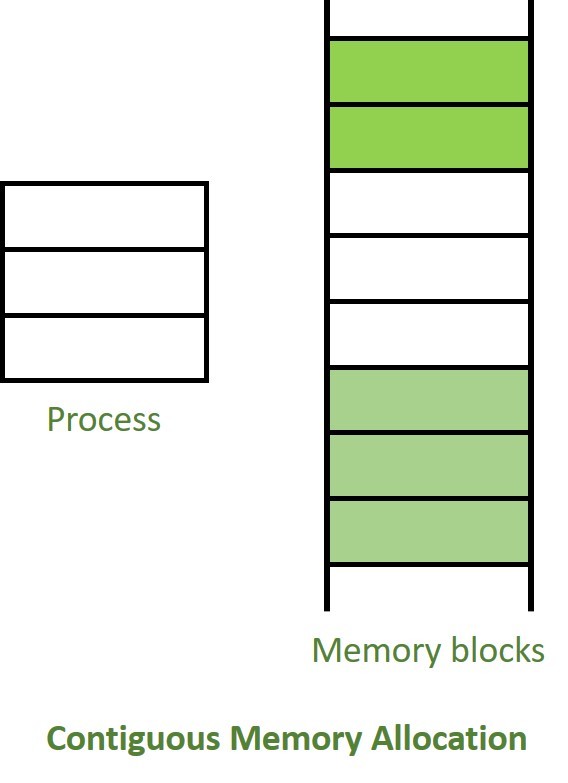
The main memory is a combination of two main portions- one for the operating system and other for the user program. We can implement/achieve contiguous memory allocation by dividing the memory partitions into fixed size partitions.
Advantages of Contiguous Memory Allocation
- **Faster Execution: Less time is consumed in the execution of processes due to the fact that memory is provided in a sequential manner.
- **Minimal Overhead: There are fewer address translations, which all contribute to the efficiency of the system.
- **Easier to Control: Organization of the memory in the operating system is sequential, which makes it possible to have efficient control of the processes.
Disadvantages of Contiguous Memory Allocation
- **Internal and External Fragmentation: It was noted that one way that memory blocks can be implemented is that they may become fragmented, which results in inefficiency.
- **Limited Multiprogramming: The disadvantage of fixed partitioning is that it hinders the ability to control and allocate several processes.
- **Wastage of Memory: With fixed partitions, memory can be wasted, especially where its usage is not optimal as required.
**What is Non-Contiguous Memory Allocation?
Non-Contiguous memory allocation is basically a method on the contrary to contiguous allocation method, allocates the memory space present in different locations to the process as per it's requirements. As all the available memory space is in a distributed pattern so the freely available memory space is also scattered here and there. This technique of memory allocation helps to reduce the wastage of memory, which eventually gives rise to Internal and external fragmentation.

Advantages of Non-Contiguous Memory Allocation
- **No Memory Wastage: Dynamic allocation makes sure that memory is used as is available and that there is no memory wasted.
- **Increased Multiprogramming: Non-contiguous allocation is advantageous where higher degrees of multiprogramming are feasible.
- **Reduced fragmentation: Based on its primary uses, it mainly minimizes internal fragmentation.
Disadvantages of Non-Contiguous Memory Allocation
- **Slower Execution: Tasks could be longer in duration because memory is frequently split into blocks.
**Difference Between Contiguous and Non-contiguous Memory Allocation
| Contiguous Memory Allocation | Non-Contiguous Memory Allocation |
|---|---|
| Contiguous memory allocation allocates consecutive blocks of memory to a file/process. | Non-Contiguous memory allocation allocates separate blocks of memory to a file/process. |
| Faster in Execution. | Slower in Execution. |
| It is easier for the OS to control. | It is difficult for the OS to control. |
| Overhead is minimum as not much address translations are there while executing a process. | More Overheads are there as there are more address translations. |
| Both Internal fragmentation and external fragmentation occurs in Contiguous memory allocation method. | Only External fragmentation occurs in Non-Contiguous memory allocation method. |
| It includes single partition allocation and multi-partition allocation. | It includes paging and segmentation. |
| Wastage of memory is there. | No memory wastage is there. |
| In contiguous memory allocation, swapped-in processes are arranged in the originally allocated space. | In non-contiguous memory allocation, swapped-in processes can be arranged in any place in the memory. |
| It is of two types:Fixed(or static) partitioningDynamic partitioning | It is of five types:PagingMultilevel PagingInverted PagingSegmentationSegmented Paging |
| It could be visualized and implemented using Arrays. | It could be implemented using Linked Lists. |
| Degree of multiprogramming is fixed as fixed partitions | Degree of multiprogramming is not fixed |
Conclusion
With respect to memory management, whether it is contiguous memory allocation or non-contiguous memory, it has its advantages and disadvantages. Despite the extent that contiguous memory allocation is easier to control and it executes faster than linked allocation, it experiences a problem of fragmentation and wastage of memory.
In contrast, non-contiguous memory allocation employs more memory space but is less efficient when, in terms of execution time, they are slower and are quite complex to manage. I have listed down the advantages and disadvantages of each of the two methods to help you understand the circumstances under which you should apply a particular method for your system.