Microkernel vs. Monolithic Kernel (original) (raw)
Last Updated : 5 Dec, 2025
Monolithic Kernel, all OS services run in kernel space, enabling high performance but risking stability, whereas a Microkernel runs only essential services in kernel space and others in user space, enhancing modularity and security at the cost of some performance due to inter-process communication overhead.
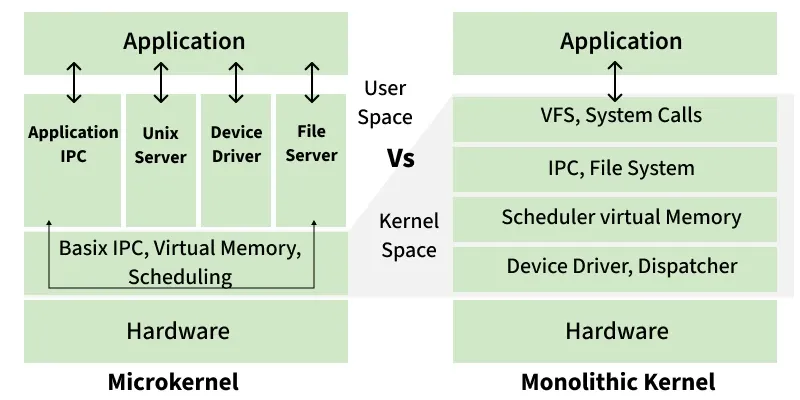
Micro-Kernel and Monolithic Kernel
**Micro-Kernel
A microkernel organizes the operating system by keeping only the most essential functions inside the kernel. These include basic process management, communication between system components, and minimal hardware control. All other services are placed outside the kernel in separate user-space programs.
- Components such as device drivers, file systems, and network services run as independent processes in user space.
- This approach keeps the kernel small, reduces the chance of system-wide failures, and makes the operating system more secure and easier to maintain.
Advantages of Micro-Kernel
- Size of Micro-Kernel is smaller, so it is easy to use.
- Easy to extend Micro-Kernel
- Easy to port Micro-Kernel
- Micro-Kernel is less prone to errors and bugs. One such example of this is Mac OS.
Disadvantages of Micro-Kernel
- The execution of Micro-Kernel is slower.
- Only the most important services are present inside the kernel and rest of the operating systems are present inside system application program.
- The communication between client process & services running in user address space is established through message that further reduces the speed of execution.
**Monolithic Kernel
A monolithic kernel design places all operating system components—both user services and kernel-level services—into the same address space, running entirely in kernel mode. This arrangement allows different parts of the system to interact quickly and efficiently without additional communication overhead.
- This architecture includes major functions such as memory management, process control, device drivers, and file systems within one large kernel.
- While this setup can improve performance, it also increases complexity, as a problem in any single component can affect the entire system and make maintenance more challenging.
Advantages of Monolithic Kernel
- Monolithic Kernel is an all in one piece where user services & kernel services are implemented under the same address space.
- It has a faster speed of execution.
- One such example of this is Linux. It is simple to design and has a very high performance.
Disadvantages of Monolithic Kernel
- The monolithic kernel has a larger size since both user services & kernel services are implemented under the same space.
- Since it is larger in size, it becomes hard to extend the Monolithic Kernel.
- Hard to export and port the monolithic kernel
- Unlike micro kernel, Monolithic kernel is more prone to errors and bugs. Thus, the system encounters more errors that the usual being.
**Microkernel vs Monolithic Kernel
| **Microkernel | **Monolithic kernel |
|---|---|
| User services and kernel services are placed in separate address spaces. | User and kernel services share the same address space. |
| More complex to design. | Easier to design and implement. |
| Smaller in size. | Larger compared to microkernel. |
| New functionalities can be added more easily. | Adding new functionalities is more difficult. |
| Requires more code to design. | Requires less code than a microkernel. |
| Failure of one component does not affect the entire system. | Failure of one component can cause the whole system to fail. |
| Slower execution speed. | Faster execution speed. |
| Easier to extend. | Not easy to extend. |
| IPC uses messaging queues. | IPC uses signals and sockets. |
| Easier to debug. | More difficult to debug. |
| Simple to maintain. | Requires extra time and resources for maintenance. |
| Requires message forwarding and context switching. | Does not require message passing or context switching during normal operations. |
| Kernel provides only IPC and low-level device management. | Kernel includes all major OS services. |
| **Example: macOS. | **Example: Windows 95. |