Difference between Multitasking and Multiprocessing (original) (raw)
Last Updated : 23 Jul, 2025
When it comes to analyzing the productivity of systems in the contemporary environment of computing, the concepts of multitasking and multiprocessing become prominent. Although both concepts are bound to how a computer processes work, their mode of function and their purpose are entirely dissimilar. The process of running several tasks or operations simultaneously using the available hardware resources is called multitasking while multiprocessing is the process of running several tasks or operations at the same time with the help of multiple processors. Knowledge of these two concepts distinguishes them and provides some insights on how to improve the performance of the system and what environment to use for certain tasks.
**What is Multitasking?
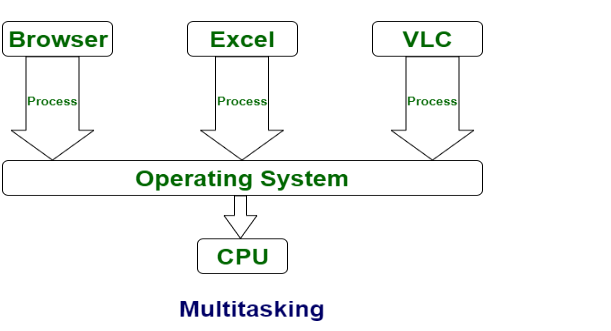
Multi-tasking is the logical extension of multiprogramming. In this system, the CPU executes multiple jobs by switching among them typically using a small time quantum, and these switches occur so frequently that the users can interact with each program while it is running. Multitasking is further classified into two categories: Single User & Multiuser.
Advantages of Multitasking
- **Increased Productivity: Multitasking refers to the ability of a system to handle several programs at a go improves productivity because it enables several tasks to proceed concurrently.
- **Efficient Use of Resources: It provides efficient utilization of the CPU by making sure that a situation where the CPU is free and there are processes to be run does not occur.
- **User-Friendly Experience: From a user perspective multitasking means being able to switch easily between different programs without having to shut them down or re-open them.
Disadvantages of Multitasking
- **Context Switching Overhead: Task switching also introduces overhead, which hurts the system overall throughput because it has to load one process out and load in a new one.
- **Resource Contention: When multiple tasks are performed concurrently and use the same resources, the tasks are likely to slow down because of competition for the resources used.
- **Risk of Errors: In some instances, parallel processing can result in instability such as system crashes or data loss.
**What is Multiprocessing?
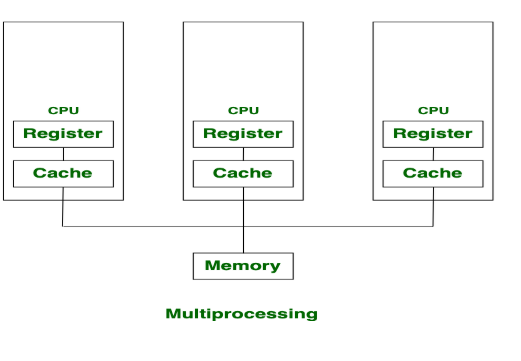
Multiprocessing is a system that has two or more than two processors. In this, CPUs are added for increasing computing speed of the system. Because of Multiprocessing, there are many processes that are executed simultaneously. Multiprocessing is further classified into two categories: Symmetric Multiprocessing and Asymmetric Multiprocessing.
Advantages of Multiprocessing
- **True Parallelism: Multiprocessing makes multiprocessing possible, as tasks are executed in parallel across different processors, thus making task completion faster.
- **Increased Reliability: In case one processor fails to work, the other processors are still able to work and this improves on the fault tolerance of the system.
- **High Performance: Through multiprocessing where there are many processors performing a single task, systems can support complex applications and large databases thus increasing system throughput.
Disadvantages of Multiprocessing
- **High Cost: Multiprocessing systems are generally costlier because of the inclusion of another or other hardware(s) (processors).
- **Complexity in System Design: Multiprocessing adds the factor of synchronization of the processors, load balancing across the processors and communication between each of the processors.
- **Power Consumption: Parallel processing requires multiple processors to be run simultaneously, thus a disadvantage in the use of power particularly for portable devices or those that are sensitive to power consumption.
**Difference Between Multitasking and Multiprocessing
| Multi-tasking | Multiprocessing |
|---|---|
| The execution of more than one task simultaneously is known as multitasking. | The availability of more than one processor per system, that can execute several set of instructions in parallel is known as multiprocessing. |
| The number of CPU is one. | The number of CPUs is more than one. |
| It takes moderate amount of time. | It takes less time for job processing. |
| In this, one by one job is being executed at a time. | In this, more than one process can be executed at a time. |
| It is economical. | It is less economical. |
| The number of users is more than one. | The number of users is can be one or more than one. |
| Throughput is moderate. | Throughput is maximum. |
| Its efficiency is moderate. | Its efficiency is maximum. |
| It is of two types: Single user multitasking and Multiple user multitasking. | It is of two types: Symmetric Multiprocessing and Asymmetric Multiprocessing. |
Conclusion
The two concepts of multitasking and multiprocessing are both important in current computing systems but as different functions. Multitasking: this is characteristic of user-oriented applications for it takes advantage of system Resources by processing many tasks on a time sharing basis. By contrast, multiprocessing is a definite mode of true parallelism which can work with several central processing units and, therefore, is helpful for tasks that involve a great deal of calculation. Knowledge of these differences assists in making decision of what approach is relevant depending on what the system is meant to accomplish and what it needs to fulfill.