Difference between Primary and Secondary Memory (original) (raw)
Last Updated : 12 Jul, 2025
Primary memory is used to store actively used data and is very fast but loses information when power is lost. Secondary memory provides long-term storage for files and programs, retaining data safely but is slower than primary memory. In this article, we are going to discuss the difference between primary and secondary memory in detail.
Computer Memories store data and instruction. The memory system can be divided into 4 categories:
- CPU Register
- Cache Memory
- Primary / Main memory
- Secondary Memory / Mass Storage
They can be represented in an hierarchical form as:
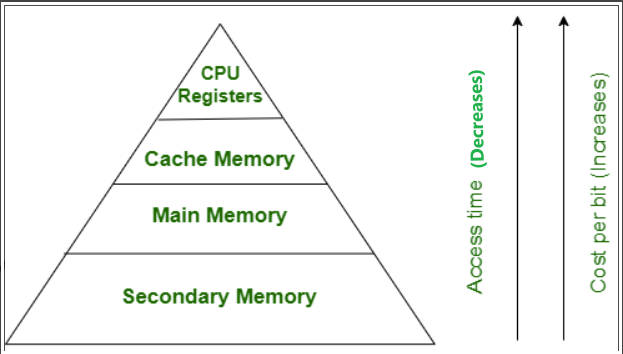
Computer Memory
**1. Primary / Main memory
Primary memory is the computer memory that is directly accessible by CPU. It is comprised of DRAM and provides the actual working space to the processor. It holds the data and instructions that the processor is currently working on.
Types of Primary Memory
- **RAM (Random Access Memory): Temporary storage for actively used data and instructions. It is volatile and lost when power is turned off.
- **ROM (Read-Only Memory): Non-volatile memory that stores firmware and essential instructions for booting the computer. The data is permanent and not lost when power is off.
**Advantages of Primary Memory
- **Speed : Provides fast access to data and instructions.
- **Direct Access : Allows the CPU to quickly read from and write to memory.
**Disadvantages of Primary Memory
- **Volatility : Loses data when power is lost.
- **Limited Size : Generally smaller in capacity compared to secondary memory.
**2. Secondary Memory / Mass Storage
The contents of the secondary memory first get transferred to the primary memory and then are accessed by the processor, this is because the processor does not directly interact with the secondary memory. Now, Let's see the difference between Primary memory and Secondary memory.
Types of Secondary Memory
- **Hard Disk Drive (HDD): Magnetic storage device used for long-term data storage. It is slower than SSD but offers large capacity.
- **Solid-State Drive (SSD): Faster than HDD, uses flash memory for storage. More durable and energy-efficient but typically more expensive.
- **Optical Discs (CD/DVD): Store data using laser technology, commonly used for media storage and software distribution.
- **USB Flash Drive: Portable storage device using flash memory, widely used for transferring and storing data.
- **External Hard Drive: Similar to HDD, used for additional storage outside the computer, portable and used for backups.
- **Tape Drive: Magnetic storage device used mainly for backups; offers high capacity but slower access speed.
**Advantages of Secondary Memory
- **Persistence : Retains data even without power.
- **Large Capacity : Typically offers much more storage space than primary memory.
**Disadvantages of Secondary Memory
- **Speed : Slower access compared to primary memory.
- **Cost : Generally more expensive than primary memory on a per-byte basis.
Difference Between Primary and Secondary Memory
Primary memory, like RAM, is where the CPU directly stores and retrieves data it’s currently working with. On the other hand, secondary memory, such as hard drives, is used for long-term storage, keeping files and programs safe even when the computer is turned off. Understanding the difference between these two types of memory is crucial for grasping how computer systems work.
| Primary memory | Secondary memory |
|---|---|
| The primary memory of a computer is the main memory that is utilized to store data temporarily. | Secondary memory defines to additional storage devices that are utilized to store data permanently. |
| Primary memory is temporary. | Secondary memory is permanent. |
| Primary memory is faster than secondary memory because it is directly accessible to the CPU. | Secondary memory is non-volatile, which means it retains data even when the power is off. |
| Primary memory is directly accessible by Processor/CPU. | Secondary memory is not directly accessible by the CPU. |
| Nature of Parts of Primary memory varies, RAM- volatile in nature. ROM- Non-volatile. | It's always Non-volatile in nature. |
| Primary memory is volatile, which means it is wiped out when the computer is turned off. | Since it is non-volatile, data can be retained in case of a power failure. |
| Primary memory devices are more expensive than secondary storage devices. | Secondary memory devices are less expensive when compared to primary memory devices. |
| The memory devices used for primary memory are semiconductor memories. | The secondary memory devices are magnetic and optical memories. |
| It can hold data/information currently being used by the processing unit. | It can hold data/information that are not currently being used by the processing unit. |
| The capacity of primary memory is usually within the range of 16 to 32 GB. | It stores a considerable amount of data and information. The capacity of secondary memory ranges from 200 GB to some terabytes. |
| Primary memory is also known as Main memory or Internal memory. | Secondary memory is also known as External memory or Auxiliary memory. |
| It can be accessed by a data bus. | It can be accessed using I/O channels. |
| Examples: RAM, ROM, PROM, EPROM etc. | Examples: Hard Disk, Floppy Disk, Magnetic Tapes, etc. |