Difference Between Turn Around Time (TAT) and Waiting Time (WT) in CPU Scheduling (original) (raw)
Last Updated : 12 Jul, 2025
As for the evaluation of the performance of various algorithms in CPU scheduling, Turn Around Time (TAT) and Waiting Time (WT) used as measurement criteria. These two metrics are important because they define the effectiveness with which the processes go through a system. Turn Around Time means the total amount of time taken from the initiation of a process to the completion time of the process while the Waiting Time represents the total amount of time that a process has to wait in the queue before getting the CPU time. Comparing TAT and WT is useful in the overall enhancement of scheduling algorithms, and enhancement of the performance of the systems involved since client experience will be given adequate priority.
**Turnaround Time (TAT) in CPU Scheduling
- It is the time interval from the time of submission of a process to the time of the completion of the process.
- The difference b/w Completion Time and Arrival Time is called Turnaround Time.
**Completion Time (CT): This is the time when the process completes its execution.
**Arrival Time (AT): This is the time when the process has arrived in the ready state.
TAT = CT - AT
Advantages of Turn Around Time (TAT)
- **Overall Process Evaluation: TAT offers an analysis of the total time a process requires hence making it effective in system assessment.
- **Efficiency Measure: Lower TAT is preferable as it leads to fast implementation of the processes and builds a more efficient system.
- **Helps in Algorithm Selection: It helps in the process of choosing the correct CPU scheduling algorithms like SJF or Round Robin which helps to reduce the TAT.
Disadvantages of Turn Around Time (TAT)
- **Not Ideal for Measuring Process Delays: To the same extent that TAT provides the total time, it does not provide details of the kind of delays that may be encountered during the waiting period.
- **Can Be Affected by External Factors: TAT is more sensitive to the I/O operations, interferences or other tasks priorities and thus its control would be difficult as compared to that of BWT.
**Waiting Time (WT) in CPU Scheduling
- The time spent by a process waiting in the ready queue for getting the CPU.
- The time difference b/w Turnaround Time and Burst Time is called Waiting Time.
**Burst Time (BT): This is the time required by the process for its execution.
WT = TAT - BT
Now with Waiting Time and Burst Time, we can also calculate Turn Around Time via:
TAT = BT + WT
Advantages of Waiting Time (WT)
- **Minimizing Delays: This means that while waiting for a particular process, activities are not left stagnant hence ensuring that more effective use of resources and system overall.
- **Key for Scheduling Optimization: WT is significant in developing such algorithms as Round Robin and Priority Scheduling so as to minimize the time that processes spend in the waiting state.
- **Improved User Experience: Reduced WT means improved reaction time of the systems in the in interactive systems to the user.
Disadvantages of Waiting Time (WT):
- **Does Not Reflect Total Process Duration: Although it helps in measuring time that the workers take to relax in between tasks, WT does not help in determining the level of overall task completion like TAT does.
- **Possible Starvation: In some of the scheduling algorithms, there are cases whereby certain processes are assigned very long WT and hence suffer from process starvation where it takes a very long time to execute low priority processes.
**Example:
| Process | Burst Time (in sec.) |
|---|---|
| P1 | 24 |
| P2 | 3 |
| P3 | 4 |
**Solution:Figure - Gantt Chart
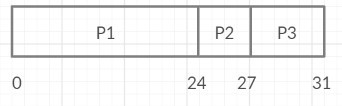
Avg. TAT = (24 + 27 + 31) / 3 = 27.33 sec
Avg. WT = (0 + 24 + 27) / 3 = 17.0 sec
Difference Between Turnaround Time and Waiting Time
__mask-th-td__index=9____mask-th-td__index=10____mask-th-td__index=11____mask-th-td__index=12____mask-th-td__index=13____mask-th-td__index=14____mask-th-td__index=15____mask-th-td__index=16____mask-th-td__index=17____mask-th-td__index=18__
Conclusion
TAT and WT are two important parameters of CPU scheduling each having its utility in the process of scheduling. TAT assesses the total time taken in a process right from its submission up to its completion while on the other hand, WT calculates the time which is taken by a process to be in the ready queue for execution. These two measures should therefore be taken into account when analyzing or proposing improvements for the CPU scheduling algorithms with respect to performance, fairness and user perspective. An ideal scheduling algorithm must, therefore, try to optimize both TAT and WT in order to facilitate efficient functioning of processes.