Acceleration (original) (raw)
Last Updated : 27 May, 2026
Acceleration is defined as the rate of change of the velocity of an object with respect to time. An object is said to be accelerating or have acceleration when its velocity is changing, i.e. object’s velocity is increasing or decreasing. It is a vector quantity, i.e., it has both magnitude and direction.
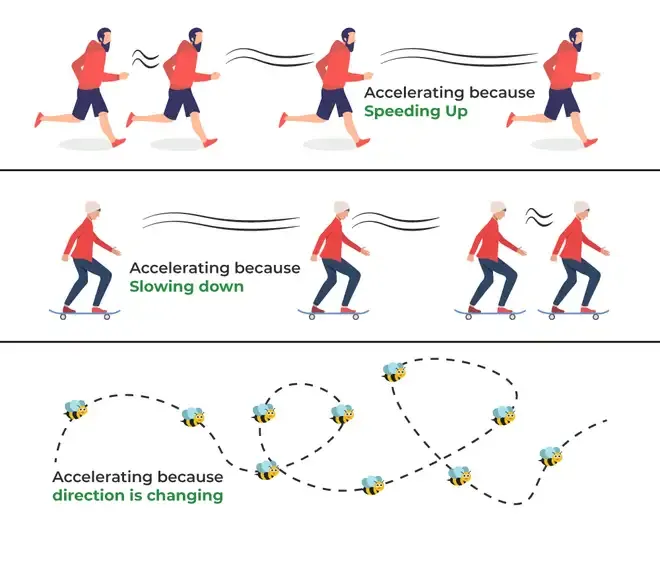
Acceleration can be positive, zero, or negative
- If the velocity of an object increases with time, it is called Positive acceleration.
- If the velocity does not change and remains constant, it is called Zero acceleration.
- If the velocity decreases with time, it is called Negative Acceleration or Retardation.
Acceleration Formula
Therefore, the acceleration of the object is given by,
Acceleration=\frac{Change\ in\ velocity}{Time\ Taken}
\boxed{a=\frac{dv}{dt}}
a=\frac{v-u}{t}
where,
- a is the Acceleration
- v is the Final Velocity
- u is the Initial Velocity
- t is the Time Taken by Object
Unit of Acceleration
- It is a vector quantity, which is associated with both magnitude and direction. It is denoted by ‘**a’.
- The unit of acceleration is meters per second squared or meters per second (the object's speed or velocity) per second or **m/s 2.
Note: Dimensional Formula of Acceleration is **[M 0 L 1 T -2 ]
Types of Acceleration
Following are the different types of acceleration associated with an object,
- Uniform Acceleration
- Non-Uniform Acceleration
- Average Acceleration
- Instantaneous Acceleration
1. Uniform Acceleration
In case the velocity of an object changes in equal amounts during the same time interval, then the body is said to be in uniform acceleration. In this case, Velocity changes uniformly and Direction may or may not change
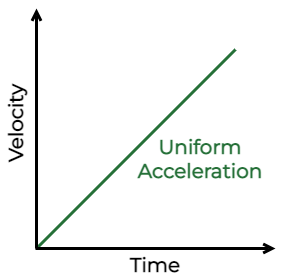
**For Example:
- A ball rolling down the slope.
- Motion of car with constant increasing velocity
2. Non-Uniform Acceleration
Variable acceleration is the velocity of the body that changes by varying amounts during the same time interval. Variable acceleration comes into the picture when the object's direction or magnitude or both changes with respect to time.
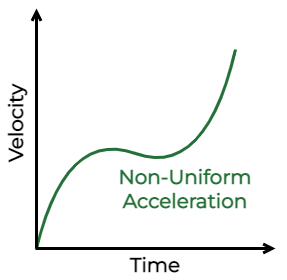
**For Examples:
- A car changing speed.
- Uniform circular motion
- The motion of the pendulum with changing speed
**3. Average Acceleration
The average acceleration is defined as the change in velocity for a particular specified time interval. The average acceleration can be calculated for a time instance, as follows,
A_v= \frac{\Delta v}{ \Delta t}
A_v = \frac{(v_f - v_i)}{(t_f - t_i)}
where,
- **v f is the Final Velocity
- **v i is the Initial Velocity
- **t iis the Initial Time
- **t fis the Final Time
**4. Instantaneous Acceleration
In order to calculate the instantaneous acceleration, the average velocity can be computed between two points in time separated by Δt and let Δt approach zero. The result obtained is the derivative of the velocity function v(t), which is instantaneous acceleration. Mathematically,
a(t)=\dfrac{d}{dt}v\left(t\right)
Thus, similar to velocity being the derivative of the position function, instantaneous acceleration is the derivative of the velocity function. We can show this graphically in the same way as instantaneous velocity. In (Figure), instantaneous acceleration at time t0 is the slope of the tangent line to the velocity-versus-time graph at time t0. We see that average acceleration given as,
\overline a=\dfrac{Δv}{Δt}
Uniform Acceleration vs Non-Uniform Acceleration
The difference between Uniform and Non-Uniform acceleration is explained in the table added below,
| Uniform Acceleration | Non-uniform acceleration |
|---|---|
| Uniform acceleration is defined as the acceleration in which the object changes its velocity within equal intervals of time. | Non-uniform acceleration is when an object changes its velocity by unequal amounts in equal intervals of time. |
| It is a straight line with constant slope. | It is a curved line with changing slope. |
| Direction remains constant throughout motion with respect to time. | Direction changes over time. |
| Object in free fall experiences uniform acceleration. | The motion of the pendulum with changing speed. |
**Always remember:

Both Differentiation and Integration would be done w.r.t time
**Related Articles
Solved Examples:
**Example 1: If a truck accelerates from 6 m/s to 10 m/s in 10 s. Calculate its acceleration.
**Solution: Given,
- Initial Velocity, u = 6 m/s
- Final Velocity, v = 10 m/s
- Time taken, t = 10 s
We have to find Acceleration 'a'
Acceleration, a = (v - u) / t
= (10 m/s - 6 m/s) / 10 s
= 0.4 m/s2
Thus, the acceleration of the truck is **0.4 m/s 2.
**Example 2: If a ball is released from the terrace of a building to the ground. If the ball took 6 s to touch the ground. Find the height of the terrace from the ground.
**Solution: Given,
- Initial Velocity u = 0 {as the ball was at rest}
- Time taken by the ball to touch the ground t = 6 seconds
- Acceleration due to gravity a = g = 9.8 m/s2
- Distance traveled by stone = Height of bridge = s
Distance covered by the ball from the terrace to the ground
s=ut+\frac{1}{2}gt^2
s = 0 + \frac{1}{2} × 9.8 × 36 = 176.4 m
Therefore,
Distance of the terrace from the ground is **176.4 m.
**Example 3: If a man is driving the car at 108 km/h slow down and bring it to 72 km/h in 5 s. Calculate the retardation of the car?
**Solution: Given,
- Initial velocity, u = 108 km/h or 108\times\frac{5}{18}=30\ m/s
- Final velocity, v = 72 km/h or 72\times\frac{5}{18}=20\ m/s
- Time taken, t = 5 seconds
Therefore, acceleration is,
\begin{aligned}a&=\dfrac{v\ -\ u}{t}\\ &=\frac{20\ -\ 30}{5}\\ &= -2\ m/s^2\end{aligned}
Negative sign shows retardation.
**Example 4: If a car moves from rest and then accelerates uniformly at the rate of 7.5 m/s 2 for 10 s. Find the velocity of the c in 10 s.
**Solution: Given,
- Initial velocity u = 0 {as the car was at rest}
- Acceleration a = 7.5 m/s2
- Time t = 10 s
v = u + at
= 0 + 7.5 × 10
= **75 m/s
**Example 5: If an object moves along the x-axis according to the relation x = 1 - 2t + 3t2, where x is in meters and t is in seconds. Calculate the acceleration of the body when t = 3s.
**Solution: Given, x = 1 - 2t + 3t2
Velocity, v = dx/dt
= d/dt {1 - 2t + 3t2}
= -2 + 6t
Therefore,
Acceleration a = dv/dt = d/dt {-2 + 6t}
a = **6 m/s 2
**Unsolved Questions
**Q1. The position x of a particle varies with time, (t) as x = at 2 - bt 3 . At what time the acceleration will be zero?
****(1) a/3b. (2) Zero (3) 2a/3b (4) a/b**
Q2. The velocity of a body depends on time according to the equation v= \frac{t^2}{10} + 20. The body is undergoing
****(1) Uniform acceleration**
****(2) Uniform retardation**
****(3) Non-uniform acceleration**
****(4) Zero acceleration**
**Q3. Motion of a particle is given by equation s = (3t 3 + 7t 2 **+ 14t + 8) m The value of acceleration of the particle at t = 1 s ?
**Q4. The relation between position (x) and time (t) are given below for a particle moving along a straight line. Which of the following equation represents uniformly accelerated motion? [where 𝜶 and 𝝱 are positive constants]
- \beta.x = \alpha.t + \alpha.\beta
- \alpha.x = \beta + t
- x.t = \alpha.\beta
- \alpha.t = (\beta + x)^\frac{1}{2}