Balanced and Unbalanced Forces (original) (raw)
Last Updated : 24 Apr, 2026
Force is a fundamental concept in physics that describes the interaction capable of changing the state of motion or shape of an object. In our daily life, we constantly experience forces—whether pushing a door, pulling a bag, or kicking a ball.
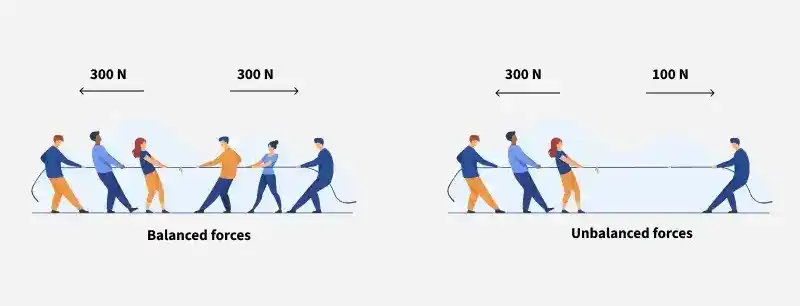
Forces can be broadly classified into two types based on their effect on an object: balanced forces and unbalanced forces. Understanding these types is essential to explain why objects remain at rest or start moving.
Force
A force is a push or pull acting on an object due to its interaction with another object.
- It can change the shape, size, or state of motion of a body
- It is a vector quantity (has magnitude and direction)
- SI unit: Newton (N)
Read More: Force
Types of Force
On the basis of action of the force applied on a body, the force is classified into two as:
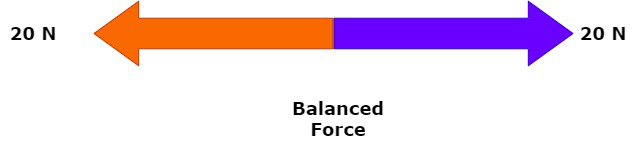
- **Balanced Force: When an equal amount of force is applied to the body but in opposite direction then this type of force is termed as Balanced Force. When balanced force is applied to a body then the body doesn't move instead, distortion of the body can happen.
- **Unbalanced Force: When an unequal amount of force is applied to the body, in the same or opposite direction then this type of force is termed as Unbalanced Force. When unbalanced force is applied to a body then the body does motion and in the direction of applied greater force.
1. Balanced Force
Balanced forces are a set of forces acting on an object in such a way that their resultant (net force) is zero.
\boxed {\text{Net Force} = 0}
**Characteristics of Balanced Forces:
- Do not change the state of motion of an object
- Can change shape or size of an object
- Forces are equal in magnitude and opposite in direction
- Object remains either at rest or in uniform motion
**On the basis of the direction of the force applied on the body, the balanced forces are categorized into:
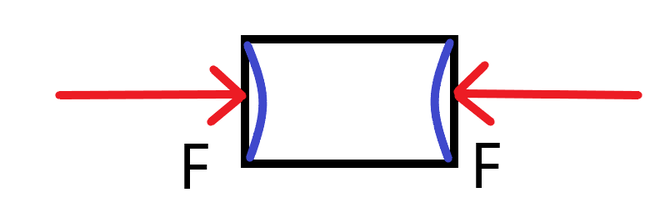
**1. Internal balanced force:
The type of balanced force in which the force acts in such a way that it pushes the object inwards is called the internal balanced force.
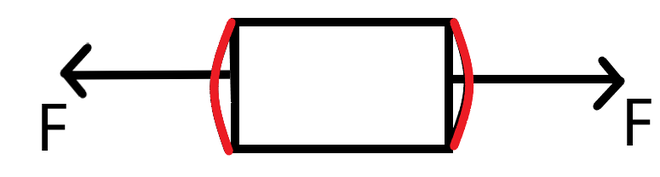
**2. External balanced force:
The type of balanced force in which the force acts in such a way that it pushes the object outwards is called the external balanced force.
**Examples of Balanced Forces:
1. A book lying on a table
- Gravity pulls it downward
- Normal force from the table pushes it upward
2. Tug of war where both teams pull equally
- Rope does not move
3. A person pushing a wall that does not move
Even though forces are acting, they cancel each other out. Hence, there is no acceleration.
2. Unbalanced Force
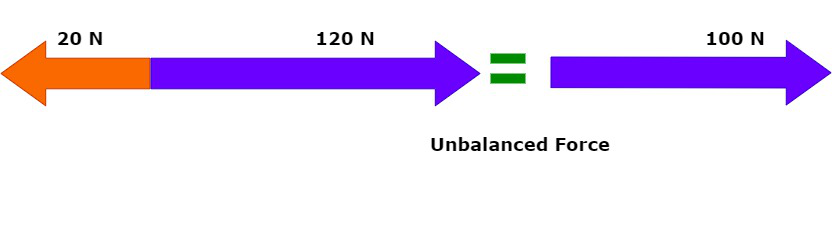
Unbalanced forces are forces acting on an object that result in a non-zero net force.
\boxed{\text{Net Force} \neq 0}
**Characteristics of Unbalanced Forces:
- Cause a change in the state of motion
- Can start, stop, or change direction of an object
- Result in acceleration
- Forces are not equal or not opposite
**Examples of Unbalanced Forces:
- Kicking a football, Ball starts moving
- A car accelerating on a road, Engine force > friction
- Pushing a box and it starts sliding
Since forces do not cancel out, the object experiences a net force, which leads to acceleration as per Newton’s laws of motion.
Difference Between Balanced and Unbalanced Forces
| Balanced Forces | Unbalanced Forces |
|---|---|
| Net force = 0 | Net force ≠ 0 |
| No change in motion | Change in motion occurs |
| No acceleration | Acceleration is produced |
| Forces equal and opposite | Forces unequal or not opposite |
| Object remains at rest or constant velocity | Object may start, stop, or change direction |
Relation with Newton’s Laws of Motion
- Balanced Forces → Newton’s First Law
An object remains at rest or in uniform motion unless acted upon by an unbalanced force. - Unbalanced Forces → Newton’s Second Law
The acceleration of an object is directly proportional to the net force acting on it.
Real-Life Applications
- Walking (friction provides unbalanced force)
- Driving a vehicle (engine force vs friction)
- Lifting objects (muscular force vs gravity)
- Construction and engineering stability
Solved Examples
**Example 1: If a force of 20 N is applied to the body on the right side while a force of 20N is applied to the body on the left side and initially body is at rest. What is the behavior of the motion of the body?
**Solution: Since, the net force on the body is 0N, so there is no change in the state of motion of the _body, so the _body is at rest
**Example 2: If a force of 50N is applied to the body on the right side while a force of 20N is applied to the body on the left side and initially body is at rest. What is the behavior of the motion of the body?
**Solution: As the net force on the body is 30N on the right side, so there is a change in the state of motion of the body on the right side, so the body starts moving towards the _right!
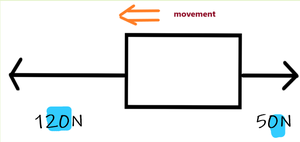
**Example 3: If a force of 50N is applied to the body on the right side while a force of 120N is applied to the body on the left side and initially body is at rest. Calculate the net force on the body and the direction of the net force.
**Solution: _Net Force = Force on left side - Force on right side
= 120N - 50N
_= 70N
Direction Of Force -> Left (As Larger Amount Of Force Is Applied On The Left Side Of The Body)
**Example 4: If the forces acting upon an object are balanced, then what happened to the object.
**Solution: If the forces acting on an object are balanced, the object will not accelerate. It could either be at rest and remain at rest, or it could be in motion at a constant velocity. In both cases, the object is not accelerating.
**Example 5: What will be the net force acting on the box shown below:
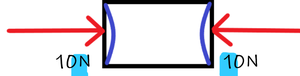
**Solution: As equal forces are applied in the _opposite direction so the _net force is 0.