Force (original) (raw)
Last Updated : 2 Apr, 2026
Force is defined as an external cause that a body experiences as a result of interacting with another body. Whenever two objects interact, a force is exerted on each object.
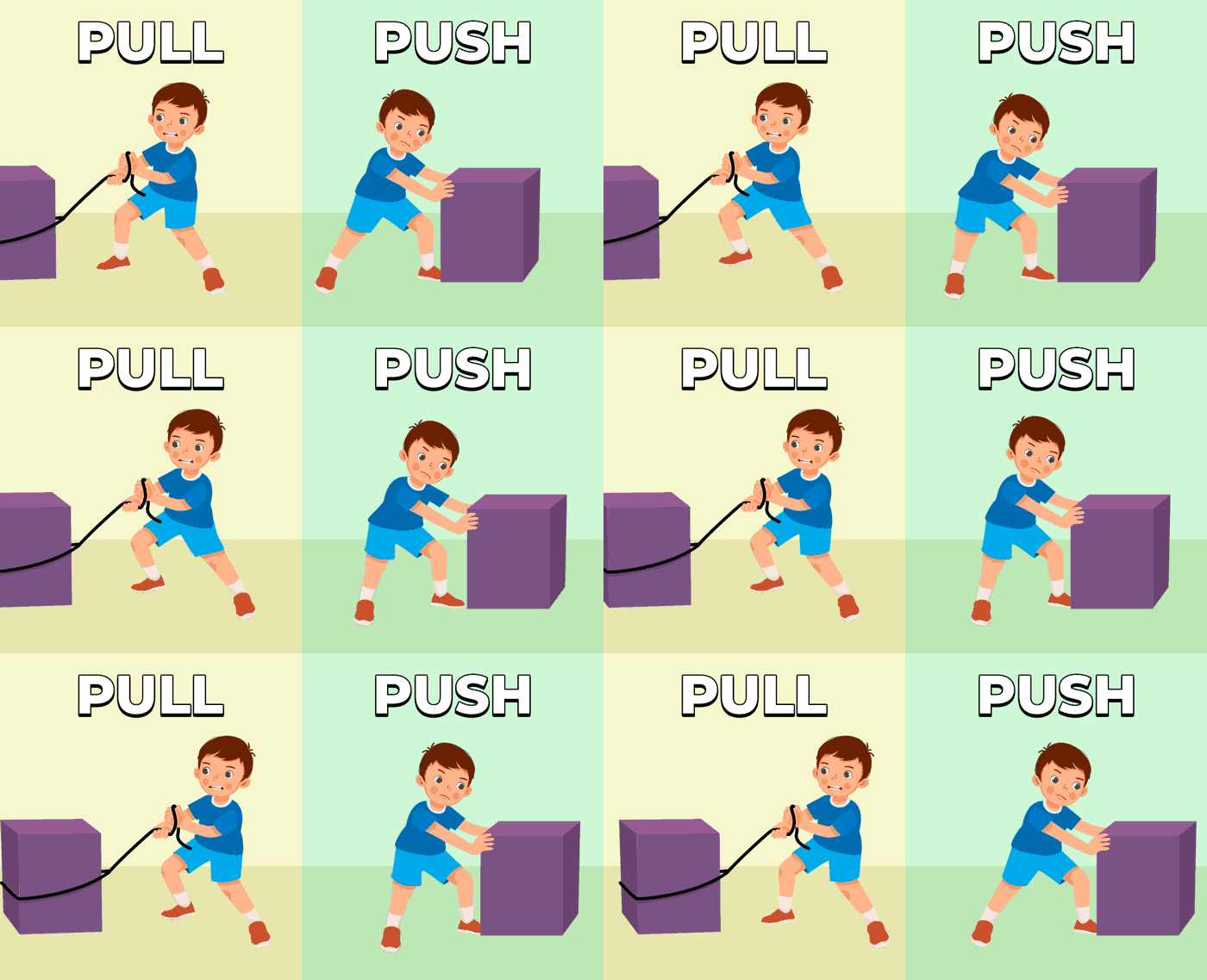
- In general terms, "To Push or Pull an Object" is defined as the force. A push or pull on an object is referred to as a force in science. Force is created when two things interact.
- Force is a vector quantity, as it has both magnitude and direction. The magnitude of a force represents its strength. The force can also cause a change in direction in the body to which it is applied.
- Two or more things must interact with each other for a force to be created. For example, a force is applied by the wind when it propels a sailboat through the water. A force is also present when gravity pulls an apple downward.
- Things can move, change their speed, or change shape in response to forces.
Unit of Force
- Force is a vector quantity; this implies it has both magnitude and direction. The force acting on an object is represented by the symbol F or \vec F .
- The SI unit of force is **Newton (N). It is named after the famous English scientist Sir Isaac Newton.
- In the CGS system, the unit of force is Dyne.
Dimensions Of Force
Force is defined as the product of the mass and acceleration of the body. So its dimensional formula is [MLT⁻²].
| Symbol | F, \vec F |
|---|---|
| Formula | F = ma OR \vec F = m \vec a |
| Unit | Newton, kg⋅m/s2 |
| Scaler Or Vector | Vector Quantity |
| Dimension | [MLT-2] |
Effects of Forces
Following are the effects of force, along with examples:
- Force can change the shape and size of an object. Example: In clay modeling, the force of hands is utilized to change the shape and size of the clay.
- Force can change the direction of an object. Example: A cricketer hits the ball in the desired direction coming towards himself/herself
- Force can change the speed of an object. Example: The frictional force of brakes is used to stop or de-accelerate a moving vehicle.
- Force can change the state of rest or motion of an object. Example: A football at rest moves when kicked.
**1. Force can change the shape and size of an object
Force can cause a change in shape. For example, when hammering a hot iron rod, the force exerted by the hammer will change the object's shape, i.e., the iron rod will be bent.
Force can cause a change in size. For example: By stretching a rubber band, the force exerted by stretching a rubber band will cause an increase in the size of the rubber band.
**2. Force can change the direction of an object
Force can cause a change in direction. For example: The time you kick the football, its direction gets changed.
**3. Force can change the speed of an object
When a batsman in games like cricket and baseball hits the moving ball with force, It causes an increase in the speed of the ball. Also, the speed of an object will depend on the direction in which the force is applied. If we apply a force in the direction of a moving object, then it will cause an increase in speed, and when it is applied against the moving object, then it will decrease the speed of the object.
**4. Force can change the state of rest or motion of an object
Force will cause a change in motion; for example, the force exerted by the motor of the car will enable the car to move, while the force exerted by the brake will enable the car to stop.
Force Formulas
Force is defined by the product of the mass and acceleration of the object. For a body with mass "**m" and the acceleration "a," the force can be calculated as,
**F = ma
where,
**F is the applied force,
**m is the mass of an object and
**a is the acceleration of the object.
Also according to Newton's Second Law of Motion, force is given by the time rate of change of momentum. Mathematically, it is given as,
F=\dfrac{\text{d}\vec p}{\text{d}t}
where,
- \text{d}\vec p is the change in momentum
- **dt is the change in time.
But, momentum (\vec p) is defined as the product of mass and velocity of the object as,
\vec p = m\vec v
where
- m is the mass and
- \vec v is the velocity of the object.
Therefore, the force becomes:
\begin{aligned}F&=\dfrac{\text{d}(m\vec v)}{\text{d}t}\\&=m\dfrac{\text{d}\vec v}{\text{d}t}\\&=m\vec a\end{aligned}
Magnitude and Direction of Force
To move a large weight, the individual must pull or push it in the same direction. When two individuals push or pull weight in opposite directions, the resultant force is the vector sum of the two forces. The magnitude of a force expresses its strength. When forces are applied in the opposite direction, the size of the resultant force is reduced.
Furthermore, equal and opposing forces cancel out; thus, the resulting force is zero. Force exerted on an item causes a change in velocity as well as a change in shape. Some forces operate on an item by making touch with it, while others act without making contact with the object. Touch forces are forces that act when an item comes into contact with them.
Contact forces include muscular forces and friction forces. Non-contact forces are those that may act without coming into touch with an item. Gravitational force, electromagnetic force, electrostatic force, and non-contact forces are all examples of forces
Types of Force
A Force can act on an object with or without any contact. For example, if you are pushing or pulling a door, then you must have contact with a door, while if you have a bar magnet, you can easily attract iron nails without having any contact with the nail. So in science, we have two types of forces; one is a contact force, and the other is a non-contact force.
The forces that are applied to other objects only through physical touching are called contact forces.
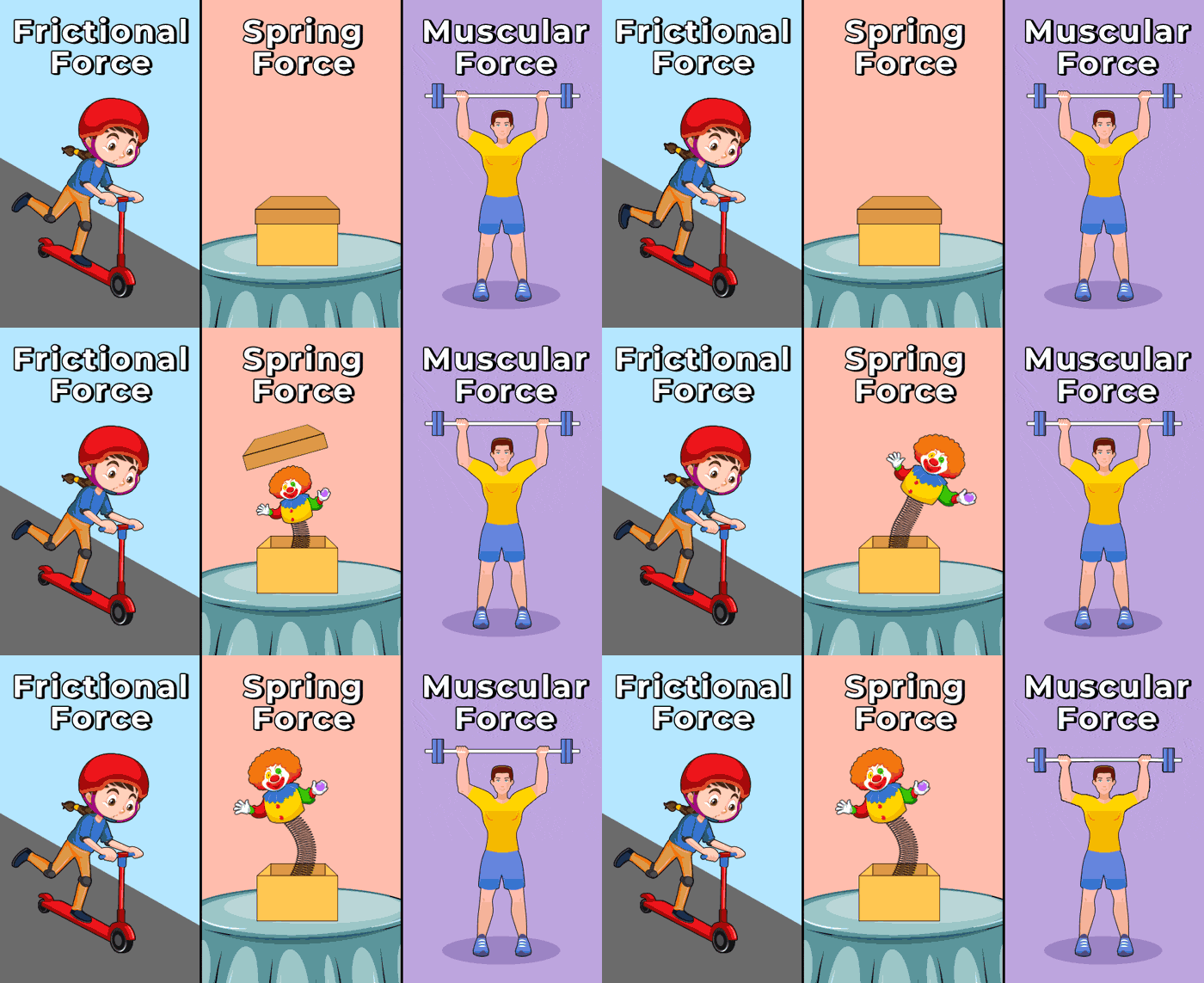
Examples of contact forces are muscular and frictional forces.
**Muscular Force
Muscular force is a contact force in which force is exerted by the muscles of the body. For example, jumping, kicking, running, walking, climbing, lifting, and pushing all are the forces exerted by our muscles.
**Force of Friction
Friction opposes the relative motion (or tendency of motion) between two surfaces in contact. For example, if we stop pedaling a bicycle, gradually it gets slower and stops after covering some distance.
**Learn More: **Frictional Force
The forces that are applied to other objects without any physical touching are called non-contact forces.
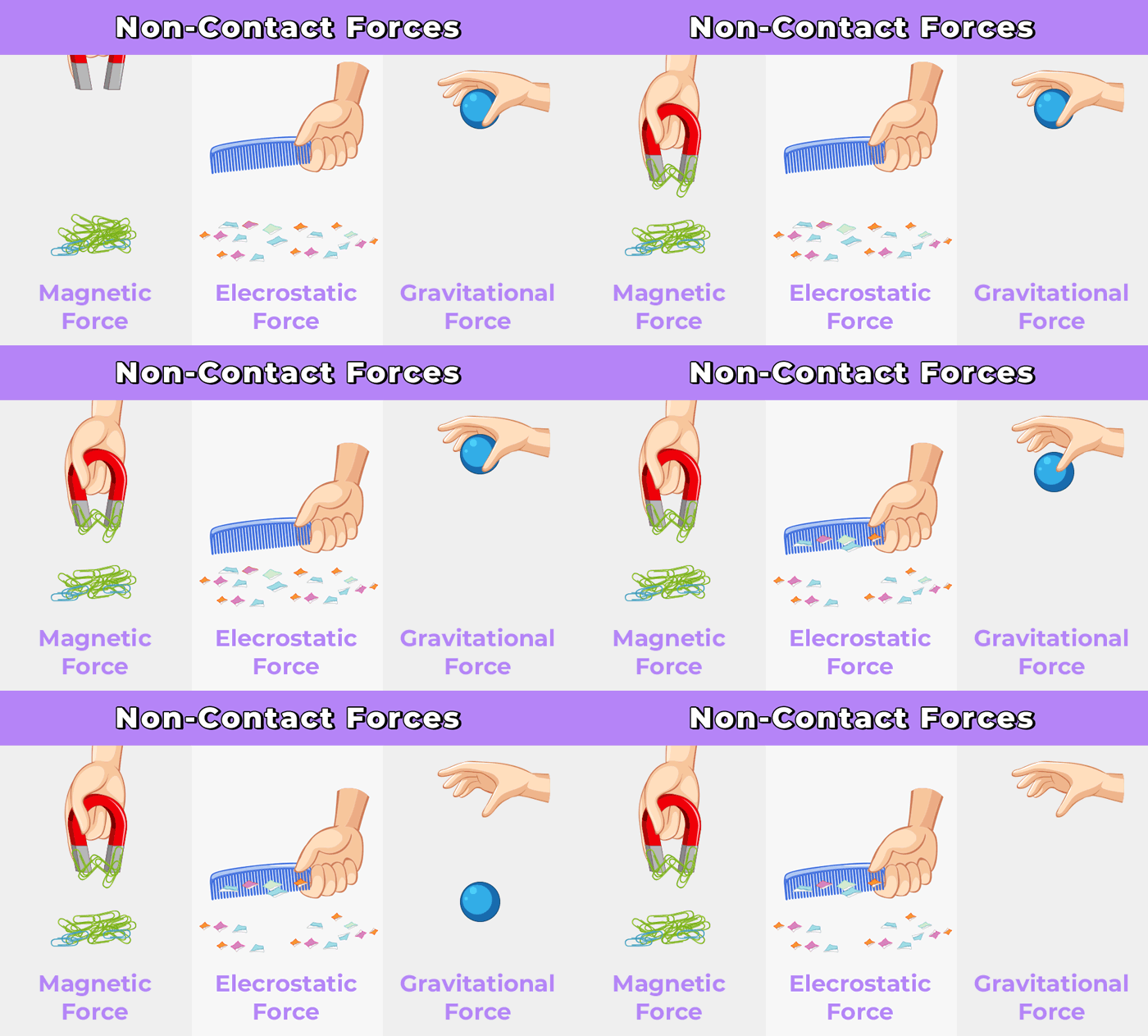
Examples of non-contact forces are magnetic force, electrostatic force, and gravitational force. Now let's discuss types of non-contact force in detail.
**Magnetic Force
Magnetic force is a non-contact force exerted by a magnet on any other magnetic substance. For example, if we bring a magnet near an iron nail, then the magnet pulls it towards it since magnets exert force.
**Electrostatic Force
An electrostatic force is a non-contact force that can be exerted by a charged object on another object from a distance. For example, when a plastic comb is rubbed in dry hair, then the electrically charged comb attracts a tiny piece of paper.
**Gravitational Force
The Gravitational force is a non-contact force between two bodies having some mass. It is an attractive force. The force of attraction between the earth and any object is called the force of gravity.
**Learn more, **Gravitational Force
Line of Action of a Force
Galileo used experiments to demonstrate that when there is no external force acting on an object, it moves at a constant speed. He could observe that a sphere's speed rises as it rolls down an inclined plane because of its gravitational attraction on it.
The net force acting on an object is 0 when all the forces are equal and balanced. A net force acting on a body, however, can change either the magnitude or the direction of its velocity if all of the forces acting on it result in an unbalanced force, which indicates that the unbalanced force can accelerate the body. For instance, when a body is subjected to a number of forces and is determined to be at rest, we can infer that there is zero net force operating on the body.
The **line of action of a force is the path it takes as it exerts its force on an object. The point of application of the force is the location where it is exerting its force on an object. The force of friction is the force that opposes the relative motion between the surfaces of two objects in contact and acts along the surfaces.
**Related Articles
Solved Examples
**Example 1: Determine the force of an object with a mass equal to 500 kg and acceleration of 60 m/s 2 .
**Solution: Given,
Mass of the object, m = 500 kg.
Acceleration, a = 60 m/s2
According to force formula,
F = ma
Substituting the given values,
F = 500 kg × 60 m/s2
= 3 × 10⁴ N
The required force is 3 × 10⁴ N
**Example 2: How much net force is required to accelerate to a 20 kg box at 5 m/s 2 ?
**Solution: Given,
Mass of the box, m = 20 kg.
Acceleration of the box, a = 5 m/s2
According to force formula,
F = ma
Substituting the given values,
F = 20 kg × 5 m/s2
= 100 N
The required force is 100 N
**Example 3: Find the acceleration of the object if the force applied is 250 N and the mass of the object is 50 kg.
**Solution: Given
Force applied is 250 N
Mass of the object, m = 50 kg
Acceleration of the object, a =?
According to force formula,
F = ma
Substituting the given values,
250 = 50 kg × a
a = 250/50
= 5 m/s2
Thus, the acceleration of the object is 5 m/s2
**Example 4: Find the mass of the object if the force applied is 225 N and the acceleration of the object is 15 m/s 2 .
**Solution: Given
Force applied is 225 N
Mass of the object, m =?
Acceleration of the object, a = 15 m/s2
According to force formula,
F = ma
Substituting the given values,
225 = m × 15
m = 225/15
= 15 kg
Thus, the mass of the object is 15 kg