Difference Between Diode And Zener Diode (original) (raw)
Last Updated : 23 Jul, 2025
A diode and a Zener diode are both semiconductor devices that allow current to flow in one direction, but they differ significantly in their construction, working principles, and applications. While a regular diode is mainly used for rectification (controlling the flow of current in one direction), a Zener diode is specifically designed to operate in reverse bias for voltage regulation and protection.
This article explains the differences between a diode and a Zener diode, along with their construction, working, advantages, and applications.

Difference Between Diode And Zener Diode
What is a Diode?
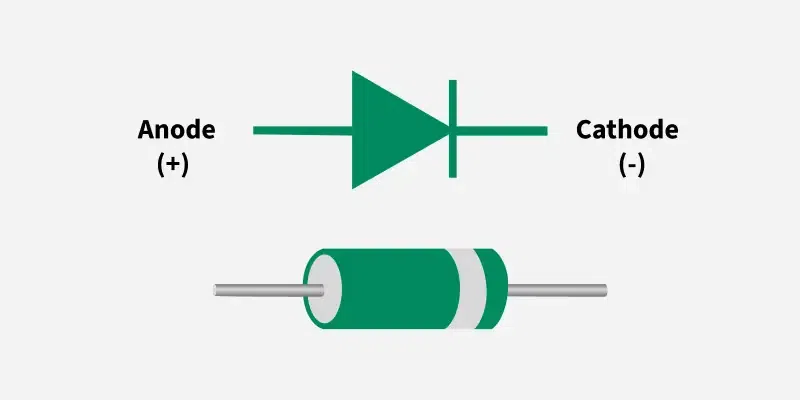
A diode is a two-terminal semiconductor device that is designed to allow current to flow in one direction only. When a diode is forward biased (positive voltage on the anode), it conducts current with a small voltage drop (typically around 0.7V for silicon diodes). When reverse biased (positive voltage on the cathode), it blocks current, and if the reverse voltage exceeds a certain threshold (known as reverse breakdown voltage), the diode may be damaged.
**Advantages of Diode
- **Simple Operation: The diode’s behavior is easy to understand and use in circuits, making it a fundamental component in electronics.
- **Wide Application: Used in applications like rectifiers (AC to DC conversion), clipping circuits, signal demodulation, and **current protection.
- **Cost-Effective: Diodes are inexpensive and easily available, making them ideal for mass-market applications.
- **Durable: Diodes are robust and can handle significant currents in forward bias without failure, provided they are not exposed to excessive reverse voltage.
**Disadvantages of Diode
- **Limited Reverse Bias Capability: Diodes cannot handle reverse bias well beyond a certain threshold. If the reverse voltage exceeds the **maximum reverse voltage rating, the diode can be permanently damaged.
- **No Voltage Regulation: A regular diode does not regulate the voltage or provide any voltage stabilization.
- **Forward Voltage Drop: Even in forward bias, there is a small voltage drop (typically 0.7V for silicon diodes), which may not be desirable in low-voltage applications.
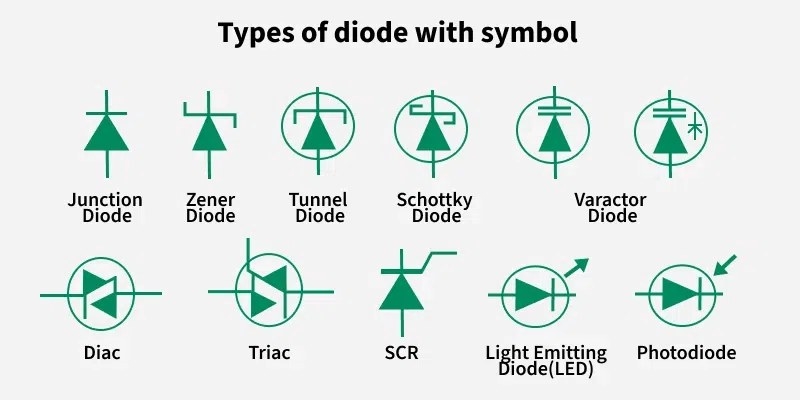
Types of Diodes
- **Light Emitting Diode (LED): Emits light when forward biased.
- **Laser Diode: Produces coherent light for applications like fiber optics.
- **Avalanche Diode: Operates in reverse breakdown for protection circuits.
- **Zener Diode: Designed for voltage regulation.
- **Schottky Diode: Has low forward voltage drop.
- **Photodiode: Converts light into electrical current.
- **PN Junction Diode: The basic diode used in rectifiers.
Types of Diode
**What is a Zener Diode?
A Zener diode is a special type of diode that is designed to operate in reverse bias and break down at a certain Zener voltage. Once the reverse voltage exceeds this threshold, the Zener diode allows current to flow freely, which is useful for voltage regulation. Unlike regular diodes, Zener diodes are meant to operate in reverse breakdown without being damaged, and they maintain a stable voltage across them. In the forward bias condition, it allows current, and in reverse bias it blocks current. After this voltage has surpassed the breakdown point (in reverse bias), the diode falls in the Zener region, where it conducts without getting damaged. Current in this region is called avalanche current.
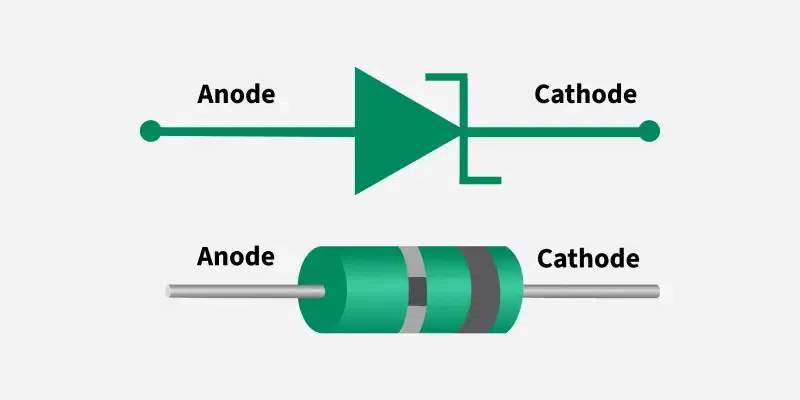
Circuit Symbol of Zener Diode
**Advantages of Zener Diodes
- **Voltage Regulation: Zener diodes ensure stable voltage in circuits, making them essential for power supplies.
- **Reverse Breakdown Stability: Tolerates reverse breakdown at a precise Zener voltage without damage.
- **Low Power Dissipation: Efficient in voltage regulation, especially for low-power circuits.
- **Cost-Effective: A reliable and affordable solution for voltage regulation.
**Disadvantages of Zener Diodes
- **Low Current Handling: Not suitable for high-power applications due to limited current-carrying capacity.
- **Temperature Sensitivity: The Zener voltage can vary with temperature, impacting performance.
- **Limited High-Power Applications: Mainly used in low-power circuits
**Applications of Zener Diodes
- Voltage regulation in power supplies
- Overvoltage protection in circuits
- Reference voltage generation in analog circuits
**Difference between Diode and Zener Diode
| **Diode | **Zener **diode |
|---|---|
| A diode is a two-terminal electronic device that conducts electricity in one direction. | Zener diode can provide a stable reference voltage. These diodes are mostly used in power supplies to provide a reference voltage. |
| It has high resistance on one end and low resistance on the other end. | These diodes can be operated in reverse bias and break down at a certain voltage. |
| The diodes transmit current in one direction, and the way in which they transmit current may differ. | In the forward bias condition, it allows current, and in reverse bias it blocks current. |
| Diode gets damaged in reverse biased condition. | Zener diode doesn't get damaged. |
| Does not regulate voltage | Provides voltage regulation in reverse bias |
| Cheaper and readily available | Slightly more expensive due to specialized design for reverse bias. |
| The diode conducts in one direction only (uni-directional only in forward biased conditions). | Zener diode is bi-directional (it conducts both in forward biased and reverse biased conditions). |
| The diode has low doping intensity. | Zener diode has high doping intensity to achieve breakdown. |
| Typically 0.7V (for silicon diodes) | Similar to regular diodes, but optimized for reverse bias operation |
| The diode has a low breakdown voltage. | Zener diode has a high breakdown voltage |
| Diodes are used as rectifiers, Clippers, and Clampers. | Zener Diode can be used as a Voltage Regulator. |
**Conclusion
Both diodes and Zener diodes are fundamental components in electronics, but their purposes differ significantly. While a diode is primarily used for basic rectification and current control, a Zener diode is specifically designed to stabilize voltage in reverse bias. The choice between the two depends on the application:
- Use a **diode for simple current flow control and rectification.
- Use a **Zener diode for voltage regulation and overvoltage protection.