Electromagnetic Waves (original) (raw)
Last Updated : 11 Dec, 2025
Electromagnetic waves are waves that are made of oscillating electric and magnetic fields and can travel without any medium, meaning they can move through air, water, and even the vacuum of space.
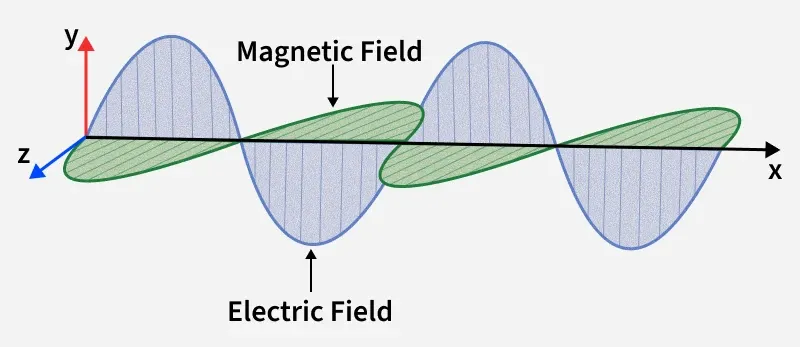
Electromagnetic waves are a special kind of wave formed by a combination of electric and magnetic field oscillations. They are produced by accelerating charged particles, and this is the origin of all electromagnetic radiation.
**Characteristics of Electromagnetic Waves:
- They travel at the speed of light (≈ 3 × 10⁸ m/s in vacuum).
- They are produced when electric charges accelerate.
- They do not need particles to move (unlike sound waves).
- The electric and magnetic fields are perpendicular to each other and to the direction of wave travel.
Formation of Electromagnetic Waves
- In general, a charged particle generates an electric field. Other charged particles are pushed by this electric field.
- Negative charges accelerate in the opposite direction of the field, while positive charges accelerate in the field's direction. The magnetic field is created by a travelling charged particle.
- Other moving particles are pushed by this magnetic field. Because the force acting on these charges is always perpendicular to their motion, it only influences the velocity's direction, not its speed.
- As a result, the electromagnetic field is created by an accelerating charged particle. Electric and magnetic fields travelling at the speed of light c through open space are referred to as electromagnetic waves.
- A charged particle is considered to be accelerating when it oscillates about an equilibrium point. The charged particle produces an electromagnetic wave of frequency f if its oscillation frequency is f.
- This wave's wavelength λ can be determined using the formula λ = c/f. Electromagnetic waves are a sort of space-based energy transfer.
Examples of Electromagnetic Waves
When electric and magnetic fields interact and change over time, electromagnetic waves are produced. These waves, which are linked to electricity and magnetism, would almost certainly travel beyond space. Electromagnetic waves include seven main types, arranged from highest wavelength to lowest wavelength.
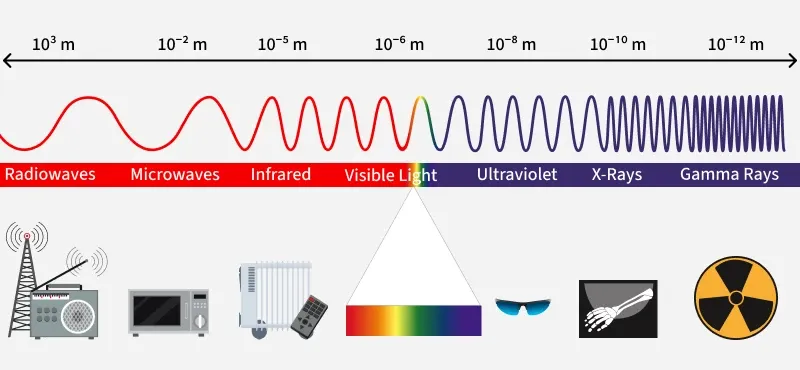
Given below are the examples of Electromagnetic waves:
| Types of Electromagnetic waves | Examples |
|---|---|
| 1. Radiowaves | AM and FM radio, Television broadcasting, Mobile communication, Wi-Fi and Bluetooth, Radar systems |
| 2. Microwaves | Cooking (heat water molecules), Radar (weather forecasting, air traffic control), GPS, Satellite communication, Wireless communication |
| 3. Infrared (IR) Rays | Thermal imaging (detects body heat), Remote controls, Infrared cameras in astronomy, Heaters and infrared lamps |
| 4. Visible Light | Vision (only part of the spectrum human eyes detect), Photography and video, Fibre optics communication, Microscopes and telescopes |
| 5. Ultraviolet (UV) Rays | Sterilization of medical tools, Tanning beds, Detecting forgeries, Killing bacteria and germs |
| 6. X-Rays | Medical imaging, Security scanners at airports, Studying atomic structures, Detecting fractures |
| 7. Gamma Rays | Cancer treatment (radiotherapy), Sterilization of medical equipment, Studying nuclear reactions |
Sources of Electromagnetic Wave (EM)
- Electromagnetic waves are created when electrically charged particles vibrate. The vibration of the electric field associated with the speeding charge produces an oscillating magnetic field. These vibrating electric and magnetic fields produce electromagnetic waves.
- When the charge is at rest, the electric field associated with it is also static. As a result, because the electric field does not change with time, no EM waves are generated.
- A charge travelling at uniform velocity has no acceleration. Because the change in the electric field with time is also constant, no electromagnetic waves would be generated. This illustrates that the only way to make EM waves is to accelerate charges.
- Consider the instance of an oscillating charge particle. It has an oscillating electric field that creates an oscillating magnetic field. After that, the oscillating magnetic field generates an oscillating electric field, and so on.
- The propagation of the wave = the regeneration of electric and magnetic fields.
- All of these events are contained in an electromagnetic wave. It's also worth noting that the frequency of an EM wave is always equal to that of the oscillating particle that produces it.
Nature of Electromagnetic Waves
- Transverse waves are Electromagnetic waves. The disturbance or displacement in the medium caused by transverse waves is perpendicular to the wave's propagation direction. In such a wave, the medium particles travel in a path perpendicular to the wave's propagation direction.
- The electric and magnetic fields will be perpendicular to an EM wave propagating along the x-axis. When wave propagation is parallel to the x-axis, the electric field is parallel to the y-axis, and the magnetic field is parallel to the z-axis.
- In nature, Electromagnetic waves are clearly transverse waves. The electric field of an EM wave is now provided by,
**E y = E 0 sin(kx-ωt )
Where Ey is the x-axis representing wave propagation, while the y-axis represents the electric field.
- The following formula is used to compute the wavenumber**-
**k = (2π/ωt)
- The magnetic fieldof an electromagnetic wave is created by,
**B z = B 0 sin( kx-ωt )
where Bz is the electric field along the z-axis, while the wave propagation direction is x.
**B 0 = (E 0 /c)
- In free space or vacuum, they're self-sustaining electric and magnetic field oscillations.
- The electric and magnetic field vibrations are unlike any other waves we've looked at so far in that there is no material medium involved. Longitudinal compression and rarefaction waves are compressions and rarefaction waves in the air.
- A rigid, shear-resistant solid can also propagate transverse elastic (sound) waves.
Energy of Electromagnetic waves
- EM waves carry energy with them as they move. As a result of this feature, they have a wide range of uses in our daily lives. The energy of an EM wave is carried in part by an electric field and partly by a magnetic field.
- The total energy stored per unit volume in an EM wave is calculated as,
**E T = Per unit volume, electric field energy is stored + stored magnetic field energy per unit volume.
**E T = (1/2)(E 2 ε 0 ) + (1/2)(B 2 μ 0 )
- Experimentally, it has been discovered that,
**Speed of an EM wave = Speed of light
**E T = (1/2)(E 2 ε 0 ) + (1/2)(E 2 /c 2 μ 0 )
- Maxwell's equations-
**E T = (1/2)(E 2 ε 0 ) + (1/2)(E 2 μ 0 ε 0 )
**E T = E 2 ε 0
Mathematical Representation of Electromagnetic Wave
It's a plane we're talking about. In the x-direction, the shape of an electromagnetic wave is
**E(x , t) = E max **cos(kx - ωt + φ)
**B(x , t) = B max **cos(kx - ωt + φ)
where,
- E = electric field vector in an electromagnetic wave,
- B = magnetic field vector in an electromagnetic wave.
Maxwell was the first to envision electromagnetic radiation, while Hertz was the first to experimentally confirm the presence of an electromagnetic wave. The propagation direction of an electromagnetic wave is determined by the vector cross product of the electric and magnetic fields. It's written like this:
Characteristics of EM waves
- The velocity of EM waves in open space or vacuum is a fundamental constant. In experiments, the velocity of EM waves was discovered to be the same as the speed of light. (c = 3 × 10⁸ m/s). c is a basic constant defined as follows :
**c = 1/√μ 0 ε 0
- EM waves require time-varying electric and magnetic fields to propagate. Electromagnetic waves convey both energy and velocity.
- ET = E2ε0 is the total energy stored per unit volume in EM waves (Partly carried by an electric field and partly by a magnetic field). This is a vital element for EM waves' practical applications since they carry both energy and momentum.
- EM waves are used in communication, such as in cell phone speech communication.
- Electromagnetic waves (EM waves) apply pressure. Because they carry energy and momentum, they exert pressure. The force exerted by electromagnetic waves is known as radiation pressure.
- The form of sunlight that we receive from the sun, for example, is visible light rays. These light beams are included in EM waves. Our hands will become warm and sweaty if we leave them in the sun for a long time. Because sunlight is transmitted in the form of energy-carrying electromagnetic waves (EM waves), this occurs.
- Assume that the total energy transferred to the hand is equal to E. Momentum = (E/c). Because c is so huge, the momentum appears to be little. The pressure is also low because the momentum is so low. Because of this, our hands are not affected by the sun's pressure.
Sample Questions of Electromagnetic Waves
**Question 1: In free space, a planar electromagnetic wave with a frequency of 44 MHz moves in the x-direction. E = 7.3 \hat j V/m at a specific point in space and time. At this moment, what is B?
**Answer:
Given : E = 7.3 V/m, c = 3 × 10⁸ m/s
We have,
B = E/c
∴ B = 7.3 / 3 × 10⁸
∴ B = 2.433 × 10⁸ T
We may determine the direction by noting that E is along the y-axis and the wave propagates along the x-axis. As a result, B should be perpendicular to both the x- and y-axes. E × B should be along the x-axis, according to vector algebra. B is in the z-direction because-
(+\hat j ) × (+\vec k ) = (+\hat j)\times(+\hat k) =\hat i .
Thus,
B = 2.433 \times 10^8 \hat k\text{ T}
**Question 2: The magnetic field in a plane electromagnetic wave is given by By =(2 × 10⁻⁷)T sin (0.5 × 10³x + 1.5 × 10¹¹t). What are the wave's wavelength and frequency?
**Answer:
Comparing the given equation with
By = B0 sin[2π(x/λ + t/T)]
We have,
λ = (2π/0.5x103) m = 1.26 cm.
And 1/T = ν = 1.5 × 10¹¹)/2π = **23.9 GHz.
**Question 3: At normal incidence, light with an energy flow of 18 W/cm2 falls on a non-reflecting surface. Find the average force applied on the surface over 30 minutes if the surface has an area of 20 cm2.
**Answer:
The total amount of energy that falls on the surface is
U = (18 W/cm2) × (20 cm2) × (30 × 60 s)
∴ U = 6.48 × 10⁵ J
As a result, the total delivered momentum (for complete absorption) is
p = U/c
∴ p = 6.48 × 10⁵ J / 3 × 10⁸ m/s
∴ p = 2.16 × 10⁻³ kg m/s
The surface is subjected to an average force of
F = p/t
∴ F = 2.16 × 10⁻³ / 0.18 × 10⁴
∴ **F = 1.2 × 10 -6 N
**Question 4: Write four applications of electromagnetic waves.
**Answer:
**Applications of electromagnetic waves :
- We can see everything around us thanks to electromagnetic radiation.
- These waves assist the pilot in navigating the aircraft and accomplishing a smooth take-off and landing. They're also used to figure out how fast planes are flying.
- In the medical field, these waves can be used in a variety of ways. X-rays and laser eye surgery, for example.
- Radio and television broadcasting signals are transmitted via electromagnetic waves.
**Question 5: Explain the formation of electromagnetic waves.
**Answer:
In general, a charged particle generates an electric field. Other charged particles are pushed by this electric field. Negative charges accelerate in the opposite direction of the field, while positive charges accelerate in the field's direction.
The magnetic field is created by a travelling charged particle. Other moving particles are pushed by this magnetic field. Because the force acting on these charges is always perpendicular to their motion, it only influences the velocity's direction, not its speed.
As a result, the electromagnetic field is created by an accelerating charged particle. Electric and magnetic fields travelling at the speed of light c through open space are referred to as electromagnetic waves. A charged particle is considered to be accelerating when it oscillates about an equilibrium point. The charged particle produces an electromagnetic wave of frequency f if its oscillation frequency is f. This wave's wavelength λ can be determined using the formula λ = c/f. Electromagnetic waves are a sort of space-based energy transfer.