Hysteresis Loop (original) (raw)
Last Updated : 23 Jul, 2025
**Hysteresis Loop- In a system with a magnetic field, hysteresis occurs. Ferromagnetic materials have a common characteristic called hysteresis. The hysteresis effect is a phenomenon that occurs when the magnetization of ferromagnetic materials lags behind the magnetic field. The word hysteresis means "lagging." Magnetic flux density (B) lags after magnetic field strength, resulting in hysteresis (H).
Hysteresis is a property of all ferromagnetic materials. Let's look at an example where a ferromagnetic material is placed within a current-carrying coil to better grasp the notion. The material becomes magnetized as a result of the magnetic field present. Hysteresis is known as the process of demagnetizing a material by reversing the direction of the current.
Table of Content
- Hysteresis Loop
- Difference between the soft magnets and hard magnets
- Magnetization and Demagnetization
- Sample Problems
Hysteresis Loop
The magnetic flux density and the magnetising field strength are represented by the hysteresis loop. The loop is created by monitoring the magnetic flux emitted by the ferromagnetic material while the external magnetising field is changed.
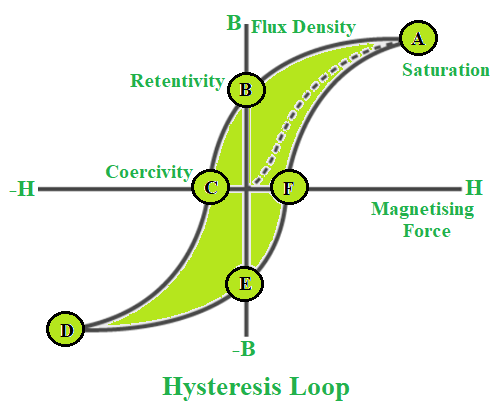
The graph will indicate a hysteresis loop if B is measured for various values of H and the results are presented in visual formats.
- When the magnetic field strength (H) is increased from zero, the magnetic flux density (B) increases.
- As the magnetic field is increased, the value of magnetism rises until it hits point A, which is known as the saturation point, where B remains constant.
- With a drop in the value of the magnetic field, there is a decrease in the value of magnetism. However, when B and H are both zero, the substance or material retains some magnetic, which is known as retentivity or residual magnetism.
- When there is a reduction in the magnetic field towards the negative side, magnetism likewise decreases. The material is entirely demagnetized at point C.
- Coercive force is the amount of force necessary to eliminate a material's retentivity (C).
- The cycle is repeated in the opposite direction, with the saturation point D, retentivity point E, and coercive force F.
- The cycle is complete due to the forward and opposite direction processes, and this cycle is known as the hysteresis loop.
**Advantages of Hysteresis Loop
- The loss of hysteresis is shown by a decreased area of the hysteresis loop.
- The relevance of retentivity and coercivity is provided by the hysteresis loop to a material. As a result, the heart of machines makes it easier to choose the correct material for making a permanent magnet.
- The B-H graph may be used to determine residual magnetism, making a material selection for electromagnets straightforward.
Retentivity and Coercivity
After an external magnetising field is used to magnetise a ferromagnetic material, the material will not relax back to its zero magnetization state when the external magnetising field is removed.
**Retentivity - It is the amount of magnetism that remains after the external magnetising field is withdrawn. It refers to a material's capacity to maintain certain magnetic properties after an external magnetising force has been withdrawn. The value of flux density at the hysteresis loop's point B is the retentivity.
**Coercivity - The coercivity of substance is defined as the amount of reverse(-ve H) external magnetising field necessary to totally demagnetize the substance. The value of H at the hysteresis loop's point C is the coercivity.
Energy Loss due to Hysteresis
- The greatest example of analysing energy loss due to hysteresis is a transformer because we know that energy is required throughout the magnetization and demagnetization processes.
- Energy is expanded during the magnetization and demagnetization of magnetic objects, and this expanded energy manifests as heat. Hysteresis loss is the term for this type of heat loss.
- Due to the continuous process of magnetization and demagnetization in transformers, energy is continuously lost in the form of heat, reducing the transformer's efficiency.
- Soft iron cores are used in transformers to prevent energy loss because the energy loss or hysteresis loss in soft iron is significantly lower than in other materials.
Difference between the soft magnets and hard magnets
- In comparison to hard magnets, soft magnets magnetise and demagnetizes readily.
- The retentivity of soft magnets is higher than that of hard magnets.
- Hard magnets have a coercivity that is higher than that of soft magnets.
- Soft magnets lose less energy than hard magnets due to their tiny surface area.
- In the case of soft magnets, the loop area is less than that of hard magnets.
- Soft magnets have higher magnetic permeability than hard magnets.
- In soft magnets, I and χ are both high, but in hard magnets, they are both low.
- Soft magnets are temporary magnets while hard magnets are permanent magnets.
- Ferrous-nickel alloy, Ferrites, etc. are examples of soft magnets while carbon steel, steel, tungsten, chromium steel, etc. are examples of hard magnets.
Magnetization and Demagnetization
The method of developing magnetic properties inside a magnetic substance is known as magnetization. With the aid of an electric current or a powerful magnet, any magnetic material may be magnetised.
- In simple terms, if any magnetic substance is placed in an external magnetising field, the material will become magnetised, and if the external magnetising field is reversed, the material will become demagnetized.
- When ferromagnetic materials are put inside a current-carrying coil, the magnetising field H produced by the current pushes some or all of the material's atomic magnetic dipoles to align with the external magnetising field, magnetising the material.
Sample Problems
**Problem 1: Which materials have the narrowest hysteresis loop?
**Solution:
A minimal quantity of wasted energy is implied by a narrow hysteresis loop. This happens because of its limited surface area, which leads to more frequent reversals of applied magnetising force. These narrow hysteresis forms are seen in soft magnetic materials utilised in systems that need alternating magnetic fields.
**Problem 2: What is the hysteresis cycle of a transformer core's material?
**Solution:
The core of the transformer is made of soft iron, which has a low coercivity and a high retentivity. As a result, its hysteresis loop is tall and thin.
**Problem 3: What is hysteresis loss?
**Solution:
When a transformer core is exposed to alternating magnetising force, hysteresis loss occurs owing to the reversal of magnetization. When the core is exposed to an alternating magnetic field, the material's domains shift orientation every half cycle. Hysteresis loss is the amount of energy used by magnetic domains to change their orientation every half cycle.
**Problem 4: What are the desired properties for the selection of transformer cores?
**Solution:
Desired properties for selection of cores are:
- Materials must go through complete magnetisation cycles on a regular basis.
- Low hysteresis loss reduces energy loss.
- To produce a high flux density, high permeability (or susceptibility) is required.
- Eddy-current losses are reduced by having a high resistivity.
- Soft iron, permalloys, and other materials are examples.
**Problem 5: A magnet has a coercivity of 1 × 10 3 A ⁄ m. What current should be delivered through a solenoid with a length of 5 cm and a number of turns of 100 such that a magnet put in it is demagnetized?
**Solution:
Given:
Length of solenoid, L = 5 cm = 0.05 m
Number of turns, N = 100
So, number of turns per unit length, n = N ⁄ L
= 100 ⁄ 0.05
= 2000
Current to be passed, i = H ⁄ n
= 1 × 10³ ⁄ 2000
= 0.5 A
Hence, the current delivered through a solenoid is **0.5 A.