Gauss's Law (original) (raw)
Last Updated : 23 Jul, 2025
Gauss's law is defined as the total flux out of the closed surface is equal to the flux enclosed by the surface divided by the permittivity. The Gauss Law, which analyses electric charge, a surface, and the issue of electric flux, is analyzed. Let us learn more about the law and how it functions so that we may comprehend the equation of the law.
What is Gauss's Law?
- According to Gauss's law, the total electric flux out of a closed surface is equal to the charge contained divided by the permittivity. The electric flux in a given area is calculated by multiplying the electric field by the area of the surface projected in a plane perpendicular to the field. The total flux associated with a closed surface equals **1 ⁄ ε 0 times the charge encompassed by the closed surface, according to the Gauss law:
**∮ E.ds = q ⁄ ε o
- For example, a point charge '**q' is put within a cube with the edge **a. The flux across each face of the cube is now q ⁄ 6ε o, according to Gauss' law. The electric field is the most fundamental concept in understanding electricity.
- In general, the electric field of a surface is computed using Coulomb's law; however, understanding the idea of Gauss' law is required to calculate the electric field distribution in a closed surface. It describes how an electric charge is enclosed in a closed surface or how an electric charge is present in a closed surface that is enclosed.
Gauss Law Formula
According to the Gauss law formula, the total electric charge enclosed in a closed surface is proportional to the total flux enclosed by the surface. As a consequence, the total electric charge '**Q' contained by the surface is: if ε0 is electric constant and ϕ is total flux.
**Q = ϕ ε o
The formula of Gauss law is given by:
**ϕ = Q⁄ε o
Where,
- ε**o is electrostatic constant,
- Q is total charge within a given surface, and
- ϕ is flux enclosed by surface.
The Gauss Theorem
The Gauss theorem connects the ‘flow' of electric field lines (flux) to the charges within the enclosed surface in simple terms. The net charge in the volume contained by a closed surface is exactly proportional to the net flux through the closed surface.
**ϕ = E.dA = q net **⁄ ε o
The net electric flow stays 0 if no charges are contained by a surface. The number of electric field lines entering the surface equals the number of field lines exiting the surface.
**A corollary of the gauss theorem statement:
The electric flux from any closed surface is only due to the sources and sinks of electric fields enclosed by the surface. The electric flux is unaffected by any charges outside the surface. Furthermore, only electric charges may operate as electric field sources or sinks. It is important to note that changing magnetic field cannot act as electric field sources or sinks.
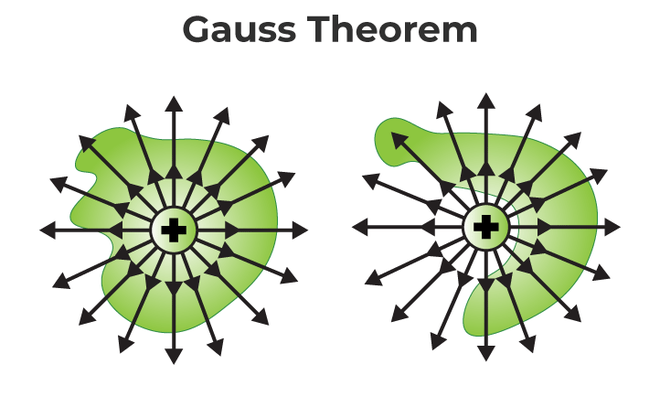
As it encloses a net charge, the net flow for the surface on the left is non-zero. Because the right-hand surface does not contain any charge, the net flow is zero. The Gauss law is nothing more than a repetition of Coulomb's law. Coulomb's law is readily obtained by applying the Gauss theorem to a point charge surrounded by a sphere.
**Note: Gauss' law and Coulomb's law are closely related. If gauss law is applied to a point charge in a sphere, it will be the same as applying coulomb's law.
Gauss Law Equation
Gauss law equation can be understood using an integral equation. Gauss’s law in integral form is mentioned below:
**∫E.dA = Q/ε 0 ⇢ (1)
Where,
- E is the electric field
- Q is the electric charge enclosed
- ε0 is the electric permittivity of free space
- A is the outward pointing normal area vector
Flux is a measure of the strength of a field passing through a surface. Electric flux is given as:
**Φ = ∫E⋅dA ⇢ (2)
Electric Flux and Charge Distributions
Flux Calculation for a Square Area:
Electric flux represents the amount of electric field passing through a given surface area. For a square surface, we can calculate the flux by integrating the electric field across that surface.
**Formula,
**Φ=∫E⋅dA
**Where,
****'E'** the electric field vector
****'dA'** is the differential area vector, pointing perpendicular to the surface.
**For a uniform electric field E, the flux through a square area 'A' is simply:
**Φ=E×A
**Where, '**E' is the magnitude of the electric field and 'A' is the area of the square.
**Example: **Consider a uniform electric field of 5 N/C passing through a square surface of area 2 m². The flux is:
Φ=5N/C×2m2=10N⋅m2/C
Flux Through a Surface Enclosing Charges:
According to **Gauss's Law, the electric flux through a closed surface is proportional to the total charge enclosed within that surface.
**Gauss's Law states:
**Φ=Q enc /ϵ 0
**Where,
****'Q** **enc'** is the total charge enclosed within the surface.
****'ϵ** **0'** is the permittivity of free space.
If we enclose a charge with a spherical surface, the flux through the surface is simply the charge divided by **ϵ 0.
**Example: Suppose a spherical surface encloses a total charge of Q=4×10⁻⁶ C; The flux through the surface is:
Φ= 4 ×10⁻⁶/8.85 ×10−12 =4.52×10⁵N⋅m2/C
Net Electric Field and Charge Distributions via Gauss's Law:
Gauss's Theorem allows us to determine the net electric field generated by a given charge distribution by considering the symmetry and applying Gauss's Law.
- **For a Point Charge: The electric field around a point charge is radial and can be determined by applying Gauss's Law over a spherical Gaussian surface centered on the charge. The electric field at distance r from the charge '**Q' is:
**E=1/4πϵ 0 /r 2 . Q/r 2
- **For an Infinite Wire: The electric field depends on the charge per unit length 'λ' and distance '**r' from the wire:
**E=λ/2πrϵ 0
- **For a Spherical Shell: The electric field inside a spherical shell of charge is zero, and outside it behaves as if all the charge were concentrated at the center.
Electric Field from three Concentric Spherical Shells:
In electrostatics, **Gauss's Law is a powerful tool for calculating electric fields, especially when dealing with symmetrical charge distributions. One such setup involves three concentric spherical shells, each carrying a charge. In this example, we will explore how to choose an appropriate **Gaussian surface and apply Gauss’s Law to calculate the electric field in various regions.
**Charge Distribution Setup:
Consider three concentric spherical shells with charges distributed as follows:
- **Shell 1: Charge Q1, radius r1
- **Shell 2: Charge Q2, radius r2
- **Shell 3: Charge Q3, radius r3
Our aim to calculate the electric field in the following regions:
- Inside Shell 1 ****(1<r** 1 )
- Between Shell 1 and Shell 2 ****(r** 1 <r<r 2 )
- Between Shell 2 and Shell 3 ****(r** 2 <r<r 3 )
- Outside all shells ****(r>r** 3 )
**Choosing an Appropriate Gaussian Surface:
For each region, we choose a **Gaussian surface that takes advantage of the symmetry of the problem. Since the system is spherical, a spherical Gaussian surface will help simplify calculations.
- For regions inside a shell, the Gaussian surface is a sphere of radius' r' smaller than the radius of the shell.
- For regions between two shells, the Gaussian surface is a sphere of radius' **r' lying between the radii of the shells.
- For regions outside all shells, the Gaussian surface is a sphere with radius' **r ' larger than the outermost shell.
Step 1: Applying Gauss's Law
**Gauss’s Law states that the electric flux through a closed surface is proportional to the charge enclosed within that surface:
**ΦE=Qenc/ϵ 0
**Where,
- **Φ E is the electric flux through the Gaussian surface.
- **Q enc is the total charge enclosed within the surface.
- **ϵ 0 is the permittivity of free space.
The electric flux **Φ E is also related to the electric field' E' and the surface area '**A' of the spherical surface:
**ΦE=E⋅A=E⋅4πr 2
**Where, 'r' is the radius of the spherical surface.
Step 2: Electric Field in Different Regions
Region 1: Inside Shell 1 ****(1<r** 1 )
- In this region, no charge is enclosed, as we are inside the first shell.
- By Gauss’s Law, if no charge is enclosed, the electric field is **zero:E=0forr<r1E = 0 \quad \text{for} \quad r < r_1E=0forr<r1
Region 2: Between Shell 1 and Shell 2 (r1<r<r2)
- In this region, the Gaussian surface encloses only the charge on the first shell, Q1Q_1Q1.
- Applying Gauss’s Law
**E⋅4πr2=Q1/ϵ0
Solving for :
**E=Q1/4πϵ0r 2
So, the electric field between the first and second shells depends on the distance from the center and points radially outward.
Region 3: Between Shell 2 and Shell 3 (r2<r<r3)
- Here, the Gaussian surface encloses both the charges on **Shell 1 and **Shell 2, so the total enclosed charge is :
Q1+Q2.
- By Gauss’s Law:
E⋅4πr2=Q1+Q2/ϵ0
- Solving for :
**E=Q1+Q2/4πϵ 0 r 2
- The electric field between the second and third shells also points radially outward and decreases with the square of the distance from the center.
Region 4: Outside All Shells (r>r3)
- In this region, the Gaussian surface encloses all three charges:
Q1+Q2+Q3.
- By Gauss’s Law:
E⋅4πr2=Q1+Q2+Q3/ϵ0.
- Solving for :
**E=Q1+Q2+Q3/4πϵ 0 r 2 .
Outside all the shells, the electric field behaves as though all the charge were concentrated at the center, and it decreases with the square of the distance from the center.
Electric Field Due to an Infinite Wire ( Cylindrical Gaussian Surface)
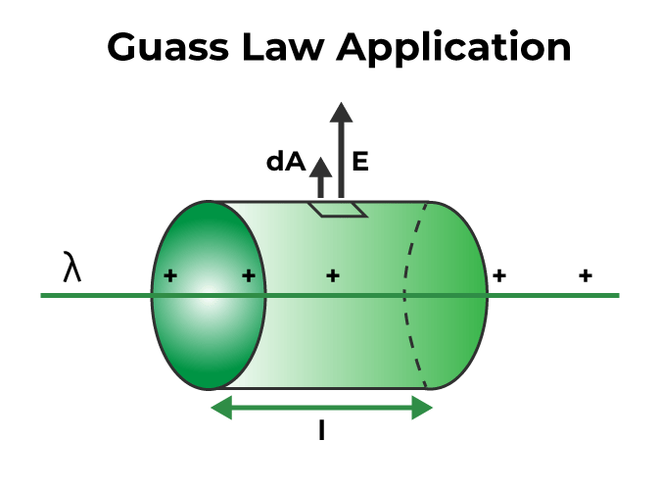
In **electrostatics, one of the classic problems is determining the electric field produced by an infinite charged wire. Since the charge distribution is infinite, the symmetry of the problem plays a crucial role in simplifying the calculation of the electric field. To solve this, we use **Gauss's Law with a **cylindrical Gaussian surface that matches the symmetry of the charge distribution.
Charge Distribution Setup:
Consider a long, straight, and infinitely long wire that carries a uniform linear charge density' λ' (charge per unit length). Our goal is to calculate the electric field at a distance' r' from the wire.
Choosing the Gaussian Surface:
Since the wire is infinite and the charge distribution is uniform, we exploit the cylindrical symmetry of the system. The best choice for the **Gaussian surface is a cylinder, coaxial with the wire, because:
- The electric field due to a straight wire is radial (it points away from the wire or toward it depending on the charge).
- The electric field is the same at any point on the cylindrical surface at distance rrr from the wire.
Thus, we consider a **cylindrical Gaussian surface with radius '**r' and length 'L' centered around the wire.
Step 1: Applying Gauss’s Law
Gauss's Law states that the electric flux through a closed surface is proportional to the charge enclosed within that surface:
**ΦE=Qenc/ϵ 0
**Where,
- **Φ E is the electric flux through the Gaussian surface.
- **Q enc is the total charge enclosed within the surface.
- **ϵ 0 is the permittivity of free space.
The electric flux Φ E is also related to the electric field 'E' and the surface area 'A' of the cylindrical surface:
**ΦE=E⋅A=E⋅(2πrL)
**Where ,**2πrL is the lateral surface area of the cylindrical Gaussian surface, where 'r' is the radius of the cylinder, and 'L' is the length of the cylinder.
Step 2: Calculating the Enclosed Charge
The total charge enclosed by the Gaussian surface depends on the charge density' λ' of the wire. Since the wire carries a uniform charge per unit length 'λ' the total charge enclosed by the cylindrical surface is:
**Qenc=λL
**Where, 'L' is the length of the cylindrical Gaussian surface.
Step 3: Electric Flux and Field Calculation
- From Gauss’s Law:
**ΦE=Qenc/ϵ 0
- Substituting for **Q enc =λL and the expression for flux:
**E⋅(2πrL)=λL/ϵ 0
- We can cancel the '**L' terms:
**E⋅2πr=λ/ϵ0
- Solving for 'E' the electric field at distance '**r' from the wire is:
**E=λ/2πϵ0rE
This shows that the electric field produced by an infinite charged wire decreases with distance from the wire and is inversely proportional to r.
Step 4: Direction of the Electric Field
The electric field due to an infinite wire is radial and points away from the wire if the wire is positively charged or toward the wire if it is negatively charged. Since the wire is infinitely long, the electric field is the same at all points equidistant from the wire.
Applications of Gauss's Law:
**Electrostatics:
- The electric field due to an infinite wire is a fundamental example in **electrostatics, helping to understand how charge distributions influence the electric field.
- The result of this calculation is used in **capacitor design and other systems where long, charged wires are involved.
**Electromagnetism:
- The electric field of an infinite wire is crucial in the study of **magnetic fields produced by currents in wires. According to **Ampère's Law, a current in a long, straight wire creates a magnetic field that can be calculated using similar symmetry considerations.
**Quantum Mechanics:
- In **quantum mechanics, the potential and field produced by an infinite wire can help in understanding the behavior of charged particles in various quantum systems, such as the motion of electrons in the presence of electric fields from wires or conducting materials.
There are different formulae obtained from the application of Gauss law for different conditions. Below are some well-known applications of Gauss law:
- In a medium with a dielectric constant of K, the strength of the electric field near a plane-charged conductor **E = σ ⁄ K ε o . E air = σ ⁄ ε owhen the dielectric medium is air.
- At a distance of **‘r' in the case of an infinite charge line, **E = (1 ⁄ 4 × π r ε 0 ) (2π ⁄ r) = λ ⁄ 2π r ε o , where λ is linear charge density.
- In a condenser or capacitor, the field between two parallel plates is E = σ ⁄ ε 0, where **σ is the surface charge density.
- The electric field strength near a plane sheet of charge is **E = σ ⁄ 2K ε o, where σ is the surface charge density.
- For a charged ring having a radius ****'R'**, from the centre of the ring at a distance 'x', here, the electric field becomes: E = \frac{1}{4\pi\epsilon_o}\frac{qx}{(R^2 + x^2)^{3/2}}
Solved Examples - Gauss Law
**Example 1: In the x-direction, there is a homogeneous electric field of size E = 50 N⁄C. Calculate the flux of this field across a plane square area with an edge of 5 cm in the y-z plane using the Gauss theorem. Assume that the normal is positive along the positive x-axis.
**Solution:
Given:
Electric field, E = 50 N⁄C
Edge length of square, a = 5 cm = 0.05 m
The flux of the field across a plane square, ϕ = ∫ E cosθ ds
As the normal to the area points along the electric field, θ = 0.
Also, E is uniform so, Φ = E ΔS = (50 N⁄C) (0.05 m)2 = 0.125 N m2 C-1.
Hence, the flux of the given field is **0.125 N m 2 **C -1.
**Example 2: There are three charges, q 1 , q 2 , and q 3, having charges 4 C, 7 C, and 2 C enclosed in a surface. Find the total flux enclosed by the surface.
**Solution:
Total charge Q,
Q = q1 + q2 + q3
= 4 C + 7 C + 2 C
= 13 C
The total flux, ϕ = Q ⁄ ε0
ϕ = 13 C ⁄ (8.854×10⁻¹² F ⁄ m)
ϕ = 1.468 N m2 C-1
Therefore, the total flux enclosed by the surface is 1.584 N m2 C-1.
**Example 3: Two conducting plates having charges Q 1 and Q 2 , are kept parallel to each other. Find the distribution on all four surfaces.
**Solution:
It can be seen from the figure that two faces lie inside the conductor when E = 0. The flux is also 0. The faces that are outside are parallel to the electric field, the flux there will be 0 too. Therefore, the total flux of the electric field is 0.
From gauss law, the total charge inside the closed surface must be 0. Therefore, the charge on the inner side of one plate should be equal to the charge on the other side.
Using the equation E = σ/2ε0, the electric field at P:
- Due to the charge Q1 - q = (Q1 - q)/2Aε0 (downward).
- Due to the charge +q = +q/ε0 (upward).
- Due to the charge Q2 + q = (Q2 + q)/2Aε0 (upward)
- Due to the charge -q = -q/ε0 (downward).
The net electric field is in the downward direction:
(Q1 - q)/2Aε0 + (-q/ε0) + (Q2 + q)/2Aε0 + +q/ε0
Q1 -q +q -Q2 = 0
q = (Q1 - Q2)/2
Q1 - q = (Q1 + Q2)/2
Q2 + q = (Q1 + Q2)/2
**Example 4: What is the differential form of the Gauss theorem?
**Solution:
The electric field is related to the charge distribution at a certain location in space by the differential version of Gauss law. To clarify, according to the law, the electric field's divergence (E) is equal to the volume charge density (ρ) at a given position. It's written like this:
ΔE = ρ ⁄ ε0
Here, ε0 is the permittivity of free space.
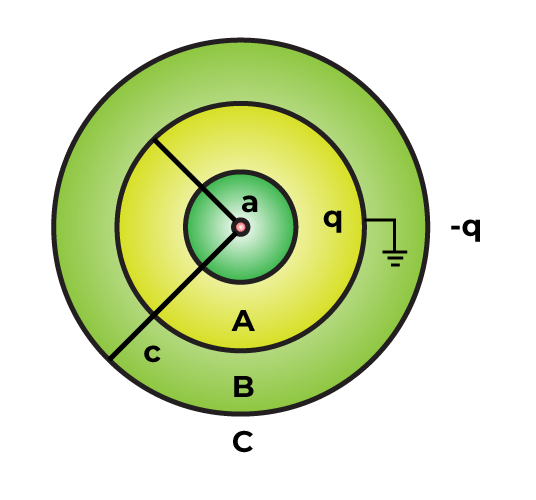
**Example 5: There are three concentric spherical shells A, B, and C with radii a, b, and c. The charges are present on shells A and C (q and -q respectively), and shell B is earthed. Find the total charges appearing on B and C.
**Solution:
Since the inner surface of shell B must have a charge of -q, suppose the outer surface of B has a charge 'x'. Then, the inner surface of C must have a charge of '-x'.
Potential due to charge 'q' on A = q/4πε0b
Potential due to '-q' on inner surface of B = -q/4πε0b
Potential due to 'x' on outer surface of B = x/4πε0b
Potential due to '-x' on inner surface of C = -x/4πε0c
Potential due to 'x - q' on inner surface of C = x - q/4πε0c
Now, the net potential: VB = x/4πε0b - q/4πε0c
This potential is equated to 0 as the shell B is earthed.
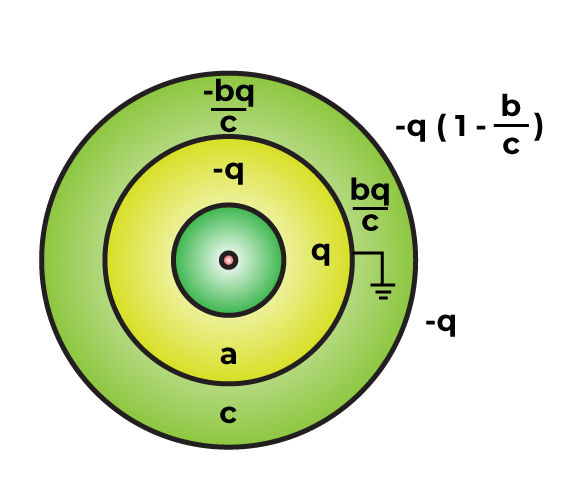
Therefore, x = qb/c
Below is the figure showing the charges on each surface:
Related Articles
- where **∮S represents the surface integral over a closed surface **S, **E is the electric field vector, **dA is the surface area vector, Qenc is the total charge enclosed by the surface, and ε0 is the permittivity of free space.
- Gauss's Law is a powerful tool for calculating electric fields in situations where the symmetry of the charge distribution makes it difficult to use Coulomb's Law. By using Gauss's Law, it is possible to calculate the electric field of a uniformly charged sphere, cylinder, or plane, for example.
- Gauss's Law has important applications in many areas of physics, including electromagnetism, electrostatics, and quantum mechanics. It is used to analyze the behavior of electric fields in charged particles, capacitors, and other electrical devices. It also plays a key role in the understanding of electromagnetic radiation and the propagation of radio waves.