Modulus of Elasticity (original) (raw)
Last Updated : 18 May, 2026
Modulus of elasticity is a fundamental material property that quantifies a material’s stiffness or resistance to elastic deformation when subjected to stress. It is defined as the ratio of stress (σ) to the corresponding strain (ε) within the elastic limit of the material, expressed as:
E = \frac{Stress (σ)}{Strain (ε)}
This modulus indicates how much a material will deform under a given load and helps predict its behavior under mechanical forces. A higher modulus of elasticity means the material is stiffer and deforms less, while a lower modulus indicates it is more flexible.
**Examples: Steel is a common example of a material with a high modulus of elasticity, widely used in construction due to its strength and durability. It resists deformation and maintains its shape under stress, allowing it to bear heavy loads without bending or breaking. Steel is relatively brittle, so safety precautions are necessary during use.
Some examples of elastic modulus values for common materials:
- Diamond: 1220 GPa (one of the highest)
- Steel: 210 GPa
- Concrete: 30–50 GPa
Calculate Modulus of Elasticity
Modulus of Elasticity, in terms of the stress-strain curve, is the slope of the stress-strain curve in the region of elastic behavior, where stress is linearly proportional to strain.
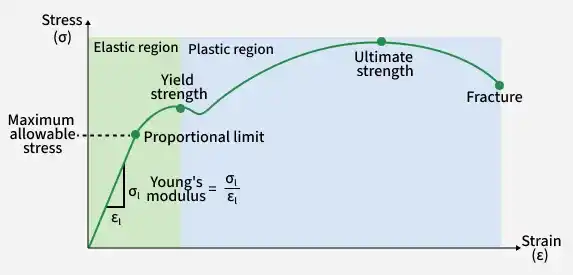
Modulus of elasticity is the slope of the stress-strain curve and represents the material's stiffness in the elastic region, which extends from 0 up to the yield strength. The yield strength is the stress required to produce a small amount of plastic deformation. Beyond this elastic region the material enters the plastic deformation region, where permanent changes in shape occur. The ultimate strength is the maximum stress a material can withstand before failure. Once this point is exceeded, the material can no longer support the load and breaks.
Determining the Modulus of Elasticity of Wire
Determining the Young's modulus (also known as the modulus of elasticity) of a material typically involves performing a tensile test on a wire or specimen.
- Cut a length of the wire to be tested. The wire should be uniform in diameter along its length and free from defects.
- Fix one end of the wire to a fixed clamp or holder. The other end should be attached to a load cell or device capable of applying a controlled tensile force.
- Set up a measurement system to accurately measure the applied force (tensile load) and the corresponding elongation (strain) of the wire.
- While measuring the elongation, apply a tensile force that gets stronger over time to the wire. Ensure that the force is applied uniformly along the length of the wire and that the loading rate is controlled.
- Keep track of the load (force) and the strain (elongation) at regular intervals during the test until the wire breaks. Plot a stress-strain curve using the recorded data.
- From the stress-strain curve, determine the elastic (linear) region where the stress is directly proportional to the strain. Calculate the slope of the linear portion of the curve, which represents the Young's modulus of the material according to Hooke's law
- Young's modulus (E) is calculated using the formula: E= Stress/Strain
Formula
The formula of Elastic Modulus is given as the ratio of stress and strain
\boxed {E = \fracσ ε}
where
- E = Elastic Modulus,
- ε = resulting strain of the material
- σ = stress applied to the material.
We can also define the modulus of elasticity by
E=\frac{\text Stress} {\text Strain} = \frac{\frac F A}{\frac {\Delta l} {l} }
\boxed {E = \frac{F \times L}{A \times \Delta L}}
where
- F = force exerted by the object under tension
- L = length
- A = cross-sectional area
- δL = change in length
- E = Young modulus in Pa
The dimensional formula for modulus of elasticity can be written as **[M 1 L -1 T -2 ]
Modulus of Elasticity vs Modulus of Rigidity
| Modulus of Elasticity | Modulus of Rigidity |
|---|---|
| Calculate the deformations of an object when the deforming force is applied parallel to the surface. | Calculate the deformation of an object when the deforming force is tangential to the surface. |
| Denoted by E | denoted by G |
| E = Stress/Strain | G = Shear Stress/Shear Strain |
| stretching or compressing type of deformation | sliding or twisting type of deformation |
| E = 3K(1 - 2v) | G = E/(2 + 2v) |
Elastic Constants
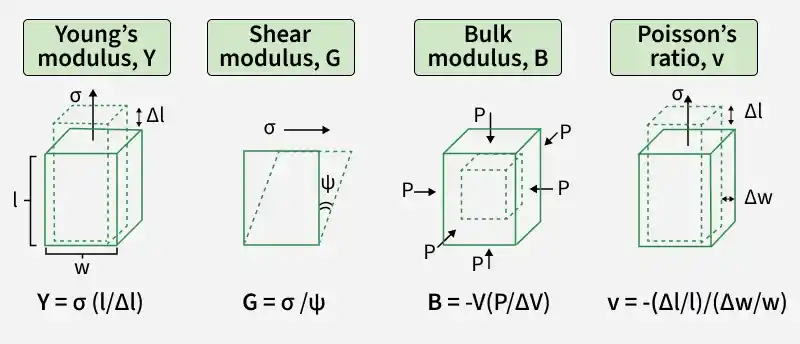
Elastic constants are used to determine the deformation produced by stress. They are used to obtain the relationship between stress and strain. There are basically 4 types of elastic constants that we use, namely:
- Young's modulus (E)
- Bulk modulus (K)
- Shear modulus (G)
- Poisson’s ratio (µ)
A. Young’s Modulus (E)
It is the ratio of stress to strain within the elastic limit of a material, and it measures the material’s ability to resist deformation under tensile or compressive forces.
In formula form:
Y = \frac{\text{Stress}}{\text{Strain}} = \frac{F/A}{\Delta L / L}
Where:
- F = applied force
- A = cross-sectional area
- L = original length
- ΔL = change in length
**B. Bulk modulus (K)
It is a measure of a material's resistance to uniform compression. In other words, it tells us how difficult it is to compress a substance.
A material's volume tends to decrease when exposed to external pressure. Bulk modulus relates the applied pressure to the fractional change in volume.
B = \frac{\text{Applied Pressure}}{\text{Fractional Change in Volume}}
= \frac{\Delta P}{\frac{\Delta V}{V}}
Where:
- B = Bulk modulus
- ΔP = Increase in pressure applied on the material
- V = Original volume of the material
- ΔV = Change in volume (usually negative because volume decreases)
The negative sign is often used to indicate that volume decreases under pressure.
B = -V \frac{\Delta P}{\Delta V}
C. Shear Modulus (G)
Shear modulus, also called the modulus of rigidity, measures a material's resistance to shear deformation. It describes how a material changes shape when a force is applied parallel to its surface, without changing its volume. It tells us how stiff a material is against forces that try to make it slide.
G = \frac{\text{Shear Stress}}{\text{Shear Strain}}
= \frac{F/A}{\Delta x / h}
= \frac{F \cdot h}{A \cdot \Delta x}
Relation with Young's Modulus and Poisson's Ratio
G = \frac{Y}{2(1 + \sigma)}
D. Poisson’s ratio (**µ)
When a material is stretched or compressed along one axis, it tends to contract or expand along the perpendicular axes. Poisson's ratio (σ) is defined as the ratio of the lateral (transverse) strain to the longitudinal (axial) strain.
\sigma = \frac{\text{Lateral Strain}}{\text{Longitudinal Strain}}
= \frac{\Delta d / d}{\Delta L / L}
Relation Between Elastic Constants
The relationship between these constants can be known by the given expression:
\frac{1}{K} - \frac{3}{G} = \frac{9}{E}
Where,
- K is the Bulk Modulus
- G is the shear modulus
- E is the Young's modulus.
Applications
Modulus of elasticity is used in day-to-day life in many ways. It is used in engineering as well as medical science.
- We can use the elastic modulus to calculate how much material will stretch and how much potential energy will be stored.
- The elastic modulus allows us to determine how a given material will respond to stress.
- Elastic modulus is used to characterize biological materials like cartilage and bone as well.
Solved Problems
**Question 1. A wire is 2 m long and has a cross-sectional area of 10⁻⁶ m. 2 A load of 980 N is suspended. Calculate the stress, the strain, and the energy stored in the wire
**Solution: Given: Y = 12 × 1010 N m-2
Stress = F / A = 980 / 10-6 = 98 × 107 N m-2
Strain = Stress / Y = 98 × 107 / 12 × 1010 = 8.17 × 10⁻³
Energy = 1/2 × (stress × strain) × volume = 1/2 × (98 × 107 × 8.17 × 10-3) × 2 × 10-6 = 8 Joules.
**Example 2. A metallic cube with a side of 0.20 m undergoes a shearing force of 1000 N. The top surface is displaced by 0.40 cm with respect to the bottom. Find the elasticity of the metal's shear modulus.
**Solution: Here, L = 0.20 m, F = 1000 N, x = 0.40 cm = 0.004 m and
Area A = L2= 0.04 m2
Therefore, Shear modulus = (1000/ 0.04) × (0.20 / 0.004) = 1.25 × 10⁶ N m-2.
**Example 3. What must be the elongation of a wire 5 m long so that the strain is 1% of 0.1? If the wire has a cross-section of 1 mm 2 and is stretched by 10 kg, what is the stress?
**Solution: L = 5m, Strain = 1% of 0.1 = 1 × 10-2 × 0.1 = 1 × 10⁻³, Area of cross-section = 1 mm² = 1 × 10⁻⁶ m²
F = 10 kg= 10 × 9.8 N
Extension = Stress × L = 5mm
Stress = Force / Area = (10 × 9.8) / (1 × 10⁻⁶) = 9.8 × 10⁷ N/m².
**Question 4: A steel wire 3 m long and cross-sectional area 2×10⁻⁶ m² is subjected to a load of 600 N; find the stress, strain, and extension if Young’s modulus is 2 × 10¹¹ N/m².
**Solution: Given
L = 3 m
A = 2 × 10⁻⁶ m²
F = 600 N
Y = 2 × 10¹¹ N/m²
Stress
\text{Stress} = \frac{F}{A}
= \frac{600}{2 \times 10^{-6}}
= 3 \times 10^8 \,\text{N/m²} \\[1mm]
Strain
\text{Strain} = \frac{\text{Stress}}{Y}
= \frac{3 \times 10^8}{2 \times 10^{11}}
= 1.5 \times 10^{-3} \\[1mm]
Extension
\Delta L = \text{Strain} \times L = 1.5 \times 10^{-3} \times 3
= 0.0045\,\text{m} = 4.5\,\text{mm} \\[1mm]
Unsolved Problems
**Question 1: A rod 10 m long has a cross-sectional area of 1.5 × 10⁻⁴ m. It is subjected to a 10-kg load. If Young’s modulus of the material is 4 × 10¹⁰ N/m2, calculate the elongation produced in the wire.
**Question 2: A metallic cube of side 100 cm is subjected to a uniform force acting normal to the whole surface of the cube. The pressure is 106 pascal. If the volume changes by 1.25 x 10⁻³ m3, calculate the bulk modulus of the material.
**Question 3: A metal cube of side 0.45 m is subjected to a shearing force of 8000 N. The top surface is displaced by 0.30 cm with respect to the bottom. Calculate the shear modulus of metal.
**Question 4: A mild steel wire of radius 0.5 mm and length 3 m is stretched by a force of 49 N. Calculate a) longitudinal stress, b) longitudinal strain, and c) elongation produced in the body if Y for steel is 2.1 × 10¹¹ N/m2.
**Question 5: A steel wire of length 4 m and cross-sectional area 2 × 10⁻⁶ m² is subjected to a tensile force of 1200 N; find the stress, strain, and extension if Young’s modulus is 2 × 10¹¹ N/m².