Momentum (original) (raw)
Last Updated : 24 Apr, 2026
In everyday life, we often observe that a fast-moving truck is much harder to stop than a bicycle, and a cricket ball moving at high speed can cause more impact than a slowly moving one. The concept of momentum explains these observations. It helps explain motion, collisions, and many real-life phenomena. Without momentum, many theories in physics would not work properly.
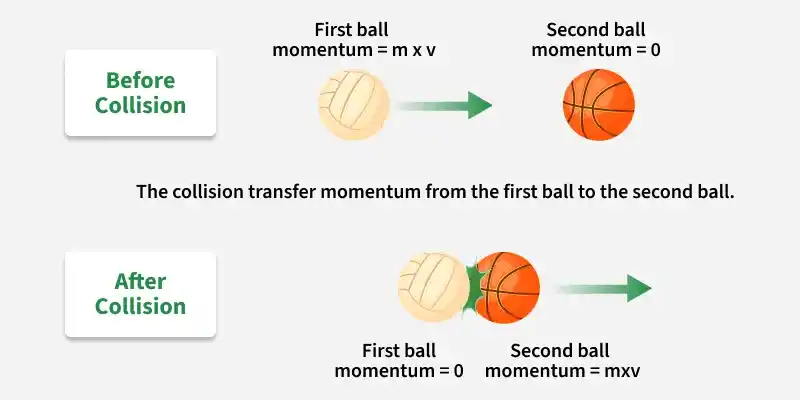
Momentum refers to the quantity of motion of an object. It depends on two factors:
- Mass of the object
- Velocity of the object
In simple terms, momentum tells us how much motion an object has, determined by how much mass is moving and how fast it is moving.
The momentum is the product of the mass of the particle and its velocity and It is denoted by (p).
\boxed { p=m.v}
where:
- p = momentum
- m = mass
- v = velocity
**SI Unit and Dimensions
- SI Unit: kg·m/s
- Dimensional Formula: [M1L1T−1]
**Nature of Momentum
- Momentum is a vector quantity
- Its direction is the same as velocity
- A body at rest has zero momentum
- Greater mass or velocity means greater momentum
Real-Life Example
Consider a truck and a bicycle moving with the same speed. The truck has greater momentum because it has more mass.
Now imagine A fast bicycle vs. a slow truck. The bicycle may have comparable momentum if its velocity is high enough.
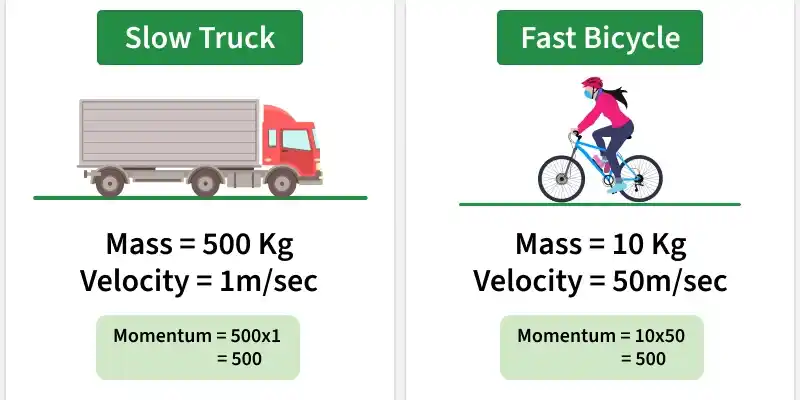
This shows: Both mass and velocity are equally important in determining momentum.
Types of Momentum
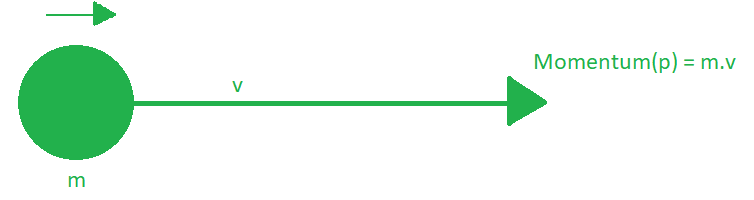
1. Linear Momentum
- Momentum in a straight line
- Given by p=mv
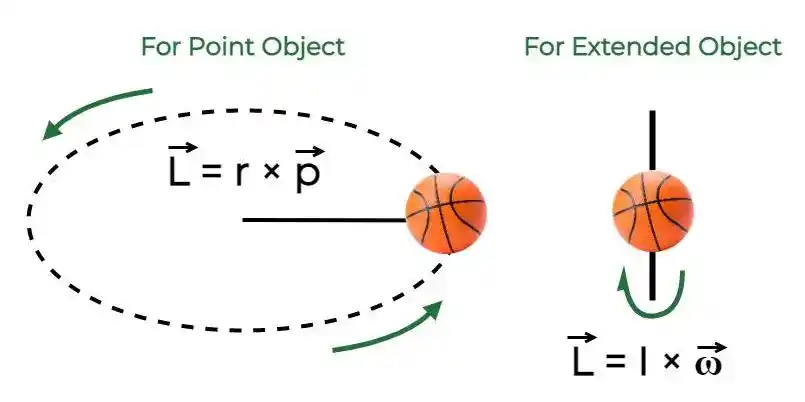
**2. Angular Momentum
- Momentum of objects moving in a circular or rotational path
- Example: rotating fan, pendulum, spinning wheel
**Relation Between Force and Momentum
According to Newton’s Second Law, the rate of change of momentum of a body is directly proportional to the applied force.
**Mathematical Form
F = \frac{dp}{dt}
For constant mass: F=ma
**Law of Conservation of Momentum
If no external force acts on a system, the total momentum of the system remains constant.
m_1u_1 + m_2u_2 = m_1v_1 + m_2v_2
Examples of Momentum in Daily Life
- A moving car has momentum.
- A pendulum in motion has momentum.
- A spinning stone tied to a rope (angular momentum)
- A bike gains momentum when speed increases.
- A ball dropped from a height gains momentum while falling.
Importance and Applications of Momentum
- Airbags in cars: Increase time of impact → reduce force
- Sports: Players move backward while catching to reduce injury.
- Engineering: Used in fluid flow and force calculations
- Rockets & Jets: Use momentum conservation to move
Momentum helps in:
- Predicting motion after collisions
- Understanding force and motion
- Designing safety systems
**Related Article:
Solved Examples
**Question 1. A bicycle of 45 kg at a 20 km velocity is on the highway; what will be its momentum?
Solution: Given,
- m = mass of bicycle = 45kg
- v = velocity (speed) of bicycle = 20 m/s
Thus by using formula for momentum,
p = m × v
p = 45 × 20
p = 900 kg.m/s
**Question 2: A car has a momentum of 250 kg.m/s. What will be its momentum if its mass is twice the mass?
Solution: Given, momentum (p) = 250 kg.m/s
Condition, Twice the mass of the car.
Thus, this changes the formula for momentum like,
p = 2(m × v)
The value of m × v is 250,
So,
p = 2 × 250
p = 500 kg.m/s
Thus if the mass was twice then the momentum will increase twice and p will be 500kg,m/s.
Unsolved Questions
**Question 1: A body of mass 4 kg is moving with a velocity of 5 m/s. Another body of mass 2 kg is moving in the same direction with a velocity of 3 m/s. If they collide and stick together, find their final velocity.
**Question 2: A force of 20 N acts on a body of mass 5 kg initially at rest for 4 seconds. Find:
(a) Final velocity of the body
(b) Momentum acquired by the body
**Question 3: Two objects of masses 3 kg and 2 kg are moving in opposite directions with velocities 6 m/s and 4 m/s, respectively. After collision, they stick together. Find their final velocity and direction of motion.