Relative Velocity Formula (original) (raw)
Last Updated : 23 Jul, 2025
Let us suppose we are travelling on a bus, and another bus overtakes us. We will not feel the actual speed of the overtaking bus, as felt by a person who looks at it, standing by the side of the road. If both the buses are moving at the same speed in the same direction, a person in one bus observes a person in the other bus at rest, even though both are in motion. If both buses are in the opposite direction, then the passengers observe a greater speed, greater than their individual speed. In all these situations, we measure the relative velocities. Here we will learn about how to calculate the relative velocity, but before discussing this, we will discuss the concept of relative velocity.
What is Relative Velocity?
Relative motion is the movement of an object as observed from a specific point of view, which can change depending on the observer’s own motion. Essentially, it's how the motion of one object appears different depending on where you are or how you're moving.
In Mathematics, the relative velocity is the vector difference of the velocities between the two bodies :
**Relative velocity = Velocity of the first body - Velocity of the second body
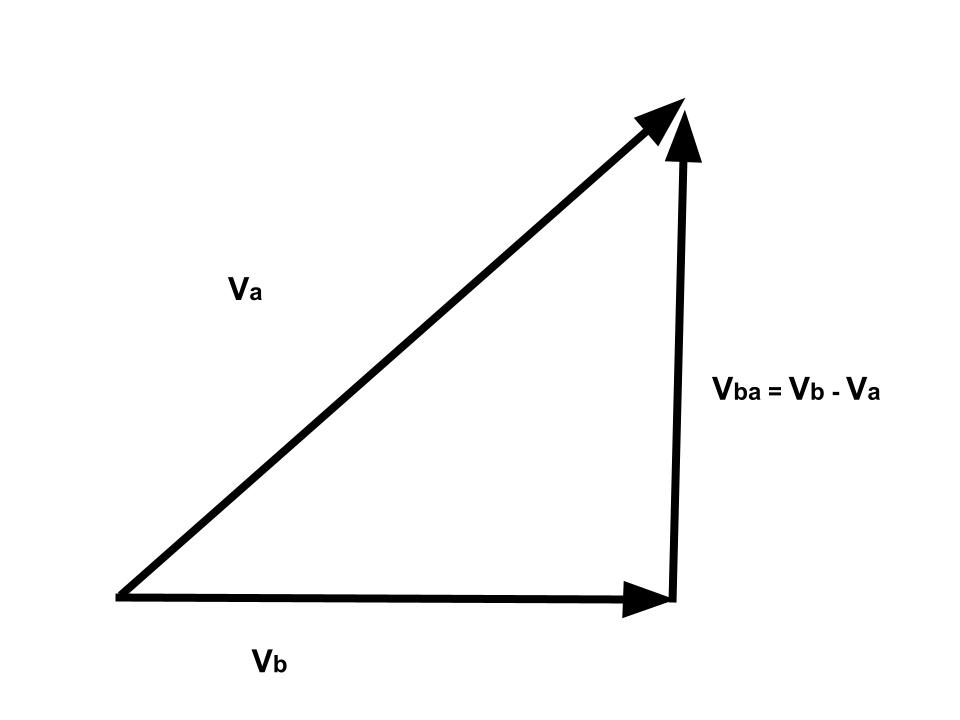
If **V aand **V brepresent the velocities of two bodies A and B respectively at any instant, then, the relative velocity of **A with respect to **B is represented by **V ab.
Then, **V ab = V a – V b ......(1)
Similarly, the relative velocity of B with respect to A is given by,
**V ba = V b – V a ......(2)
So, from the equations (1) and (2), we can write
**V ba = – V ab
**This implies that
**Relative velocity of A with respect to B = - Relative velocity of B with respect to A
Henceforth, the magnitude of both relative velocities are equal to each other.
**Do you Know ?
Relative velocity is that when two objects are moving towards each other, their relative velocity is the sum of their individual velocities, not the difference. This is because their speeds combine as they close the gap, making the rate at which they approach each other faster than either would if they were stationary.
**Difference between velocity and relative velocity: The difference between velocity and relative velocity is that velocity is measured with respect to a reference point which is relative to a different point. While relative velocity is measured in a frame where an object is either at rest or moving with respect to the absolute frame.
**Dimension Unit of relative velocity: The dimension Unit of relative velocity is similar to the unit of velocity may be expressed as :
**[ **M 0 L 1 T -1 ].
**Case 1: Relative Velocity for two objects moving in the same direction with equal velocities.
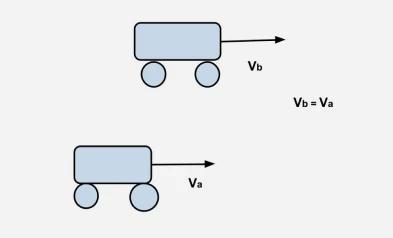
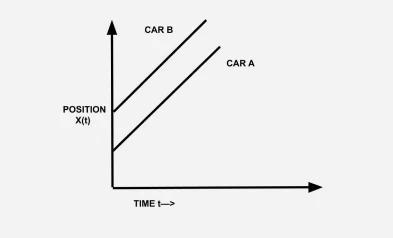
Let's now consider four different cases regarding relative motion. In the first case let us suppose two cars **A and B are moving in the same direction with equal velocities ****(Va = Vb)**. For a person seated in **A, the car **B would appear to be at rest, if he forgets for a moment the fact that he himself is in motion. Hence the velocity of **B relative to A is zero.
**V ba = V b – V a = 0 (as Va=Vb)
Similarly, in the case of a person seated in car B and observing car A. The relative velocity of A with respect to B is also zero.
**V ab = V a – V b = 0 (as Va=Vb)
So, if **V b – V a = 0, means the two cars are moving in the same direction and are keeping the same distance between them always. So their position-time graphs are two parallel straight lines.
**Case 2: Relative velocity for two objects starting from the same point and moving in the same direction with unequal velocities.
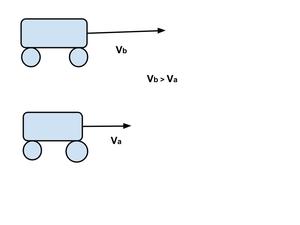
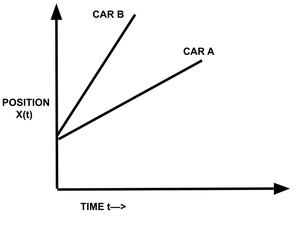
In this case let Car A is moving with a velocity V a and Car B,(starting from the same point or **X 1 (0)=X 2 (0), be moving with a greater velocity **V bin the same direction. Then, the person in **car A feels that **Car B is moving away from him with velocity,
**V ba = V b – V a
And for an observer in car B, car A appears to go back with a velocity,
**V ab **= V a -V b = – (V b – V a )
**Velocity of A with respect to B= - (Velocity of B with respect to A)
That is, the velocity of A relative to B is the negative of the velocity of B relative to **A.
**Case 3: Relative velocity for two objects starting from different positions and moving in the same direction with unequal velocities.
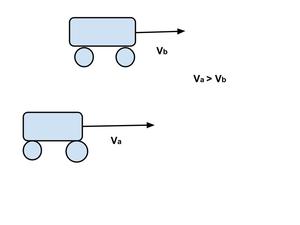
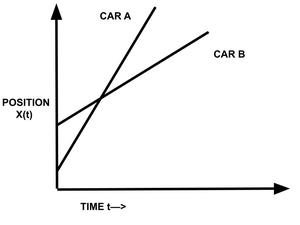
Here, V a > V b. If **Car A which is having the higher velocity and moving behind the **Car B, then **Car A will overtake the **Car B at some instant and the position-time graphs of the two cars will intersect at a point.
**V ab =V a -V b ≠0 and
**V ba =V b -V a ≠0 as V a > V b
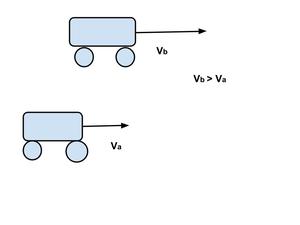
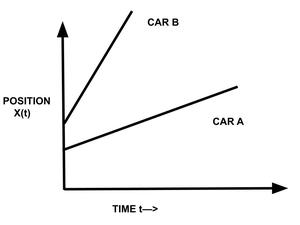
And **V b > V a . If the car with greater velocity(in this case **car B) is moving ahead, there is no chance of overtaking the other car A and hence the position-time graphs will not intersect, both the lines move far from each other as shown in the graph
**V ab =V a -V b ≠0 and
**V ba =V b -V a ≠0 as V b > V a
Clearly, If **V b – V a ≠ 0, means the two cars are moving with unequal velocities. Their position-time graphs are straight lines inclined to the time axis and one of them will be steeper than the other.
**Case 4: Relative velocity for two objects moving in the opposite direction.
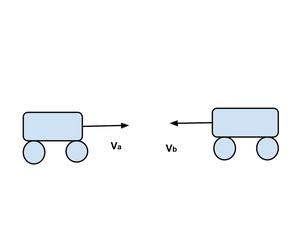
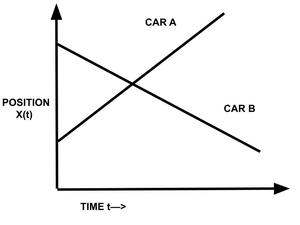
If both the cars are moving in opposite directions as shown in the figure, the relative velocity of **V baor **V abwill be,
**V ba =V b -(-V a ) = V b +V a,
Similarly,
**V ab =V a -(-V b ) = V a +V b
or
**V ab =V ba =V a +V b
It means, when two **cars A and B are moving in opposite directions each seems to go very fast relative to the other.
Examples of Relative Velocity
Let's clear the concept of relative velocity with the help of following examples:
**Example 1: Bus A travel with a speed of 40 m/s towards North and bus B travel with a speed of 60 m/s towards South. What is the relative velocity?
**Solution:
Speed of bus A= Va = 40 m/s (towards north)
Speed of bus B= Vb = 60 m/s (towards south)
As both the buses are moving in opposite direction, so relative velocity is:
Vab = Va - (-Vb)
= 40 - (-60)
= 100 m/s
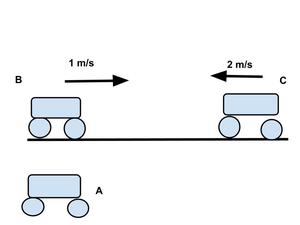
**Example 2: Two trucks, standing a few distances apart, start moving towards each other with speeds 1 m/s and 2 m/s along a straight road. What is the **speed with which they approach each other?
**Solution:
Let us consider that "A" denotes any truck at rest, "B" denotes first truck and "C" denotes second truck. The equation of relative velocity for this case is :
⇒ Vca = Vba + Vbc
Vba = 1m/s ,
Vca= 2m/s
Using,
Vbc = Vba + Vca
1m/s+2m/s
= 3 m/s
The two trucks are approaching each other with a relative speed of 3 m/s. This means that Truck C is closing in on Truck B at 3 m/s, and Truck B is closing in on Truck C at the same speed of 3 m/s. Therefore, we can say that the trucks are moving towards each other with a combined relative speed of 3 m/s.
**Example 3: Two cars, initially 900 m distant apart, start moving towards each other with speeds 1 m/s and 2 m/s along a straight road. When would they meet?
**Solution:
The relative velocity of two cars (say 1 and 2) is: **V 21 = V 2 -V 1
Let us consider that the direction V1 is moving in a positive direction.
Here, V1 = 1 m/s and V2 = -2 m/s. So, relative velocity of two cars (of 2 w.r.t 1) is : ⇒ V21 = − 2 − 1 = − 3 m / s
This means that car "2" is approaching car "1" with a speed of -3 m/s along the straight road.
Similarly, car "1" is approaching car "2" with a speed of 3 m/s along the straight road. Therefore,
So can say that two cars are approaching at a speed of 3 m/s. Now, let the two cars meet after time:
t = Displacement ⁄ Relative velocity
= 900/3 = **300 sec.
**Example 4: How long will a girl sitting near the window of a train travelling at 36 km h-1 see a train passing by in the opposite direction with a speed of 18 km/h? The length of the slow-moving train is 90 m.
**Solution:
Given : Velocity of train = Vt = 36 Km/h = 36 × 5/18 m/s = 10 m/s
Velocity of passenger moving in opposite direction = Vp = 18 Km/h = 18 × 5/18 m/s = 5 m/s
The relative velocity of the slow-moving train with respect to the girl is **V tp = V t - (-V p) = Vt + Vp
Vtp = (10 + 5) m/s = 15 m/s.
As the girl will watch the full length of the other train, to find the time taken to watch the full train:
Using relative speed = distance / time
15 = 90/t
t = 90/15
= **6 sec
**Example 5: A girl, moving at 3 km/hr along a straight line, finds that the raindrops are falling at 4 km/hr in the vertical direction. Find the angle with which raindrop hits the ground.
**Solution:
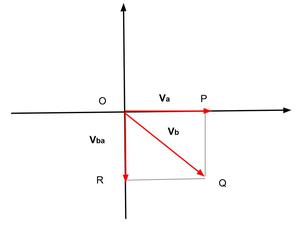
Let the girl be moving in the x-direction. Let us also denote girl with “A” and raindrop with “B”. we need to know the direction of raindrop with respect to ground=Vb.
Here Given
Va=3km/hr , Vb =? , Vba =4km/hr
Using equation, **V ba **= V b -V a
So V=Va+Vba
In ΔOQR, Angle with which rain drop hits the ground = ∠QOR = θ
So tanθ= Va/Vba
tanθ=3/4
Hence,
θ= tan-1(3/4)
or
**θ = 37°
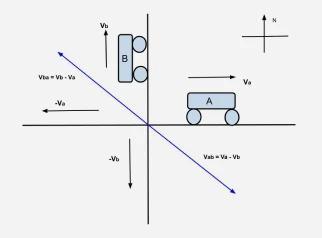
**Example 6: A bus starting from a point travels towards the east with a velocity of 3 m/s. Another bus starting from the point travels towards the north with a velocity. of 4 m/s. Find the magnitude of the relative velocity of one with respect to another.
**Solution:
Given that,
The Bus-A moves towards East with velocity = Va = 3 m/s
And Bus-B moves towards North with velocity = Vb =4 m/s
Now the relative velocity Vba of Bus-B with respect to Bus-A is towards the west of north direction as shown in the figure
Magnitude of Vba = √32+42 => Vba = 5 m/s
Similarly, relative velocity Vab of Bus-A with respect to Bus-B is towards the south of east direction as shown in the figure, so:
Magnitude of Vab = √42+32
Hence,
**V ab **= 5 m/s
Conclusion
Relative velocity refers to the speed at which one object moves in comparison to another, essentially describing how quickly one object is shifting from the viewpoint of the other. It is calculated by finding the difference in their velocities. This concept is crucial in different frames of reference, as the observed speed of an object can vary depending on the observer's position and movement. It helps to determine how fast two objects are approaching or separating from each other.
**Also Read,