Spherical Mirrors (original) (raw)
Last Updated : 9 May, 2026
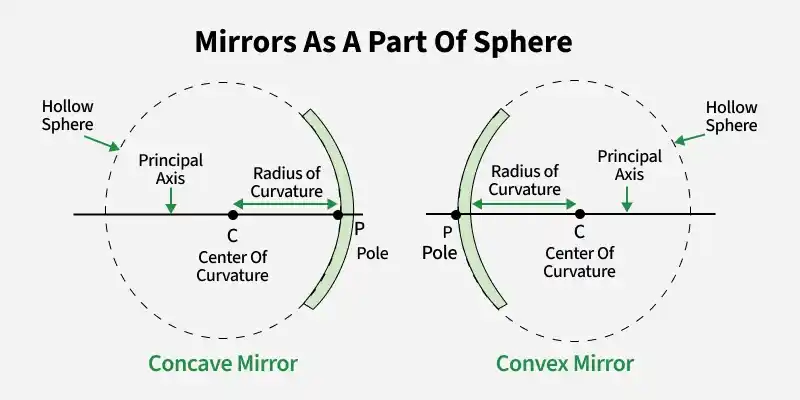
A spherical mirror is a mirror whose reflecting surface is a part of a hollow sphere. It is usually made of glass with a reflective coating (silver or aluminium) on one side and a polished surface on the other where reflection occurs.
There are two types of spherical mirrors: concave and convex mirrors.
A concave mirror reflects light from its inner curved surface, while a convex mirror reflects light from its outer curved surface.
The spherical mirror formula is a relation that describes how object distance (u) and image distance (v) are related to the focal length (f) of a spherical mirror. The spherical mirror equation is one of the most important relations in optics.
The spherical mirror formula is given as,
\frac{1}{f} = \frac{1}{v} + \frac{1}{u}
- f is the focal length
- v is the image distance
- u is the object distance
The focal length of the mirror is equal to half of the radius of curvature of the spherical mirror and is given by the relation:
f = \frac{R}{2}
- f is the focal length of the spherical mirror
- R is the Radius of Curvature of the spherical mirror
Magnification of the spherical mirror determines how smaller or bigger the image is formed after reflection from the spherical mirror. Magnification is given either by the ratio of image and object height or by the ratio of image and object distance of the mirror.
m = \frac{I}{O} = \frac{v}{u}
- I = Height of the Image formed
- O = Height of the Object
- v = image distance
- u = object distance
Basic Terminologies
There are some common terms that we need to know while studying spherical mirrors, and they are as follows:
- **Centre of Curvature (C): The center of the sphere of which the mirror surface is a part is called the center of curvature. It is represented by the letter **C.
- **Radius of Curvature (R): The distance between the pole (P) and the center of curvature (C) is called the radius of curvature. It is represented by R, and R = 2f.
- **Principal Axis: The imaginary straight line that passes through the pole and the center of curvature of a spherical mirror is called the principal axis. All distances are measured along this axis.
- **Pole (P): The geometrical center or midpoint of the spherical mirror is called the pole. It is represented by **P, and all distances are measured from this point.
- **Aperture: The diameter of the reflecting surface of a spherical mirror is called its aperture. It determines the size of the mirror.
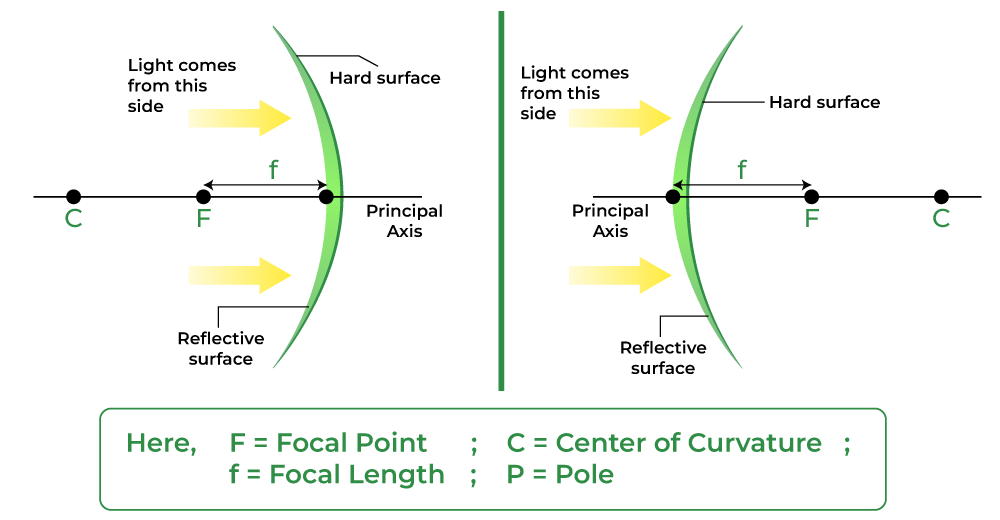
- **Principal Focus (F): The point on the principal axis where rays of light parallel to the principal axis converge (for concave mirrors) or appear to diverge (for convex mirrors) after reflection is called the principal focus.
- **Focus: Any point on the principal axis where light rays parallel to the principal axis converge or appear to converge after reflection from the mirror.
Structure of Spherical Mirrors
A spherical mirror can be a concave or a convex mirror depending upon the surface of the reflection. If it is bulged out, then it is a convex spherical mirror, whereas if it is bent inwards, it is termed as a concave spherical mirror. A typical spherical mirror is a part of a big sphere of which the cut-out has been taken. The following diagram describes different parts that are there in a spherical mirror. The definition of these parts is already given above.
Types of Spherical Mirrors
Spherical mirrors are of two types, namely:
- Concave Mirrors
- Convex Mirrors
1. Concave Mirror
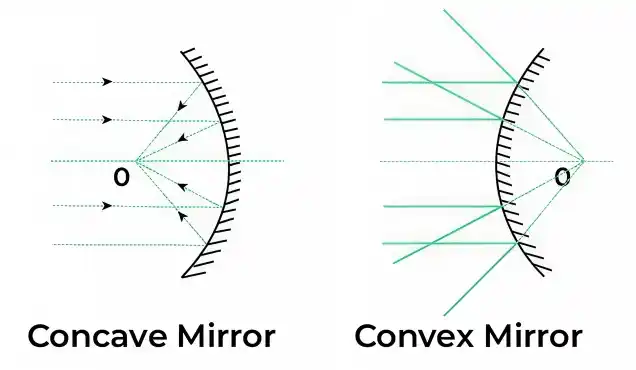
A concave mirror is a spherical mirror whose reflecting surface curves inward toward the center of the sphere. It is called a converging mirror because parallel rays meet at the focus after reflection. The inner surface of a spoon is an example. It can form real or virtual images depending on the object’s position.
**Uses of Concave Mirror
- Shaving mirrors, as they form enlarged images of the face for better visibility.
- Ophthalmoscope, for examining the inner parts of the eye.
- Astronomical Telescope, where large concave mirrors act as objective mirrors to collect light from distant stars.
- Headlights of automobiles, torchlights, and railway engines, where they act as reflectors to produce a strong parallel beam of light.
- Solar Furnace, to focus sunlight and generate high temperatures.
2. Convex Mirror
A convex mirror is a spherical mirror whose reflecting surface curves outward. Reflection occurs from the outward bulged surface. It is also called a diverging mirror because reflected rays spread out and form a virtual, erect, and diminished image.
**Uses of Convex Mirror
- Vehicles, where they are used as rearview mirrors to provide a wider field of view.
- Security mirrors are placed near ATMs, shops, and corridors to observe surroundings.
- Inside buildings and parking areas, to allow people to see a larger area at once.
- Streetlight reflectors to spread light over a wider region.
Sign Conventions
A set of rules that are used to set signs for terms like the object distance, image distance, focal length, etc., used in spherical mirrors for mathematical analysis during the image formation are called the Sign Conventions for Spherical Mirrors.
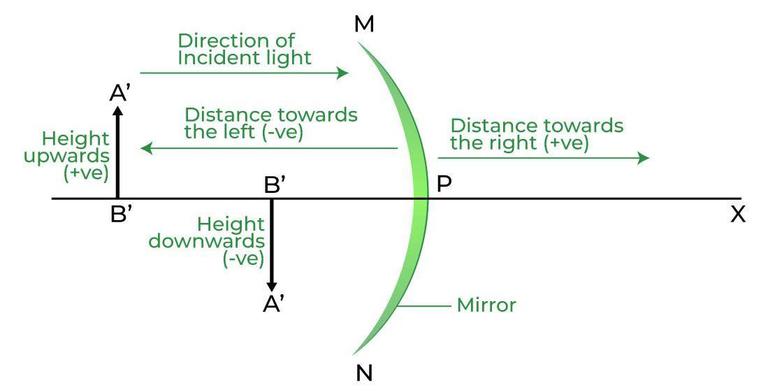
According to the sign convention for spherical mirrors:
- All distances are measured or taken from the pole of the spherical mirror.
- Objects are considered to be placed on the left side of the spherical mirror.
- The distances measured along the direction of the incident ray are taken as positive, while the distance measured along the direction of the reflected ray, or opposite, is taken as negative.'
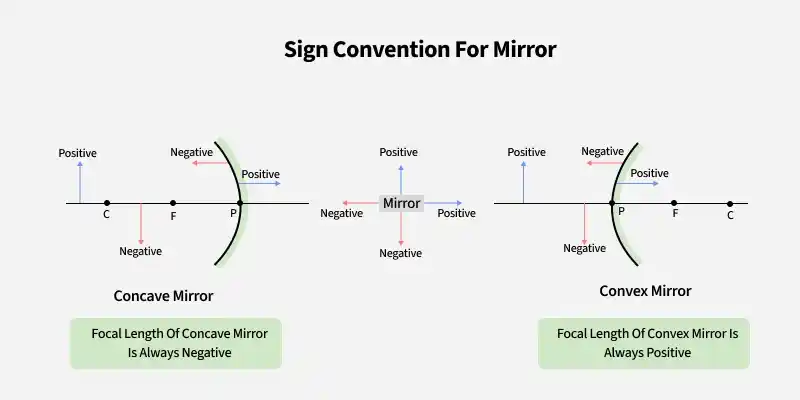
Image Formation
Images formed by any type of mirror can be found either where the reflected light appears to diverge from or where it converges. We have two types of spherical mirrors: concave and Convex Mirrors. The image formation in each type of mirror are:
| **Images Formed by Concave Mirrors | |||
|---|---|---|---|
| **Position of Object | **Ray Diagram | **Position of Image | **Nature of Image |
| **At Infinity (∞) | 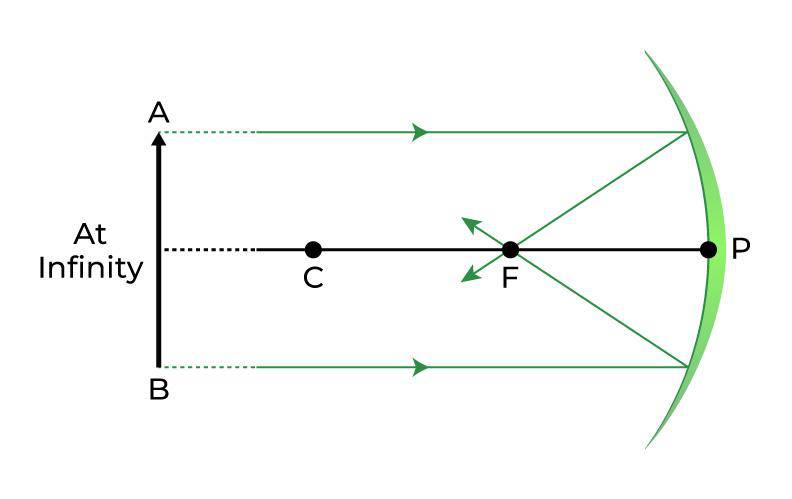 |
At the Principal Focus (F) | Real, inverted and extremely smaller in Size |
| **Beyond the Centre of Curvature (C) |  |
Between principal Focus (F) and Center of Curvature (C) | Diminished, Real and Inverted |
| **At the Centre of Curvature (C) | 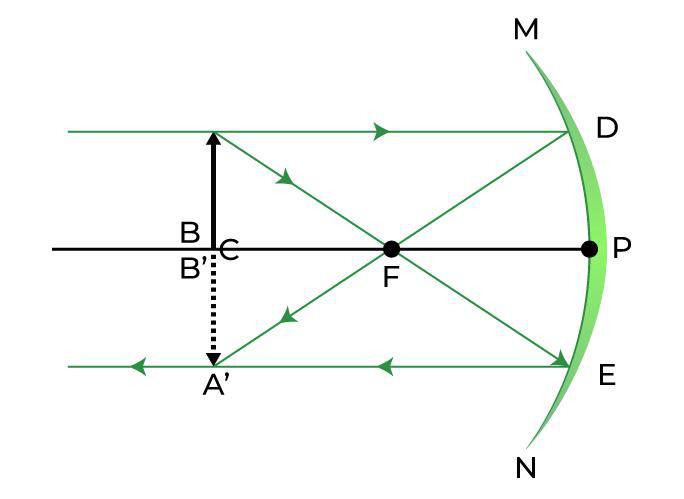 |
At the Center of Curvature (C) | Same size as the object, Real and Inverted |
| **Between Focus (F) and Center of Curvature (C) | 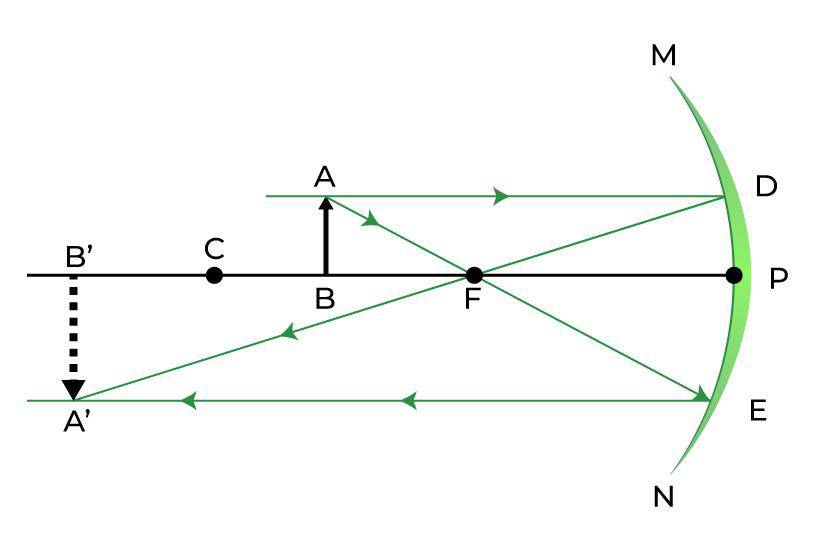 |
Beyond Center of Curvature (C) | Magnified, Real, and Inverted |
| **At the Principal Focus (F) | 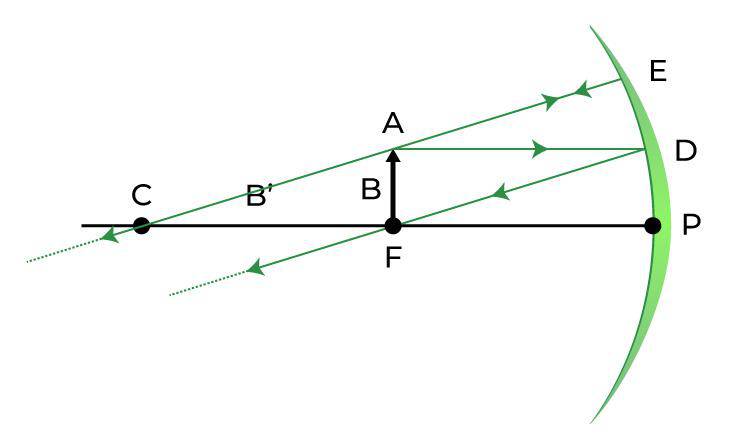 |
At Infinity ( ∞) | Highly Magnified |
| **Between the Pole (P) and Focus (F) |  |
Behind the Mirror | Magnified, Virtual, and Erect |
Properties of the Image formed by Concave Mirrors
- Point-sized image, highly diminished in size, real and inverted image.
- The parallel lines, which come from the very distant object at infinity, after striking the reflecting surface of the concave mirror, get reflected back and meet at a point, or, we can say in this case, converge at a point. This point is known as the principal focus of the concave mirror.
| **Images Formed by Convex Mirrors | |||
|---|---|---|---|
| **Position of Object | **Ray Diagram | **Position of Image | **Nature of Image |
| **At Infinity ( ∞) |  |
Behind the mirror at Principal Focus (F) | Highly Diminished, Virtual, and Erect |
| **Between infinity and pole (P) of the mirror |  |
Between Pole (P) and Focus (F), behind the mirror | Highly Diminished, Virtual, and Erect |
Properties of the Image formed by Convex Mirrors
- The image formed is highly diminished in size, virtual, and erect.
- The parallel lines that come from the very distant object at infinity after striking the reflecting surface of the convex mirror get reflected back and appear to meet at a point, or we can say in this case diverge from the surface and appear to meet at a point. This point is known as the principal focus of a convex mirror.
Uses
- Concave mirrors are used in torch headlights to disperse light over a larger surface, hence enhancing the field of vision.
- Convex mirrors are used in a car's rearview mirror, as they give a wider field of view that helps the driver to see most of the traffic behind him.
- Concave mirrors are used in telescopes, satellite dishes, and by dentists and ENT specialists to create images of the teeth, ears, skin, and other body parts that are larger than the actual.
Solved Problems
**Question 1: An object is placed 20 cm in front of a concave mirror whose focal length is 10 cm. Find the image distance.
**Solution: Given
\text{f = −10 cm (concave mirror)}
\quad u=-20\,cm
Mirror formula
\frac{1}{f}=\frac{1}{v}+\frac{1}{u}
\frac{1}{-10}=\frac{1}{v}+\frac{1}{-20}
\frac{1}{v}=-\frac{1}{10}+\frac{1}{20}
\frac{1}{v}=-\frac{1}{20}
v=-20\,cm
**Question 2: An object of height 5 cm forms an image of height 10 cm in a spherical mirror. Find the magnification.
**Solution: Given
\text{I = 10\,cm}
\quad O=5\,cm
Magnification formula
m=\frac{I}{O}
m=\frac{10}{5}\text{= 2}
\text{Magnification = 2 (image is magnified)}
**Question 3: The radius of curvature of a spherical mirror is 40 cm. Find the focal length.
Solution: Given
R = 40 cm
Relation between focal length and radius of curvature
f=\frac{R}{2}
f=\frac{40}{2}=20\,cm
Focal length = 20 cm.
**Question 4: An object of height 4 cm is placed 30 cm in front of a concave mirror whose focal length is 15 cm. Find the position of the image and the height of the image.
**Solution: Given
\text{f = -15\,cm}
\quad u=-30\,cm
Mirror formula
\frac{1}{f}=\frac{1}{v}+\frac{1}{u}
\frac{1}{-15}=\frac{1}{v}+\frac{1}{-30}
\frac{1}{v}=-\frac{1}{15}+\frac{1}{30}
\frac{1}{v}=-\frac{1}{30}
v=-30\,cm
Now magnification
m=\frac{v}{u}
m=\frac{-30}{-30}=1
Image height
I=m \times O
I=1 \times 4=4\,cm
Image is formed 30 cm in front of the mirror, and the image height is 4 cm (real and inverted).
Unsolved Problems
**Question 1: An object is placed 24 cm in front of a concave mirror whose focal length is 12 cm. Find the image distance and magnification.
**Question 2: A convex mirror has a focal length of 20 cm. If an object is placed 40 cm in front of the mirror, determine the position of the image.
**Question 3: An object of height 6 cm is placed 30 cm in front of a concave mirror with focal length 15 cm. Find the image distance and height of the image.
**Question 4: The radius of curvature of a spherical mirror is 50 cm. An object is placed 30 cm in front of the mirror. Calculate the focal length and image distance.
**Question 5: An object is placed 10 cm in front of a concave mirror with a focal length of 15 cm. Find the image distance and state the nature of the image