Superconducters (original) (raw)
Last Updated : 23 Jul, 2025
Superconductors are those elements that conduct electricity without resistance after they become colder than a particular temperature, which is also called "critical temperature". At this temperature, electrons move freely through the material hence they become superconductors.
Ordinary conductors, such as copper gradually get more conductive with a decrease in temperature but superconductors like metals mercury get conductive all at once, after the critical temperature. This is also called phase transition.
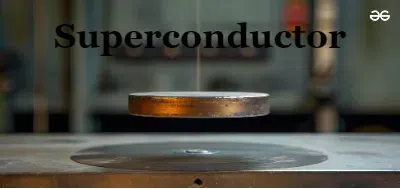
In this article, we will study superconductor definitions, types of superconductors, properties of superconductors, working of superconductors, applications of superconductors and others in detail.
Table of Content
- What is Superconductor?
- Working of Superconductors
- Superconductor Examples
- Superconductor Graph
- Types of Superconductor
- Properties of Superconductors
- Application of Superconductors
What is Superconductor?
A specific type of conductors which behave differently when temperature decreases are said to be superconductors like metals mercury and lead, ceramics and organic carbon nanotubes. We can understand superconductivity by understanding what happens when temperatures are decreased to a certain point, also called a critical point. High magnetic fields destroy superconductivity and restore the normal conducting state.
Superconductor Definition
A superconductor is defined as an element that at, or below critical temperature has no resistance.
Some elements like mercury at critical temperature (the point where resistance becomes zero) allow electricity to pass through them without any resistance, these elements are named superconductors. Other conductors gradually decrease their resistance, but superconductors after critical temperature instantly drop resistance to zero.
Critical Temperature for Superconductors
Electrical resistivity of metals falls to zero when the temperature is decreased at a specific point, this is called the critical temperature, the point where ordinary metals get superconductive properties. This temperature can be different for various superconductors metals. At normal temperatures or above critical temperature, superconductors behave as normal conductors.
**Superconductor at Room Temperature
Electrons of ordinary conducting metals when temperature is decreased below critical temperature, start forming bonds which is known as Cooper pairs. These pairs help electricity to flow through the metal smoothly. When the temperature is increased, these bonds break and the metal starts resisting current as usual and loses its superconductive properties.
Working of Superconductors
Superconductors are ordinary conductors at normal temperatures, when the temperature goes below a certain temperature, also called critical temperature, superconductors start forming cooper bonds and these bonds help them provide zero resistance, once the temperature increases these cooper bonds break and they loose their superconductive properties.
Superconductor Examples
Twenty-Seven Metal elements are superconductors at low temperature. Some of the metals that have superconductive properties are, **aluminium, niobium, magnesium diboride, cuprates such as yttrium barium, copper oxide and iron pnictides.
At standard atmospheric pressure, **cuprates is known to be the best superconductor, getting superconductivity at temperature −135 °C. **Magnesium diboride is a high temperature superconductor.
| Name of Superconductor | Critical Temperature |
|---|---|
| Aluminium | 1.2 K |
| Magnesium Diboride | 39 K |
| Niobium | 9.25 K |
| Indium | 3.4 K |
| Yttrium Barium | 93 K |
| Mercury | 4.2 K |
| Copper Oxide | 30K |
Superconductor Graph
Graph of superconductors shows instant drop in resistance after critical temperature. The graph of superconductor and ordinary conductors moves similar until critical point, after this temperature the normal conductor moves in the same way while superconductors show no resistance properties.
This change at critical temperature in superconductors is also called phase transition. The graph of super conductor is added in the image below:

Superconductor Graph
Types of Superconductor
Superconductors are classified into two types:
- Type-I
- Type-II
Type-I Superconductors
A Dutch physicist first observed the phenomenon of superconductivity in 1911 in mercury. Generally, Type- I superconductors have critical temperatures between 0.000325 °K and 7.8 °K. They need extreme pressure and low temperature. Also, these types of superconductors have perfect diamagnetism and conductivity.
Type-II Superconductors
An American physicists John Bardeen, Leon Cooper, and John Schrieffer first observed the phenomenon of superconductivity in 1957 in niobium-germanium. They are generally referred to as High temperature superconductors. Type II superconductors, like lead or copper compounds, work at higher temperatures than Type I. Unlike Type I, they can handle magnetic fields, making them useful for things like medical imaging and power systems.
You can also check the difference between Type-I and Type-II Superconductor to know more about it.
Properties of Superconductors
Superconductors have some unique properties after critical temperatures, that makes them work like superconductors. Some of the properties of superconductors are listed below,
- **Transition Temperature: Also known as critical temperature, below this point metals get their superconductive properties. Superconductors start forming cooper pairs which help reduce resistance to zero.
- **Zero Electric Resistance: Superconductors offer zero electric resistance, which is also called infinite conductivity. Even Good Conductors have some resistance, but superconductors have no resistance to current.
- **Messier Effect: Superconductors hate magnetic field, hence they exhibit expulsion of magnetic field. This is also defined as Messier Effect (perfect diamagnetism)
- **Critical Magnetic Effect: At this point, superconductors start losing their special zero resistance power and behave as normal conductors.
Advantages of Superconductors
Various advantages of the superconductors are:
- Superconductors offer no resistance at critical temperature, hence it offers no energy loss.
- Ideal for storing heavy energy.
- Ideal for transferring high energy effectively.
- Low power loss and High speed operation.
Disadvantages of Superconductors
Various disadvantages of the superconductors are:
- Superconductors have a Need of low temperature to get superconductive properties, as a consequence it has high operational cost.
- Superconductor are mostly brittle, hence they are hard to shape.
- In presence of magnetic field at a certain range, superconductors lose its properties.
Application of Superconductors
Some application of superconductors are:
- Generation and transmission of electric power as they have zero resistance.
- Medical diagnosis where MRI is needed.
- Making of Supercomputers
- Magnetic Energy storage Devices.
- High power transmission lines and Superconducting transformers.