System of Units (original) (raw)
Last Updated : 12 Dec, 2025
A unit is the standard measurement for a physical quantity, defined by both its kind and magnitude.
- Units provide a consistent framework for comparing and quantifying physical phenomena in science, technology, and daily life.
- The "number of units" refers to how many times the unit occurs in a given amount of that quantity.
- There are several systems of units, but the most commonly used are the **International System of Units (SI) and the **Imperial System.
- The **SI system is the modern form of the metric system and is widely used in science, engineering, and most countries around the world. It includes seven base units (such as meters for length, kilograms for mass, and seconds for time), which are used to derive other units for more complex measurements.
- The imperial system is a measurement system that includes units such as inches, feet, pounds, and gallons.
In science and engineering, there are two types of units commonly used.
1. The Fundamental Units
Fundamental units are the core, independent units used to measure physical quantities such as length, mass, and time. They are not derived from other units and serve as the foundation for defining all other units of measurement within a system, such as the SI system.
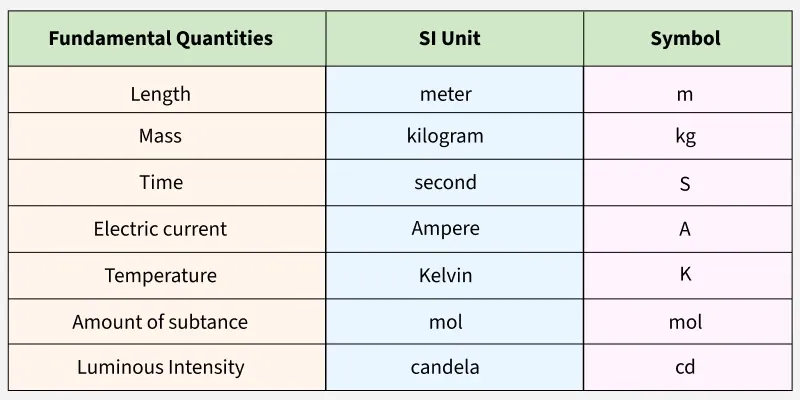
Fundamental Units
- Each fundamental unit represents a basic and universally recognized physical quantity that does not rely on any other unit for its description.
- These units are used to define derived units, which are combinations of fundamental units to measure more complex quantities like speed (meters per second) or force (kilograms meter per second squared).
There are two other supplementary fundamental units, namely **Radian and **Steradian are two supplementary which measures plane angle and solid angle respectively.
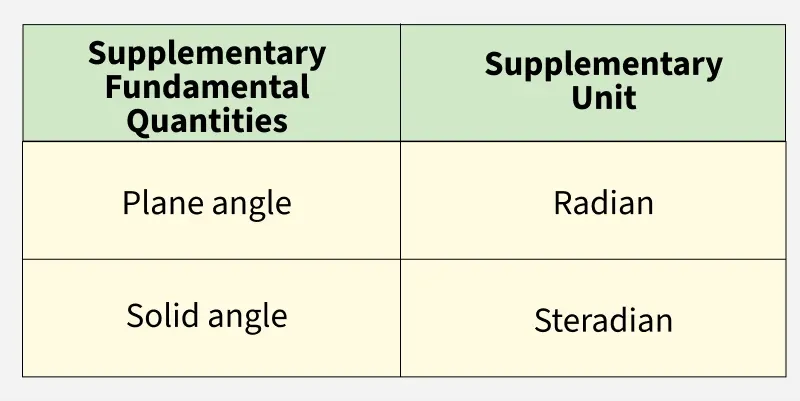
Supplementary Fundamental Units
2. The Derived Units
Derived units are those that can be expressed in terms of fundamental units. Every derived unit is originated from some physical law defining that unit. These units are essential for measuring more complex physical quantities. There are several steps involved in deriving a unit.
**Step -1: Identify the formula for the quantity.
**Step -2: Substitute the units of all involved quantities in the same system.
**Step -3: Simplify the expression to obtain the final derived unit.
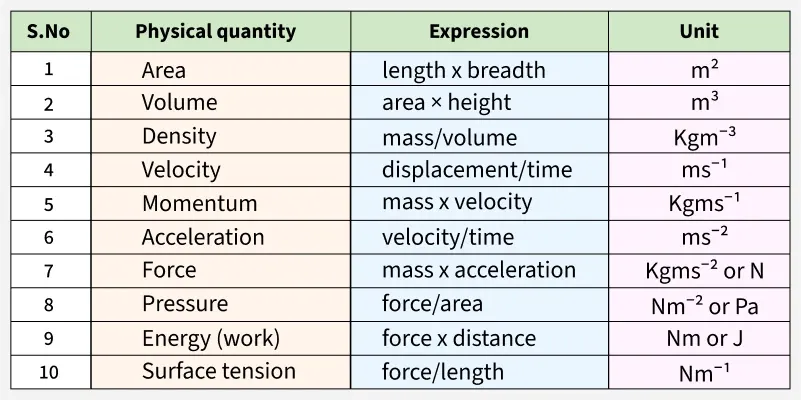
Derived Units
- Derived units are created by combining fundamental units, allowing for the measurement of more specific physical phenomena like velocity, force, and energy.
- Derived units can be expressed through mathematical formulas, making them versatile for a wide range of scientific and engineering applications.
English System of Units
The English system of units uses the foot (ft), pound-mass (lb), and second (s) as the three fundamental units for length, mass, and time, respectively. Below is a table listing some common conversion factors from the English system to SI units.
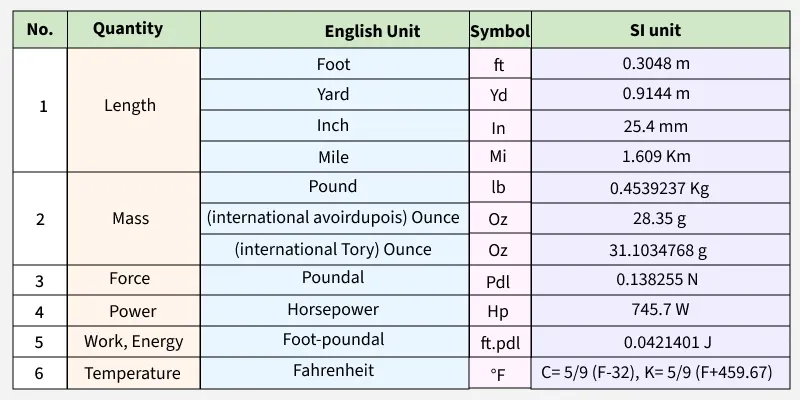
English System of Units
Measurement Standards
Generally, there are four levels of measurement standards:
1. International Standards
An international standard of measurement ensures that units like length, weight, and time are consistent worldwide, with the highest possible accuracy. These standards are regularly checked to maintain uniformity across the globe.
2. Primary Standards
Primary standards are maintained by national laboratories worldwide, such as the National Bureau of Standards (NBS) in Washington and the National Physical Laboratory (NPL) in the UK. These standards represent fundamental and some derived units, with their main role being the verification and calibration of secondary standards.
3. Secondary Standards
A secondary standard is a reference standard calibrated against a primary standard. It is used to check the accuracy of working standards and instruments in laboratories and industries. Essentially, it serves as an intermediary to ensure the reliability of measurements taken with less precise equipment.
4. Working Standards
A working standard is a measurement standard used in laboratories and industrial environments for routine calibration, quality control, and instrument verification. It is a step below secondary standards and helps ensure the accuracy and consistency of measurements in everyday operations.
Sample Problems
**Problem 1. Convert the unit of G, which is gravitational constant, G = 6.67 x 10 -11 Nm 2 /kg 2 in CGS system.
**Solution:
Since, we have
G = 6.67 x 10⁻¹¹ Nm2/kg2
Converting kg into grams, 1 kg = 1000 gms
= 6.67 x 10-11 x 108 x 103 cm3/ g2. s2
= 6.67 x 108 cm3/g2. s2
**Problem 2. Name the S.I units of the following commodities :
**a. Pressure
**b. Solid angle
**c. Luminous intensity.
**Solution:
a. Pascal
b. Steradian
c. Candela
**Problem 3. Derive the S.I unit of latent heat.
**Solution:
Latent heat = \frac{Heat energy}{Mass}
Latent\space Heat = \frac{Q}{m} \\ =\frac{ kg m^2 s^{-2}}{kg} \\ = m^2 s^{-2}
**Problem 4: How are A 0 **and A.U related?
**Solution:
Describing both quantities in terms of meters,
Ao = 10-10m
and 1 A.U. = 1.4961011m.
Therefore,
1 A.U. = 1.496 x 1011 x 1010 A0
1 A.U = 1.496 x 10²¹ A0
**Problem 5: Describe 1 light-year in meters.
**Solution:
A light-year is a distance travelled by light in 1 year with the speed of light :
= 9.46 x 10¹⁵ m