Types of Radioactivity (original) (raw)
Last Updated : 12 Mar, 2026
Radioactivity occurs when unstable atomic nuclei release energy in the form of radiation. This process involves three main types of decay: alpha, beta, and gamma. Each type of decay has unique characteristics, affecting how it interacts with matter. This radiation is emitted through three primary types of decay: alpha, beta, and gamma. Here, we will explore the different types of radioactivity, focusing on the three most common forms—alpha, beta, and gamma decay.
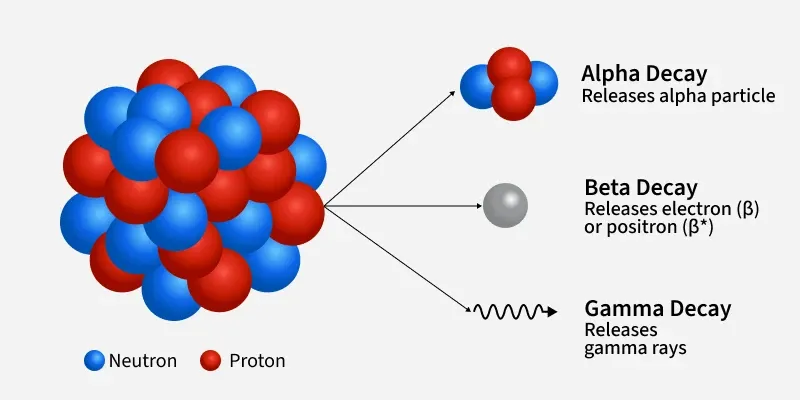
Alpha, Beta and Gamma Decay
During natural radioactive decay, three common types of emissions were first observed. At that time, scientists were unable to identify them as known particles and gave them the following names:
- Alpha particles (α)
- Beta particles (β)
- Gamma rays (γ)
These names were chosen based on the first three letters of the Greek alphabet. Over time, it was discovered that alpha particles are actually helium-4 nuclei, beta particles are electrons, and gamma rays are a high-energy form of electromagnetic radiation, similar to X-rays but far more intense and potentially more harmful to living organisms.
- Radioactivity was discovered by Henry Becquerel in 1896 while studying uranium salts.
- Pierre and Marie Curie later identified radium as a new radioactive element.
- Examples of radioactive elements include uranium, radium, thorium, and neptunium.
- The radioactivity of a substance cannot be controlled by physical factors (pressure, temperature, or electric/magnetic fields) or chemical changes.
- Elements with an atomic number greater than 82 are naturally radioactive.
- The process of converting lighter elements into radioactive elements through the bombardment of fast-moving particles is called artificial or induced radioactivity.
- Radioactivity is a nuclear process, not an atomic one, so the electronic configuration of an atom is unrelated to its radioactivity.
- When radiation passes through an external electric field, it splits into three parts: alpha rays, beta rays, and gamma rays.
Ionizing and Penetration Ability of Radiation
- **Alpha particles are the heaviest, with about 4 times the mass of a proton or neutron and **8,000 times that of a beta particle. Their large mass grants them the highest ionizing power, making them effective at damaging tissue. However, their size limits their ability to penetrate matter; they can be stopped by paper, clothing, or the outer layer of skin. The threat arises when alpha emitters are inhaled or ingested.
- **Beta particles are smaller than alpha particles, so they have less ionizing power, but their small size allows for greater penetration. Beta particles can be stopped by a sheet of aluminum. The primary danger comes from internal exposure.
- **Gamma rays are a form of electromagnetic radiation with no mass or charge. They have the greatest penetration power and can pass through the human body, requiring dense shielding (like lead) to block them. They have the lowest ionizing power compared to alpha and beta radiation.
| Particle | Symbol | Mass | Penetrating Ability | Ionizing Ability | Shielding |
|---|---|---|---|---|---|
| Alpha | α | 4 amu | Very Low | Very High | Paper, Skin |
| Beta | β | 1/2000 amu | Intermediate | Intermediate | Aluminum |
| Gamma | γ | 0 (Energy only) | Very High | Very Low | 2 inches of Lead |
Modes of Nuclear Decay
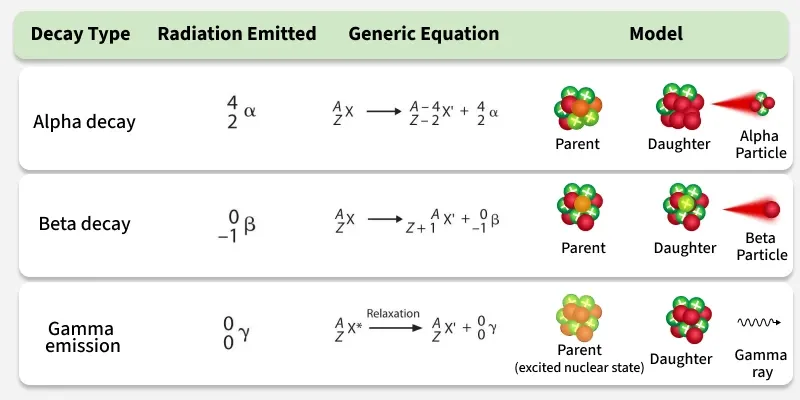
Modes of Nuclear Decay
1. Alpha (α) Decay
Alpha decay is the spontaneous emission of an alpha particle (α) from a radioactive nucleus. This process occurs when an unstable nucleus emits an alpha particle, which consists of 2 protons and 2 neutrons, also known as a helium-4 nucleus (²He⁴). The emission of an alpha particle reduces the atomic number (Z) by 2 and the atomic mass (A) by 4, resulting in the transformation of the original nucleus into a different (daughter) nucleus.
For example:
88Ra226 ⇢ 86Rn222 + 2He4
92U238 ⇢ 90Th234 + 2He4
94Pu242 ⇢ 92U238 + 2He4
**Properties of Alpha Decay:
- Alpha particles have a charge of +2e and a mass of 4 atomic mass units (4u).
- The typical kinetic energy of an alpha particle is around 5 MeV (million electron volts).
- Alpha emission occurs primarily in large, unstable nuclei that are too massive to be stable. These nuclei emit alpha particles to reach a more stable state.
- Nearly 90% of the 2,500 known radioactive nuclides decay with alpha or beta emissions.
- Alpha decay is influenced mainly by the strong nuclear force (which holds the nucleus together) and the electromagnetic force (which governs the repulsion between protons).
- Alpha decay is typically observed in heavy elements like uranium, radium, and thorium, and the emission helps these large nuclei decrease their size, moving them toward greater stability.
2. Beta (β) Decay
Beta decay is the spontaneous emission of beta particles from a radioactive nucleus, allowing the nucleus to achieve greater stability. In beta decay, either a neutron is converted into a proton or a proton is converted into a neutron.
The general reaction for beta decay is given as
ZXA→Z+1YA+β−+νˉe
In this reaction, a beta-minus particle (β⁻) is emitted, consisting of an electron (−1e0) and an antineutrino (νˉe).
Beta decay can be of three types:
- Beta-minus (β-)
- Beta-plus (β+)
- Electron capture.
**1. Beta-minus (β-) Decay
- In beta-minus decay, a neutron inside the nucleus is converted into a proton and an electron (beta particle).
- This type of decay occurs in nuclei with an excess of neutrons (where the neutron-to-proton ratio, N/Z, is too high).
- The reaction is as follows:
n→ p + β−+ νˉe
In this process, a neutron decays into a proton, resulting in a decrease of one neutron (N), an increase of one proton (Z), and no change in the atomic mass (A).
**2. Beta-plus (β+) Decay
- In beta-plus decay, a proton is converted into a neutron and a positron (β+).
- This occurs in nuclei with too many protons, meaning the ratio of neutrons (N) to protons (Z) is too low.
- The reaction for this is
p → n + β+ + νe
In this process, a neutron is converted into a proton, causing an increase of one neutron (N), a decrease of one proton (Z), and no change in the atomic mass (A).
**3. Electron Capture
Electron capture is a process in which the nucleus absorbs an inner orbital electron, and a proton in the nucleus is converted into a neutron, emitting a neutrino in the process.
The reaction is
p+e−→n+νe
**Properties of Beta Decay
- The beta-minus particle (β−) has the same mass as an electron and carries a negative charge.
- The beta-plus particle (β+) has the same mass as an electron but carries a positive charge (positron).
- In beta-minus decay, the emission is accompanied by an antineutrino (νˉe), and in beta-plus decay, the emission is accompanied by a neutrino (νe).
- Antineutrinos and neutrinos are massless and chargeless, with a spin of 1/2.
- The emission of a neutrino or antineutrino helps conserve angular momentum during the beta decay process.
- In beta-minus decay, the neutron transforms into a proton, and the atomic number (Z) increases by 1, while the atomic mass (A) remains unchanged.
- In beta-plus decay, the atomic number (Z) decreases by 1, and the atomic mass (A) remains the same.
- Neutrinos (νe) and antineutrinos (νˉe) are not "massless and chargeless" in the strictest sense, but they are extremely light and do not carry electric charge.
- Electron capture is more common in heavier elements because the electrons are more tightly bound, making it easier for them to be absorbed by the nucleus.
**3. Gamma (γ) Decay
Gamma decay is the spontaneous emission of high-energy photons (gamma rays) from a radioactive nucleus. This process occurs when an unstable nucleus in an excited state transitions to a lower energy state or ground state by emitting a gamma-ray photon. Gamma decay typically follows the emission of alpha or beta particles, as the daughter nucleus may be left in an excited state.
For example:
82Pb210 ⇢ 83Bi210* + -1e0 + Antineutrino
83Bi210* ⇢ 83Bi210 + γ-ray
**Properties of Gamma Decay
- Gamma photons have no charge and no rest mass.
- The energy of gamma rays typically ranges from 100 keV to several MeV.
- Gamma emission occurs after the nucleus has undergone alpha or beta decay and is in an excited state.
- Gamma rays are electromagnetic radiation, like X-rays, but with higher energy.
- Gamma decay is governed by the electromagnetic force and is often observed in nuclei of heavy elements that are in an excited state after alpha or beta decay.
- Gamma rays are highly penetrating and can pass through most materials, requiring thick shielding (such as lead or concrete) to be blocked effectively.
- Gamma decay plays an important role in helping the nucleus reach a more stable state after other forms of radioactive decay.