Atomic Mass (original) (raw)
Last Updated : 8 Apr, 2026
Atomic mass is the total mass of all subatomic particles of an atom, including protons, neutrons, and electrons. However, the mass of electrons is incredibly small, so it's typically neglected when determining an atom's overall mass.
The unit commonly used to express atomic mass is the Atomic Mass Unit (AMU) and dalton, a non-SI unit. One dalton is equivalent to one-twelfth of the mass of a carbon-12 atom at rest in its ground state.
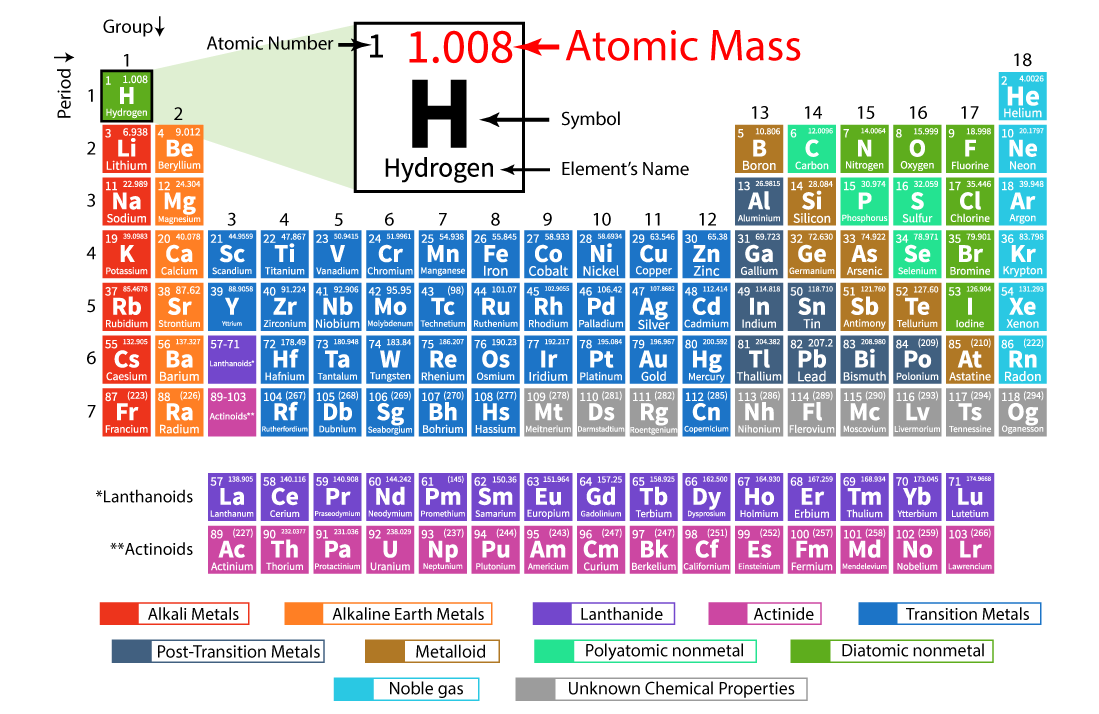
- Atomic mass of an element is a measure of the average mass of its atoms.
- It is expressed in atomic mass units (AMU).
- It is defined as the total mass of one atom of that element.
- The average mass of an element's atoms expressed in atomic mass units is known as its atomic mass (amu, also known as daltons, D).
**Atomic Mass Unit
- An atomic mass unit (amu) is a unit of mass used to express atomic and molecular mass.
- It is defined as one twelfth (1/12) of the mass of an unbound neutral atom of carbon-12 in its nuclear and electronic ground state.
- It is equivalent to approximately 1.66053906660 × 10⁻²⁷ kilograms.
**Mass Number
- The total number of protons and neutrons in an atom's nucleus is known as the mass number.
- Consequently, an atom of carbon will have an exact mass of 12 if its nucleus contains 6 protons and 6 neutrons.
- The difference between the mass number and the atomic mass of an element is that a mass number is a whole number obtained by the addition of a number of protons and neutrons.
- While the atomic mass, or atomic weight, is the average number of protons and neutrons in an element for all of its isotopes.
Mass Number = Number of Protons + Number of Neutrons
**Example:
**Carbon–12 (¹²C)
Protons = 6
Neutrons = 6A= 6+6 =12
So, the mass number of carbon–12 is 12.
Calculate Atomic Mass
- **By looking up the atomic mass on the periodic table- In the periodic table, the digit of an atomic mass is usually marked under the representation of an element. Like Hydrogen 1u and Helium 3u.
- **Adding the Mass of Protons and Neutrons - The total number of protons and neutrons in an atomic nucleus gives the mass number.
- **Weighted Average for All Atoms of an Element - The weighted average of each element's isotopes, grounded in nature by their abundance, is the atomic weight of that element.
These recommendations can be used to calculate the atomic mass of the component. A list of isotopes with natural abundance and mass is given a percentage or decimal value. Each isotope's abundance is multiplied by its mass. Divide the solution by 100 and add the findings if isotope abundance is present. - **Formula:
\text{Atomic Mass} = \frac{(m_1 \times a_1) + (m_2 \times a_2) + (m_3 \times a_3) + \dots}{100}…
Where:
- m = mass of isotope
- a = percentage abundance
Atomic Mass and Atomic Number
| **Atomic Number (Z) | **Atomic Mass |
|---|---|
| Number of protons present in the nucleus of an atom. | Average mass of atoms of an element. |
| Z | Generally written as atomic mass (A) |
| Identity of an element | Mass (weight) of an atom |
| Only number of protons | Protons and Neutrons (mainly) |
| No unit (just a number) | Atomic mass unit (amu or u) |
| Always a whole number | Usually a decimal number |
| Same for all isotopes | Different for different isotopes (average value taken) |
| Determines position of element | Written below the symbol but does not decide position |
| 6 | 12.011 u |
Fractional Atomic Mass
- Fractional atomic mass refers to the average mass of an element's isotopes relative to the mass of a carbon-12 atom, which is assigned a mass of exactly 12 atomic mass units (amu).
- The fractional atomic mass takes into account the relative abundances of the isotopes of an element found in nature.
- Since many elements exist as a mixture of isotopes, each with its own mass and abundance, the fractional atomic mass provides a weighted average of these isotopic masses.
- For example, carbon has two stable isotopes: carbon-12 and carbon-13, with natural abundances of approximately 98.9% and 1.1%, respectively.
- To calculate the fractional atomic mass of carbon, one would consider the mass of each isotope weighted by its abundance:
**Example:
Fractional Atomic Mass of Carbon = (0.989 × 12) + (0.011 × 13)
= 12.011 u