Uniform and NonUniform Motion (original) (raw)
Last Updated : 8 Apr, 2026
In physics, motion is defined as the change in position of a body relative to its surroundings over time. In short, an object is in motion if its position changes over time.
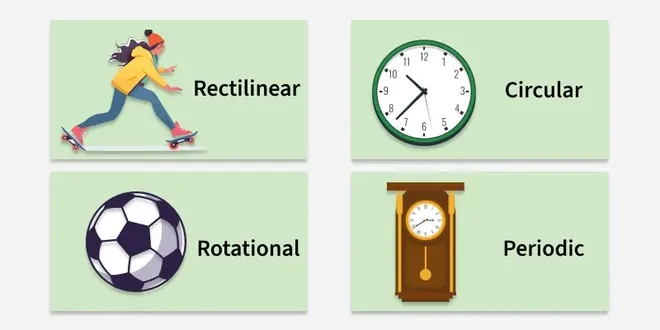
Common Types of Motion
**Some Types of Motion are:
- **Linear motion: Motion that follows a straight linear path.
- **Oscillatory motion: Motion that an object does by repeating the same movement again and again.
- **Rotational motion: Motion where an object moves along a circular path about a fixed axis.
- **Periodic motion: Motion repeated in equal intervals of time.
**Note: Uniform motion and non-uniform motion describe motion based on how an object covers distance with time.
Uniform Motion
Uniform Motion of a body can be defined as the motion of an object in which it covers equal distances in equal intervals of time without any change in speed or direction. As the body is moving in rectilinear motion with a constant velocity (v = const), the acceleration of the body is zero (a = 0).
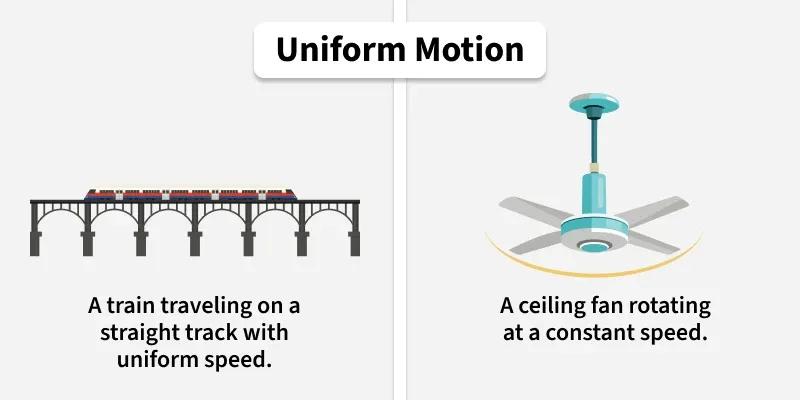
If an object moves along a straight line covers equal distances in equal intervals of time, then it is said to be in uniform motion along a straight line.
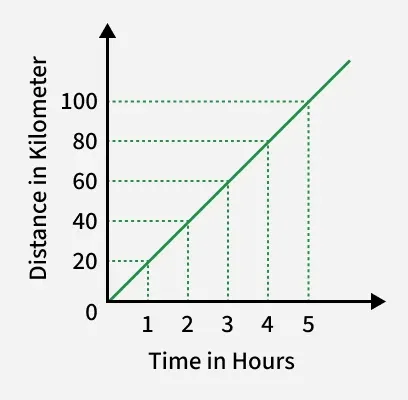
Uniform Motion Graph
**Example: Let us suppose that a car is traveling at a speed of 20 km/hr, which means the car covers 20 km in one hour. Hence, the speed of the car is constant for every hour, and its acceleration is zero. The graph of uniform motion is given below.
Examples of Uniform Motion
Various examples of Uniform Motion are discussed below:
- An airplane cruising at a constant speed.
- A car is going along a straight road at a constant speed.
- A train moving at a constant speed along straight tracks.
Non-Uniform Motion
The non-uniform motion of a body is defined as the motion of a body that travels at odd speeds and doesn't cover equal distances at equal time intervals, irrespective of the duration of time. As the body is moving in rectilinear motion and the motion of the body is not consistent, the acceleration of the body will be non-zero.
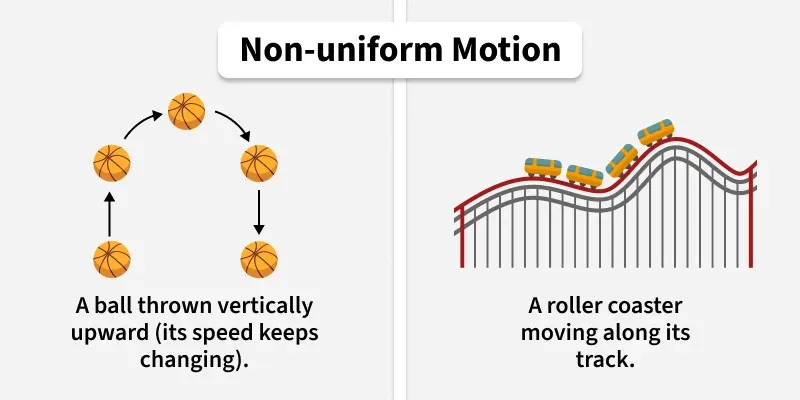
If an object travels with varied speed and it does not cover the same distance in equal time intervals, irrespective of the time interval duration.
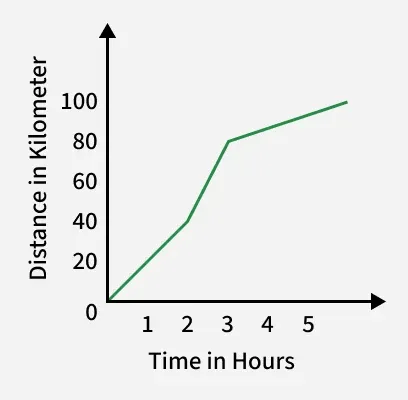
Non-Uniform Motion Graph
**Example: A cyclist travelled 40 km in the first 2 hours, the next 40 km in 1 hour, and the last 20 km in 2 hours. This shows that the speed of the cyclist is inconsistent and he is in nonuniform motion. The graph of Non-Uniform Motion is given below.
Examples of Non-Uniform Motion
The majority of the motions around us are non-uniform in nature. Various examples of Non-Uniform Motion are discussed below:
- A ball bouncing randomly
- A car accelerating along the curve path
- Movement of an asteroid
Uniform and Non-Uniform Circular Motion
Uniform circular motion of an object is the motion of an object that is moving in a circular path and has a fixed speed. Whereas, Non-Uniform Circular Motion is the motion of the object in circular motion with variable speed.
What are Uniform Circular Motion?
A body is said to be in uniform circular motion if it moves at a constant speed around a fixed axis or point, the object in uniform circular motion travels in a curved path, it is at a constant radial distance from the center point at any given time, and its velocity is tangential to the curved path.
In a uniform circular motion, the object moves with constant speed but not with constant velocity, as the direction of the motion is due to the circular path always changing.
What are Non-Uniform Circular Motion?
A body is said to be in the state of non-uniform circular motion if it travels at variable angular speed around a fixed axis or center point; here, the motion of that object is inconsistent as the object covers an unequal distance in unequal time intervals.
Rectilinear Motion or Linear Motion
Rectilinear motion, also known as linear motion, is a 1-Dimensional motion along a straight line. It can be described mathematically using only one spatial dimension.
Rectilinear motion can be of two types:
- **Uniform linear motion: Has constant velocity
- **Non-uniform linear motion: Has variable velocity
Uniform vs Non-Uniform Motion
The difference between Uniform and Non Uniform motion can be understood with the help of the table given below:
| Uniform motion | Non-uniform motion |
|---|---|
| In uniform motion, an object covers equal distances at equal intervals of time. | In a non-uniform motion, the object does not cover equal distances at equal intervals of time. |
| The average speed of the object during the whole journey is equal to its actual speed in uniform motion. | The average speed of the object during the whole journey is different from its actual speed in non-uniform motion. |
| Distance-time graph of an object with uniform motion is a straight line. | Distance-time graph of an object with non-uniform motion is a curved line. |
| Acceleration of the object is zero in Uniform Motion. | Acceleration of the object will be non-zero in Non-Uniform Motion. |
**Common Misconceptions
- **Uniform motion means slow motion
Uniform motion can be fast or slow; the speed just needs to remain constant. - **Non-uniform motion always follows a curved path
Non-uniform motion can occur along a straight line if the speed changes. - **Uniform circular motion has no acceleration
Even at constant speed, acceleration exists due to continuous change in direction. - **Equal distances in equal times mean zero motion
Equal distances in equal times indicate constant motion, not rest.
Related Articles:
**Practice Questions on Uniform and Non-Uniform Motion
**Question 1. An object travels along a straight road at a constant speed of 20 m/s for 40 seconds. Calculate the total distance covered by the object during this time.
**Question 2. A car accelerates uniformly from rest to a speed of 30 m/s in 10 seconds. Determine the acceleration of the car and the distance it travels during this time.
**Question 3. A car moves with a constant speed of 72 km/h along a straight road.
(a) Find the distance covered in 25 s.
(b) State the acceleration of the car.
**Question 4: A cyclist starts from rest and accelerates uniformly at 2 m/s² for 10 seconds. He then travels at a constant speed of 10 m/s for the next 20 seconds. Determine the total distance covered by the cyclist during this time interval.
**Question 5. A particle moves in a straight line such that it covers 20 m in first 2 s, 40 m in next 4 s, and 30 m in next 3 s.
(a) Is the motion uniform or non-uniform?
(b) Calculate the average speed of the particle.
**Question 6. Assertion (A): In uniform motion, acceleration is zero.
**Reason (R): Uniform motion means constant velocity.
(a) Both A and R are true and R is the correct explanation of A
(b) Both A and R are true but R is not the correct explanation of A
(c) A is true but R is false
(d) A is false but R is true