Matplotlib Axes Class (original) (raw)
In Matplotlib, **Axes class is the area where the data is plotted. It is one of the core building blocks of a plot and represents a single plot area inside a **Figure. A single **Figure can contain multiple **Axes, but each **Axes can belong to only one **Figure.
Each Axes object contains:
- The x-axis and y-axis (for 2D plots),
- Optionally a z-axis (for 3D plots),
- The plot itself (lines, markers, etc.),
- Labels, titles and legends
The **axes() function or **add_axes() method can be used to manually create axes at specific locations within a figure.
axes() function
axes() function create a new set of axes inside a figure at a custom position. The position is given as a list: **[left, bottom, width, height], where all values are between **0 and **1, showing how much space they take up compared to the full figure.
Syntax:
plt.axes([left, bottom, width, height])
**Parameter:
- **left: distance from the left side of the figure.
- **bottom: distance from the bottom of the figure.
- **width: width of the axes area.
- **height: height of the axes area.
Example:
This code manually adds a custom-sized axes to a figure using **plt.axes() and displays it with **plt.show(). The position is set using normalized coordinates. This positions plot area centrally inside the figure window.
Python `
import matplotlib.pyplot as plt fig = plt.figure() ax = plt.axes([0.1, 0.1, 0.8, 0.8]) # [left, bottom, width, height] plt.show()
`
**Output
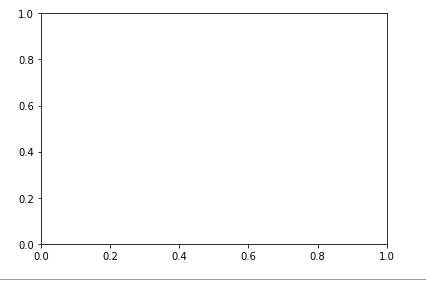
**Explanation:
In axes([0.1, 0.1, 0.8, 0.8])
- 0.1: 10% from the left
- 0.1: 10% from the bottom
- 0.8: 80% width of the figure
- 0.8: 80% height of the figure
add_axes() method
add_axes() method adds a new axes to a figure. It allows the user to set the exact position and size of the axes using [left, bottom, width, height] relative to the figure size.
Syntax:
fig.add_axes([left, bottom, width, height])
Example:
This example shows how to add an axes to a figure using **add_axes() method. The axes fills the entire figure area, as specified by **[0, 0, 1, 1] and **plt.show() displays figure window.
Python `
import matplotlib.pyplot as plt fig = plt.figure() ax = fig.add_axes([0, 0, 1, 1]) plt.show()
`
**Output
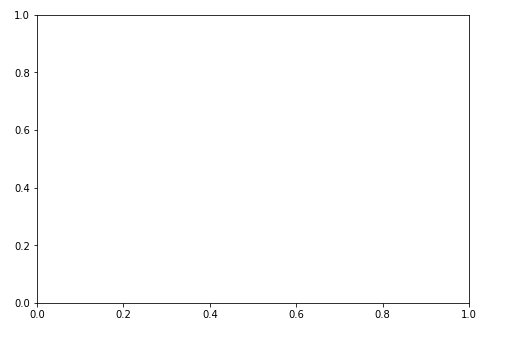
ax.plot() Function
ax.plot() function draws lines or markers on the axes. It lets user plot data points by connecting them with lines, making it useful for visualizing trends or comparisons.
Syntax:
ax.plot(X, Y, 'CLM')
**Parameter:
- **X: x-axis data
- **Y: y-axis data
- **CLM: format string (Color, Line style, Marker)
Example:
This code plots three points connected by a red dashed line with circle markers using **ax.plot().
Python `
import matplotlib.pyplot as plt
fig = plt.figure() ax = fig.add_axes([0.1, 0.1, 0.8, 0.8])
ax.plot([1, 2, 3], [4, 5, 6], 'ro--') # red color, circle marker, dashed line plt.show()
`
**Output
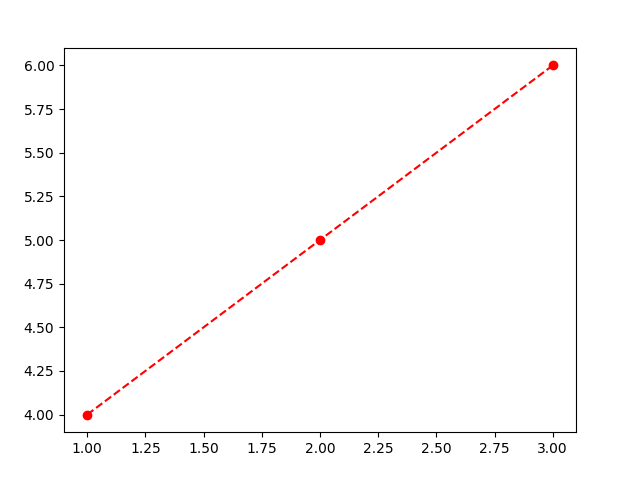
Output
**Explanation:
- **r: red color
- **o: circle markers
- **--: dashed line connecting the points
**Common Marker Styles:
| Characters | Description |
|---|---|
| . | Point Marker |
| o | Circle Marker |
| + | Plus Marker |
| s | Square Marker |
| D | Diamond Marker |
| H | Hexagon Marker |
ax.legend() Function
ax.legend() function adds a legend to the axes. It helps label and describe the plotted elements (like lines or markers) so the viewer knows what each one represents.
Syntax:
ax.legend(labels, loc)
**Parameter:
- **labels: List of labels for the plots
- **loc: Legend location (e.g., 'upper left', 'lower right', etc.)
Example:
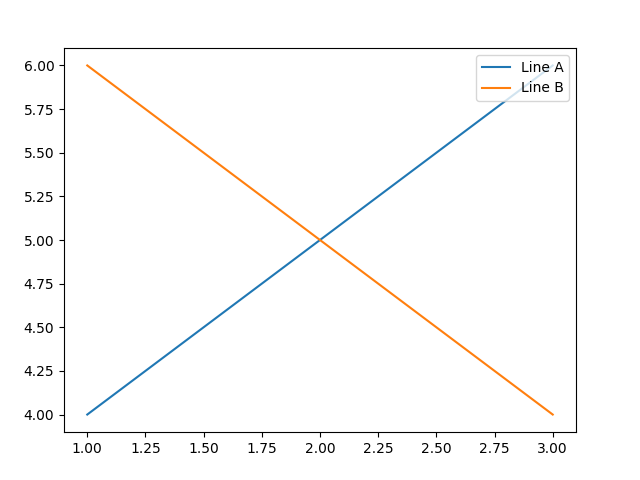
This code creates a figure with custom-sized axes and plots two lines labeled 'Line A' and 'Line B'. The **ax.legend() function is used to display a legend in the upper right corner, helping to identify each line in the plot.
Python `
import matplotlib.pyplot as plt
fig = plt.figure() ax = fig.add_axes([0.1, 0.1, 0.8, 0.8])
ax.plot([1, 2, 3], [4, 5, 6], label='Line A') ax.plot([1, 2, 3], [6, 5, 4], label='Line B')
ax.legend(loc='upper right') # Add legend at the upper right plt.show()
`
**Output
Complete Example: Plotting Sine and Cosine Curves
This code plots sine and cosine curves using Matplotlib. It creates custom axes using coordinates, then plots cosine function with blue square markers and sine function with red circle markers. A legend and title are also added to label the curves and describe the plot.
Python `
import matplotlib.pyplot as plt import numpy as np
X = np.linspace(-np.pi, np.pi, 15) C = np.cos(X) S = np.sin(X)
Create axes using coordinates
ax = plt.axes([0.1, 0.1, 0.8, 0.8])
Plot cosine and sine
ax1 = ax.plot(X, C, 'bs:') # Blue squares with dotted line ax2 = ax.plot(X, S, 'ro-') # Red circles with solid line
ax.legend(labels=('Cosine Function', 'Sine Function'), loc='upper left') ax.set_title("Trigonometric Functions") plt.show()
`