Weather and Climate (original) (raw)
Last Updated : 2 Feb, 2026
The atmosphere, which surrounds our planet, is a huge blanket of air. To exist, all living organisms on this planet rely on the atmosphere. It provides us with the air we breathe and protects us from the sun's harmful rays. If we didn't have this blanket of protection, we'd be burned alive by the heat of the sun during the day and frozen at night. As a result, it is this mass of air that has kept the Earth's temperature manageable.
Weather
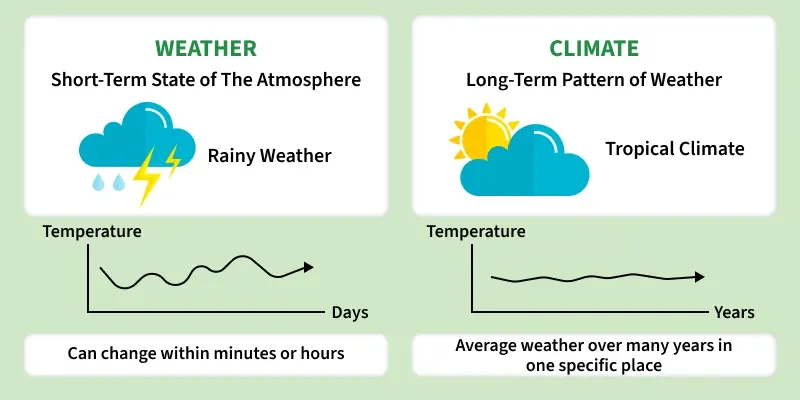
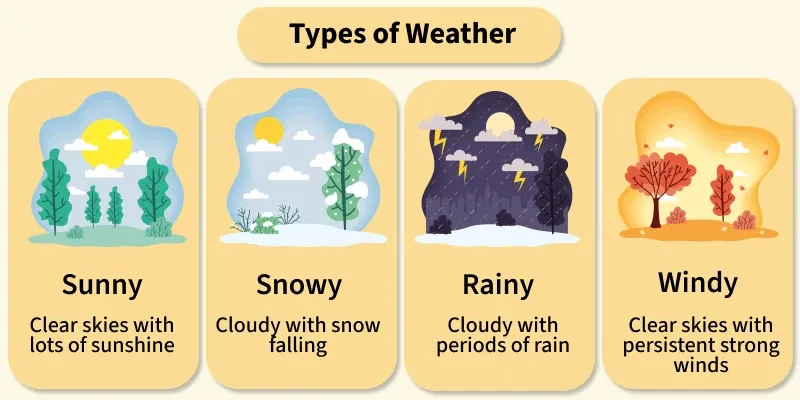
The state of the atmosphere, like clear or foggy, hot or cold, peaceful or stormy, is described by the weather. Weather refers to daily temperature, precipitation, and other atmospheric circumstances, whereas climate refers to the long-term average of atmospheric conditions.
Characteristics of weather
Characteristics of weather are given below:
- The troposphere, the lowest layer of the planet's atmosphere immediately below the stratosphere, is where most weather events occur on Earth.
- The weather is influenced by changes in air pressure, temperature, and moisture.
- These changes could be caused by the Sun's angle at any given point, which varies with latitude.
- The largest-scale atmospheric circulations are caused by the huge temperature difference between polar and tropical air.
- Weather events in the middle latitudes, such as extratropical cyclones, are caused by instabilities in the jet streamflow.
- Because the Earth's axis is tilted with respect to its orbital plane, sunlight strikes the globe at various angles throughout the year.
- Changes in Earth's orbit can have a long-term impact on the amount and distribution of solar energy received by Earth, influencing long-term climate and global climate change.
**Causes of Weather
On Earth, wind, cloud, rain, snow, fog, and dust storms are all common meteorological phenomena. The troposphere is the location of almost all meteorological phenomena that we are familiar with. Weather happens in the stratosphere and can influence weather in the troposphere.
- Changes in air pressure, temperature, and moisture from one region to another are the primary causes of weather.
- These fluctuations are caused by the sun's angle at any given point, which varies with latitude away from the tropics.
- In other words, as one moves further from the tropics, the sun angle decreases, causing colder zones to form due to the distribution of sunlight across a greater surface.
- The temperature differential between polar and tropical air causes large-scale atmospheric circulation cells and jet streams.
- Weather systems in the mid-latitudes, such as extratropical cyclones, are caused by instabilities in the jet stream movement.
**Effect on humans
Weather has played an important, and sometimes direct, part in human history. Aside from climatic changes that have caused population drift, extreme weather events have caused smaller-scale population movements and have intervened directly in historical events.
Climate
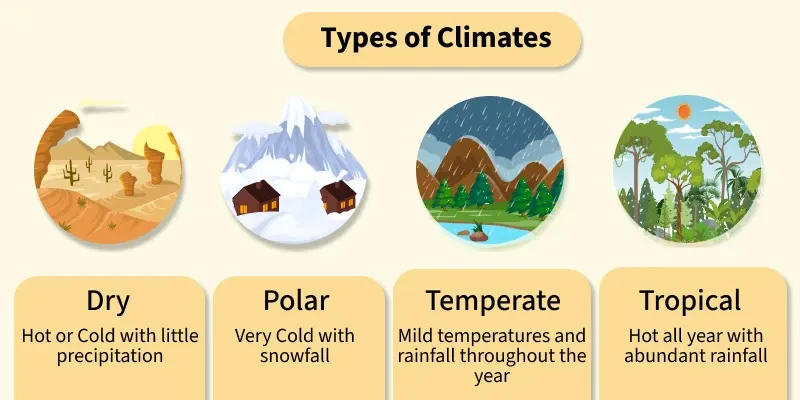
Climate is the long-term weather tendency of a location, which is typically averaged over 30 years. Climate refers to the state of the Earth's climate system as a whole, which includes the ocean, land, and ice.
Characteristics of Climate
Characteristics of Climate are given below:
- It is the average and variability of meteorological variables over time periods ranging from months to millions of years.
- Temperature, humidity, air pressure, wind speed, and precipitation are just a few of the meteorological variables that are recorded daily.
- The climate of a location is impacted by its latitude/longitude, topography, altitude, and proximity to water bodies and currents.
- Climates are classified according to average and usual parameters, the most common of which are temperature and precipitation.
- Classification systems are interested in the origin of air masses that define the climate of a region.
**Climate variability
Beyond specific weather events, climate variability refers to variations in the mean state and other elements of the climate on all geographical and temporal scales. Some of the variability appears to be generated at random intervals rather than in a planned fashion. This is referred to as random variability or noise. Periodic variability, on the other hand, occurs in discrete modes of variability or climate patterns.
**Climate change
Climate change refers to the variation in global or regional climates through time. It reflects changes in the variability or average state of the atmosphere across time periods ranging from decades to millions of years. Internal Earth processes, external causes, and, more lately, human activities can all cause these changes.