Agile SDLC (Software Development Life Cycle) (original) (raw)
Last Updated : 23 Jul, 2025
Software Development Life Cycle (SDLC) is a process of maintaining or building software applications/services/systems. Generally, it includes various levels, from initial development plan and analysis to post-development software testing and evaluation. It also consists of the models and methodologies that development teams use to develop the software systems. An information system is designed to perform a particular set of assignments. Frequently, this set of tasks that the system will perform offers well-defined results, which include complex computation and processing.
It is a hard and boring job to govern the entire development process to ensure that the end product comprises a high degree of integrity and strength, as well as user acceptance. Thus, a systematic development process that can point to the understanding of the scope and complication of the total development process is essential to achieve the characteristics of a successful system.
Presently, two SDLC methods are used by most system developers. They are traditional development and agile development. In this article, we will discuss about Agile Software Development Cycle.
Table of Content
- What is the Agile Software Development Life Cycle (Agile SDLC)?
- Steps of Agile SDLC Model
- Agile SDLC Process Flow
- Agile SDLC vs Traditional SDLC
- Agile SDLC Models
- Rules to identify the desired SDLC
- Advantage of Agile SDLC
- Disadvantage of Agile SDLC
- Conclusion
- Frequently Asked Questions on Agile SDLC
**What is the Agile Software Development Life Cycle (Agile SDLC)?
The Agile Software Development Life Cycle (SDLC) is an iterative and incremental software development methodology that prioritizes flexibility, collaboration, and customer feedback. Unlike traditional SDLC models, such as the waterfall model, which completes each step sequentially, the agile SDLC divides the development process into smaller iterations or increments.
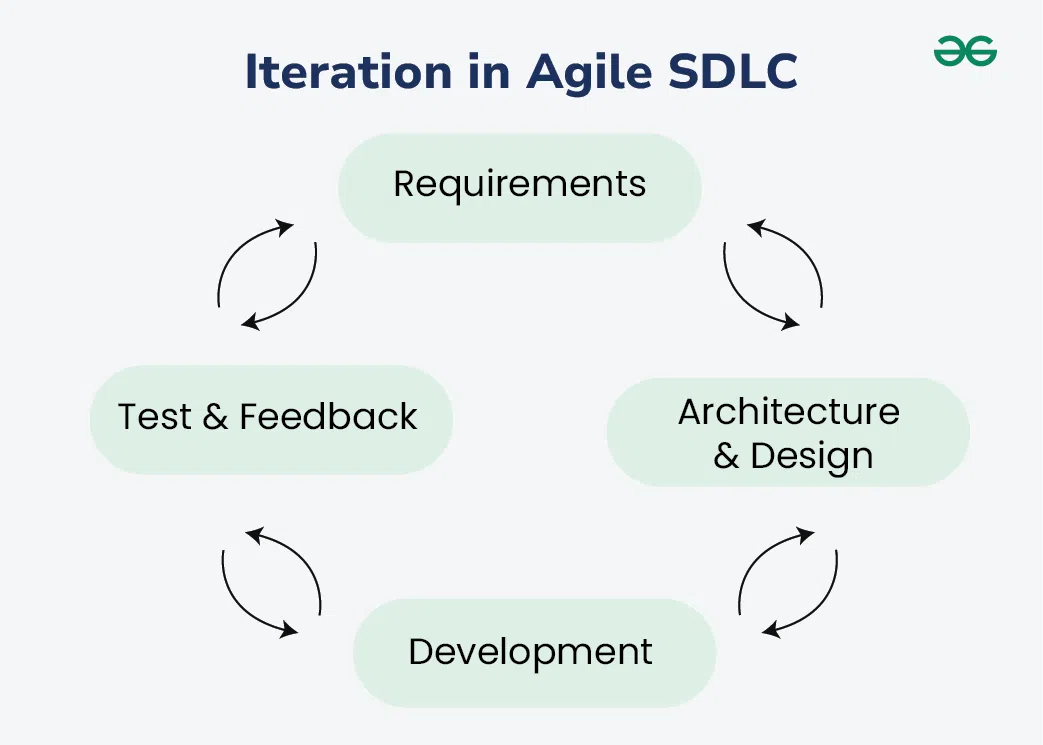
Iteration in Agile SDLC
The major factors of agile, according to **Agile Manifesto, are following four:
- Early customer involvement
- Iterative development
- Self-organizing teams
- Adaptation to change
Steps of Agile SDLC Model
The agile model is a combination of iterative and incremental process models. The steps involve in agile SDLC models are:

Phases of Agile SDLC
- Requirement gathering
- Design the Requirements
- Coding
- Testing
- Deployment
- Feedback
**1. Requirement Gathering: In requirement Gathering collaboration takes place with stakeholders to understand and prioritize needs for the project, that focus on delivering value. In this step techniques like user stories and workshops for effective communication.
**2. Design the Requirements: In design the requirement step that gathered requirements is translated into actionable tasks, breaking them down into smaller, manageable chunks. In this step developers develop visual representations of the solution, such as wireframes or prototypes, to get early feedback and ensure alignment with stakeholder expectations.
**3. Coding: During the coding step, the development team implements the software in short, iterative cycles known as sprints. Each sprint focuses on delivering small, functional increments of the product. Developers write code, continuously integrate it into the main codebase, and regularly commit changes to detect and address issues early.
**4. Testing / Quality Assurance: Testing is an integral part of each iteration, ensuring the quality and functionality of the software. Unit tests are written to verify individual components, while integration tests check that different parts of the system work together as intended. User Acceptance Testing (UAT) involves end-users testing the software in real-world scenarios to ensure it meets their needs.
**5. Deployment: Deployment involves releasing the software increments to production frequently and reliably. Automated deployment tools makes the process, allowing for quick and consistent releases. Monitoring the deployment process and system performance helps identify and resolve any issues promptly.
**6. Feedback: Feedback is crucial for continuous improvement in Agile. Stakeholders and end-users provide feedback through surveys, direct communication, and usage analytics. This feedback is used to refine requirements, prioritize changes, and identify areas for improvement.
Agile SDLC Process Flow
- **Concept: In concept phase vision of the project, its scope, objectives, and goals are set.
- Inception: This stage is conducted before Construction. The major goal of this phase is to complete just enough work to get your team moving in the correct direction.
- **Iteration/Construction: The main goal of this phase is to create a consumable solution with enough functionality to satisfy your stakeholders' present needs, or to configure it in the event of a package implementation.
- **Release: This stage normally involves final performance testing, security assessments, and documentation updates, as well as user acceptability testing (UAT), which ensures that user demands are satisfied and the product is successful. When the software is complete, it is released into production or made available to users.
- **Production: The Production Phase aims to keep systems viable and productive after they have been deployed to the user population.
Agile SDLC vs Traditional SDLC
| Aspect | Agile SDLC | Traditional SDLC |
|---|---|---|
| Process | Iterative and incremental | Sequential (waterfall-like) |
| Flexibility | Emphasizes adaptability to change | Less adaptable to change |
| Requirements | Evolves throughout development | Defined upfront, difficult to change mid-project |
| Customer involvement | Continuous feedback and collaboration | Minimal involvement until end of project |
| Delivery | Incremental, frequent releases | Single, large release at the end of the cycle |
| Documentation | Minimal documentation, focus on working code | Extensive documentation, including requirements |
| Risk management | Early detection and mitigation of risks | Risks addressed late in the process |
| Team structure | Cross-functional teams, self-organizing | Siloed teams with defined roles and hierarchy |
| Progress measurement | Working software as primary measure | Completion of phases or milestones |
**Agile SDLC Models
**Six methods are identified as agile development methods they are following :
- Crystal methodologies
- Dynamic software development method
- Feature-driven development
- Lean software development
- Scrum
- Extreme programming
Software Development Life Cycle is a technique that shows the entire development process, which a software development organization must use to guarantee a successful software development.
**Rules to identify the desired SDLC
**There are some rules that the development crew could use to identify the desired SDLC. These include
- The size of the crew
- Geographical situation
- Size of Software
- Complication of software
- Types of projects
- Business strategies
- Engineering capability and others where it may be found suitable.
It is also crucial for the crew to study the differences, advantages, and disadvantages of each SDLC before rejecting the decision. An SDLC selection and adoption process are important in that it ensures the organization maximizes its chance for delivering its software successfully.
Advantage of Agile SDLC
Following are the Advantage of Agile SDLC
- **Responds to Change: Agile allows for changes in requirements even late in the development process, adapting to evolving business needs and market conditions.
- **Iterative Development: Features are developed in small, manageable increments, making it easier to pivot or refine the product as necessary.
- **Continuous Testing: Regular testing at each iteration helps identify and fix defects early, ensuring higher quality.
- **Incremental Releases: By delivering small, functional parts of the project regularly, Agile ensures that valuable features reach users faster.
- **Frequent Feedback: Regular interaction with customers and stakeholders ensures that their needs are met and their feedback is incorporated.
- **Cross-Functional Teams: Agile promotes collaboration among diverse team members, including developers, testers, designers, and business analysts.
- **Focus on Priorities: Agile helps teams prioritize tasks that deliver the most value, reducing waste and focusing efforts on what matters most.
- **Early Issue Detection: Regular iterations and continuous integration help identify and address risks early in the development process.
- **Transparency: Agile methodologies like Scrum involve daily stand-ups, sprint reviews, and retrospectives, providing clear visibility into progress and challenges.
- **Retrospectives: Regular reflection on processes and outcomes allows teams to identify areas for improvement and implement changes effectively.
Disadvantage of Agile SDLC
Following are the disadvantage of Agile SDLC
- **Variable Scope: Frequent changes in requirements can make it hard to predict the final scope of the project.
- **Uncertain Costs and Timeline: Iterative development means that the exact time and cost of completing the project can be difficult to estimate upfront.
- **Minimal Documentation: Agile focuses on working software over comprehensive documentation, which can lead to insufficient documentation.
- **Changing Requirements: Continuous changes can lead to scope creep, where additional features are added without corresponding increases in time or budget.
- **Training Needs: Teams unfamiliar with Agile need training to understand and effectively implement Agile practices, which can be time-consuming.
- **Continuous Integration Demands: Agile requires frequent integration of new code, which can be technically challenging and require robust tools and practices.
- **Technical Debt: Rapid development cycles can result in the accumulation of technical debt if not managed properly, affecting future maintainability.
Conclusion
The Agile SDLC model offers a flexible and iterative approach to software development, promoting continuous collaboration, rapid delivery, and responsiveness to change. This model enhances customer satisfaction through frequent deliveries and the ability to adapt quickly to evolving requirements. Agile SDLC is well-suited for dynamic projects where requirements are expected to change and where early and frequent delivery of product increments is crucial. Adopting Agile requires a cultural shift, effective communication, and a commitment to iterative improvement, making it a powerful tool for delivering high-quality software.