Introduction to ALE(Application Link Enabling) in SAP (original) (raw)
Last Updated : 23 Jul, 2025
We often come across some terminology such as**SAP HANA, **SAP EDI, SAP ALE, **SAP ABAP, **SAP CO, and other SAP-related products. In this article, we would like to focus on ALE(Application Link Enabling) in SAP. It is an emerging technology for remote connections that enables business processes to be decentralized by linking decentralized systems. It is similar to the work-from-home principle where many working professionals from various corners of their work from home comfortably towards their company's perspective and improve their reputation. By using the ALE process we can develop business processes that take place across various in-house IT systems. ALE is based on RFC which stands for **Remote Function Call. These systems are physically separated from various sectors and the communication takes place through Logical Systems which does computations and other processes.
-in-SAP-copy.webp)
Introduction to ALE(Application Link Enabling) in SAP
Table of Content
- What is SAP ALE?
- Purpose of SAP ALE
- Basic Process flow of ALE
- System Architecture of SAP ALE
- FAQs on ALE in SAP:
- Conclusion
What is SAP ALE?
SAP ALE stands for Application Link Enabling is a technology that is used to swap business data between various SAP systems or between **SAP **and non-SAP systems. It acts as an integration technology that enables the different types of applications and system operations within an organization to facilitate the business processing and flow of information. In simple terms, **SAP ALE describes the message flow between logical systems.
**There are three layers in the ALE system and that is mentioned below:
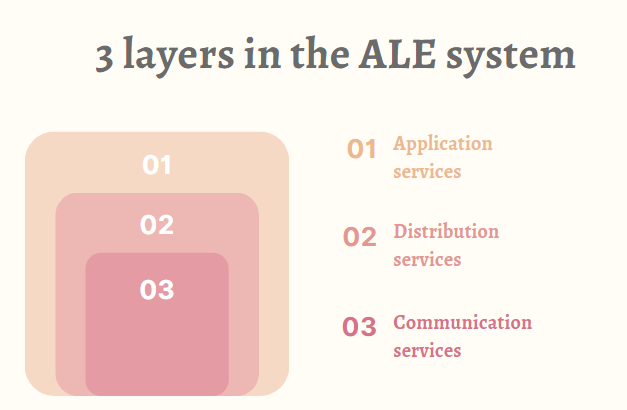
Layers in ALE System
- **Application services - One of the integration technologies which comprise of business messages and data management in SAP systems.
- **Distribution services - It allows us to distribute data asynchronously which means that data is sent from one system to another without any real time connection or immediate processing of any data or an process activity.
- **Communication services - It uses communication by using some methods such as RFC, IDocs and other standard protocols.
We used to transfer the data often between SAP enabled systems through **IDoc which stands for **Intermediate documents.
Purpose of SAP ALE
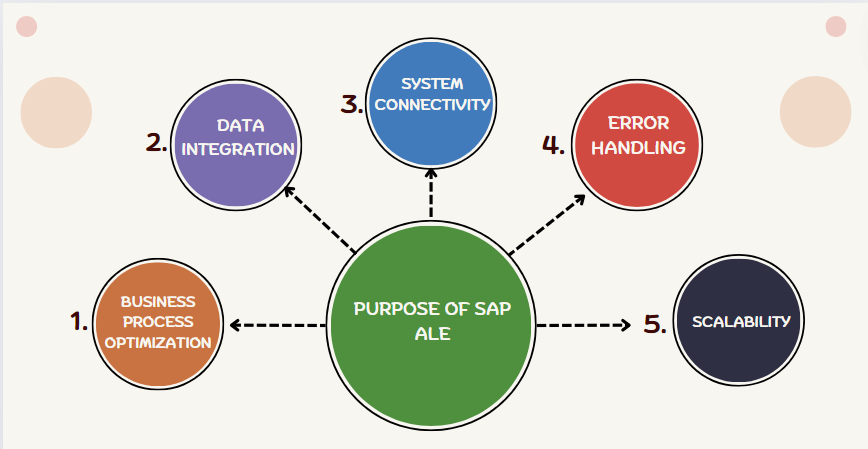
Purpose of SAP ALE
- **Business Process Optimization - ALE in SAP helps us to optimize business processes by ensuring the related real time data which is available in needs. It can lead to increase efficiency and productivity feature.
- **Data Integration - It allows us to integrate various SAP applications and systems, which enables to exchange the data with them. It is highly important and crucial to maintain data consistency and accuracy across any organization.
- **System Connectivity - It provides an additional feature to connect with other customers and suppliers which act as external resources which leads to exchange of data and information in a proficient manner.
- **Error handling - The error handling mechanism in ALE enables us to manage data inconsistencies and problems which may arise during data swapping between any systems and additionally it is used to maintain data quality and data integrity.
- **Scalability - It is scalable and it offers scalability and in order to create a complex integration technique which consists of multiple systems then first i should need to exchange the data between SAP systems.
Overall the main purpose of **ALE in **SAP is to enable more industries to integrate their SAP systems and customer or suppliers which consistently ensures that the right data is available in the right place and also it supports optimized business performance and so on.
Basic Process flow of ALE
The basic process in ALE SAP involves several key steps as shown below. Note that the below diagram and details shown here is an simplified overview process flow in ALE However the actual implementation involves complexity and certain integration requirements.
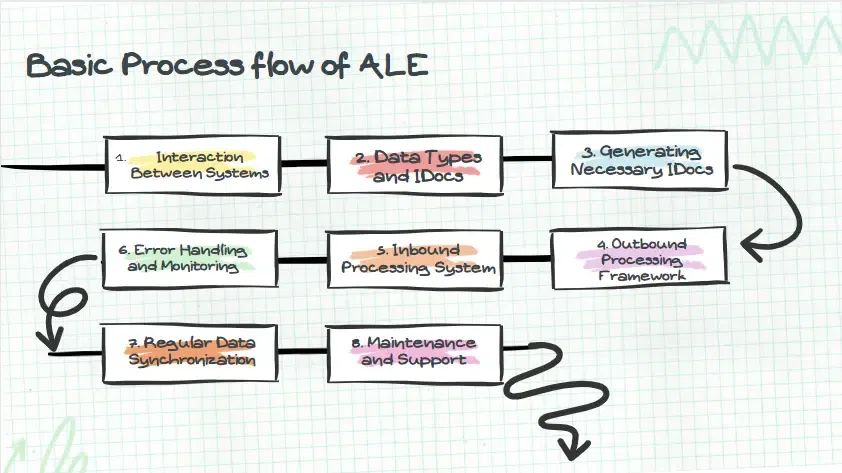
Basic Process flow of ALE
- First we need to represent the logical interaction between systems for communication in which both sender and receiver systems involved in **ALE communication.
- By defining what are the types of data that is being swapped and shared between systems with their associated **IDocs.
- Generate necessary **IDocs using data in the system which are the structured data in the SAP which is useful for generating customer programs or by using **SAP transactions.
- IDocs generated to process the outbound processing framework in which the system processes to convert IDocs to ALE formatted data and sends the related ALE data to the receiver system here the data is being shared through standard protocols such as **RFC, HTTP.
- Inbound processing system act as an receiver in which the ALE communication receives the data and again the data is converted into IDocs which is typically called workflows.
- Error handling and monitoring is used to ensure that data is shared between systems in a safe state and it provides tracking to know the specific status of the data exchange.
- Data should be synchronized regularly.
- Maintenance and support is needed for this data exchange process which act as an crucial part in this process.
System Architecture of SAP ALE
- **Logical systems and Distribution model - Logical systems act as a core of SAP ALE architecture which enables to communicate between systems (communication takes place) and the data is exchanges using distribution model.
- **IDocs - IDocs(Intermediate Document) are the one of the representation of data generally data is exchanged between IDocs and it holds the information to be sent in a specific format.
- **Inbound Processing - It is an receiver system where the **SAP ALE communication layer receives the incoming data.
- **Outbound Processing - It is an sender system where the data is being exchanged and converted into IDocs.
- **ALE communication layer - Several communication takes place in this layer and it handles and manages the transmission of data between systems through communication protocols such as **HTTP, RFC.
Conclusion
**ALE( Application Link Enabling) in SAP plays a crucial role in enabling data consistency and integration techniques across various components through SAP. It is an versatile technology which is required to meet some specific needs in SAP to SAP systems or external connectivity. ALE in SAP improves and optimizes the business performance ensuring good flow of data between systems through RFC and so on. We also came across the simplified version of process flow and architecture of ALE in SAP.