Scalability Testing Software Testing (original) (raw)
Last Updated : 16 May, 2026
Scalability Testing is a type of non-functional testing that checks how well a system can handle increased workload (users, data, transactions) without affecting performance. It ensures the application can scale up or down smoothly as demand changes.
- Verifies system performance under increasing and decreasing load
- Helps identify bottlenecks and system limits
- Ensures the system can scale efficiently (vertical or horizontal)
Example: Banking Application
A banking application is tested by gradually increasing the number of users to evaluate how well it handles growing transactions.
- Check response time for transactions like balance inquiry and fund transfer
- Ensure system stability under heavy load
- Verify performance after adding resources like servers
Types of Scalability Testing
Scalability testing can be performed in different areas to evaluate how well a system handles growth in users, data, and workload.
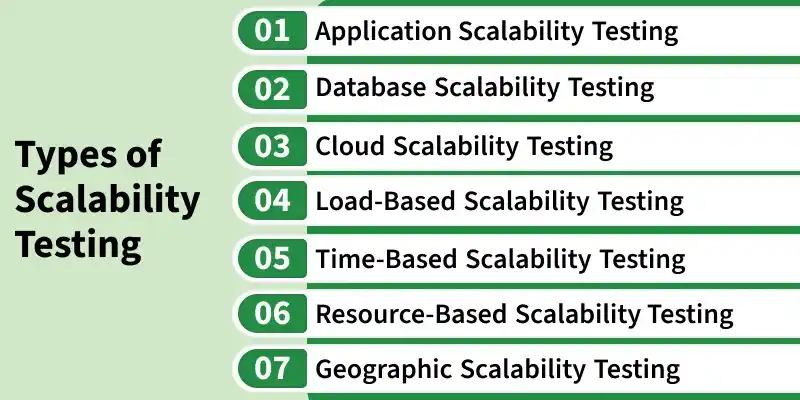
Types of Scalability Testing
**1. Application Scalability Testing: Tests how the application handles an increase in users, requests, or transactions while maintaining performance.
**Example: An e-commerce app handling thousands of users during a sale.
**2. Database Scalability Testing: Evaluates how efficiently the database manages increasing data volume and queries.
**Example: Using sharding or replication to handle large datasets.
**3. Cloud Scalability Testing: Checks how well cloud-based systems scale automatically based on demand using technologies like auto-scaling services, containers, and orchestration platforms such as Kubernetes.
**Example: Auto-scaling application instances during peak traffic in cloud environments.
**4. Load-Based Scalability Testing: Measures how efficiently the system scales as workload gradually increases.
**Example: Increasing users from 1,000 to 10,000 and observing system behavior.
**5. Time-Based Scalability Testing: Evaluates whether the system can maintain scalability and stable performance over extended periods.
**Example: Running the system continuously for hours or days with growing users.
Scalability Testing Process
Scalability testing follows a structured process to evaluate how a system performs as workload increases.
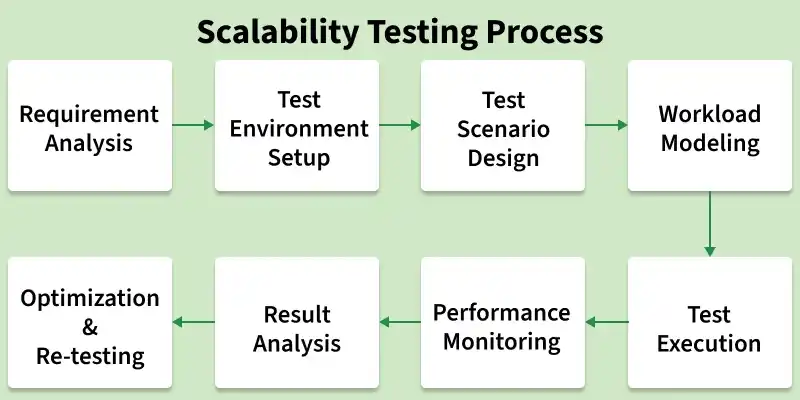
Scalability Testing Process
- **Requirement Analysis : Analyze test results to identify bottlenecks, scaling thresholds, maximum system capacity, and performance degradation points, and evaluate whether the system meets scalability requirements under increasing workload.
- **Test Environment Setup : Prepare a test environment similar to production with required hardware, software, network, and testing tools.
- **Test Scenario Design : Create test scenarios based on real-world usage and define user actions, transactions, and workload patterns.
- **Workload Modeling : Plan and gradually increase workload such as users, data, or transactions to simulate real system growth.
- **Test Execution : Execute tests with increasing load levels and observe how the system behaves under different conditions.
- **Performance Monitoring : Monitor key metrics like response time, CPU usage, memory usage, and throughput during testing.
- **Result Analysis : Analyze test results to identify bottlenecks and evaluate whether the system meets scalability requirements.
- **Optimization & Re-testing : Fix performance issues, optimize the system, and re-test to ensure improvements are effective.
Metrics of Scalability Testing
Key metrics are used to measure how well a system performs as the workload increases.
- **Response Time : Time taken by the system to respond to a request
- **Throughput : Number of requests processed per second
- **CPU & Memory Usage : Amount of system resources utilized during load
- **Error Rate : Number of failed requests or errors under load
- **Latency : Delay between request and response
Advantages of Scalability Testing
Scalability testing ensures that the system maintains performance and stability as workload increases.
- Enhances application performance and availability under increasing load
- Detects performance bottlenecks (e.g., slow response time) at an early stage
- Minimizes future cost and effort by identifying issues in advance
- Ensures a smooth and consistent user experience during peak traffic
- Improves efficient utilization and optimization of system resources
Limitations of Scalability Testing
Scalability testing has certain limitations that can affect cost, time, and testing accuracy.
- Does not identify functional defects in the application
- Requires expensive tools, infrastructure, and testing environments
- Needs skilled professionals for proper test planning and analysis
- Can be time-consuming and resource-intensive
- Test outcomes may not completely match real-world production conditions
Common tools are used to simulate increasing load and measure system performance under scalable conditions.
- **Apache JMeter : Open-source tool used to simulate heavy user load and analyze performance
- **LoadRunner : Advanced tool for large-scale performance and scalability testing
- **Gatling : High-performance tool designed for testing web applications
- **Locust : Python-based tool for scalable load testing with custom scenarios
- **k6 : Modern tool for performance testing using JavaScript scripting
Scalability Testing Vs Load Testing
Scalability testing checks how well a system grows with increasing load, while load testing evaluates performance under expected user traffic.
| Basis | Scalability Testing | Load Testing |
|---|---|---|
| **Purpose | Checks how the system scales with increasing load | Checks system performance under expected load |
| **Focus | Growth handling and resource expansion | System behavior under specific load |
| **Load Pattern | Gradually increasing load | Fixed or expected load |
| **Goal | Identify scaling limits and improvements | Verify system can handle normal user load |
| **Resource Usage | May add resources (servers, CPU, etc.) | Usually tests with existing resources |
| **Outcome | Determines scalability capability | Determines system stability and performance |