What is Test Driven Development (TDD)? (original) (raw)
Last Updated : 12 Jul, 2025
**Test-Driven Development (TDD) is a Software development method in which you write **Automation Tests before the actual development process starts, which is coding. Here we are learning **TDD in detail with these important points related to the same.
Table of Content
- History of TDD
- What is Test Driven Development (TDD)?
- Process of Test Driven Development (TDD)
- Approaches of Test Driven Development (TDD)
- Test-driven work in Test Driven Development (TDD)
- TDD Vs. Traditional Testing
- Advantages of Test Driven Development (TDD)
- Disadvantages of Test Driven Development (TDD)
History of TDD
TDD shares similarities with test-first programming from **Extreme Programming, which started in 1999. However, TDD has gained more widespread interest on its own. Programmers also use TDD to improve and fix old code written with different methods.
The idea of Test-Driven Development (TDD) which invented from an old book on **Programming. In this suggested method you will manually enter the expected output and then write a code until the actual output when matches it. After creating the first xUnit framework, We will remember this and give it a try which is related to the the invention of the TDD for me.
What is Test Driven Development (TDD)?
Test-Driven Development (TDD) is a method in software development where the focus is on writing an **Automation Tests before writing the actual code for any feature of an application or product. This approach uses short development cycles that repeat to verify the quality and correctness.
TDD simply means a method of coding in which you first write a test, and it fails, then write the code to pass the test of development, and clean up the code. This process is recycled for one new feature or change. In other methods in which you write either all the code or all the tests first, TDD will combine and write tests and code together into one.
Process of Test Driven Development (TDD)
It is the process in which **Test Casesare written before the code that validates those cases. It depends on the repetition of a concise development cycle. Test-driven Development is a technique in which automated Unit tests are used to drive the design and free decoupling of dependencies.
The process of Test-Driven Development (TDD) follows a repetitive cycle called **Red-Green-Refactor.
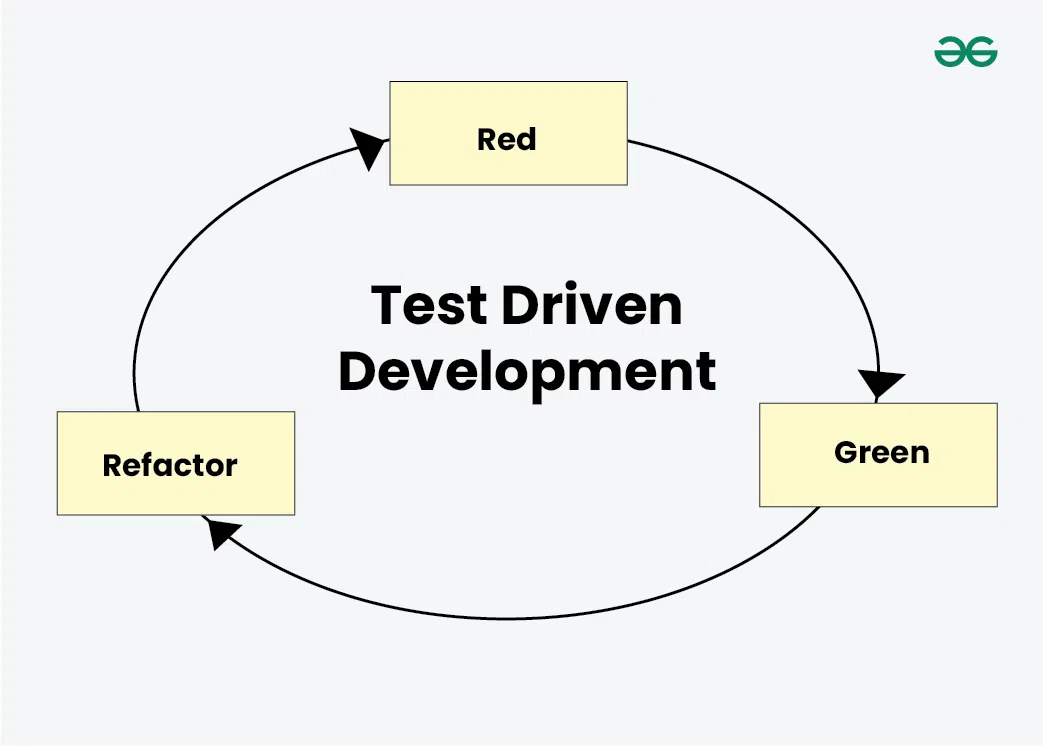
Test Driven Development (TDD)
Run all the test cases and make sure that the new test case fails.
- **Red - Create a test case and make it fail, Run the test cases
- **Green - Make the test case pass by any means.
- **Refactor - Change the code to remove duplicate/redundancy and Refactor code - This is done to remove duplication of code.
Once you completed through the **Red-Green-Refactor cycle, you continue repeating the process for the next piece of functionality or unit of code. Every time you write a new test, your code gets better and more reliable, making the overall software stronger.
Approaches of Test Driven Development (TDD)
There are two main approaches to TDD: **Inside Out and **Outside In.
**1. Inside Out:
In Test-Driven Development (TDD), you begin by testing the smallest units of code, such as individual functions or methods. **Inside Out approach is also known as the **Detroit School of TDD or **Classicist.
- Focuses on testing the smallest units first and building up from there.
- The architecture of the software emerges naturally as tests are written.
- Design and architecture are refined during the refactor stage, which can sometimes lead to significant changes.
- Easier to learn for beginners.
- Minimizes the use of mocks.
- Helps prevent over-engineering.
**2. Outside In:
**Outside In approach known as the **London School of TDD or **Mockist. It will focuses on testing user behavior and interactions.
- Testing starts at the outermost level, such as the user interface, and works inward to the details.
- Relies heavily on mocks and stubs to simulate external dependencies.
- Harder to learn but ensures the code meets overall business needs.
- Design is considered during the red stage, aligning tests with business requirements from the start.
Test-driven work in Test Driven Development (TDD)
TDD, or Test-Driven Development, is not just for software only. It is also used to create product and service teams as test-driven work. To make testing successful, it needs to be created at both small and big levels in test-driven development.
This means testing every part of the work, like methods in a class, input data values, log messages, and error codes. Other side of software, teams use **Quality Control (QC) will check before starting work. These will be checks to help plan and check the outcomes of the tests. They follow a similar process to TDD, with some small changes which are as follows:
- "Add a check" instead of "Add a test"
- "Run all checks" instead of "Run all tests"
- "Do the work" instead of "Write some code"
- "Run all checks" instead of "Run tests"
- "Clean up the work" instead of "Refactor code"
- Repeat these steps
TDD Vs. Traditional Testing
- **Approach: Test Driven Development (TDD) it is a way of making software in that tests are written first after that the code is written. In traditional testing it the other way, It will making the code first and then start testing in it.
- **Testing Scope: TDD checks small parts of code one by one. Traditional testing checks the whole system, including how different parts work together.
- **Iterative: TDD is works in small small steps. It will write a small code and tests, and then improve regularly to code until it passes all the tests which are required. Traditional testing tests the code one time and then fixing any problems which ate been find.
- **Debugging: TDD will try to find mistakes early in the process of code, which makes it will easier to fix them. Traditional testing will find the mistakes for after, which can be when held then it will harder to fix in the future.
- **Documentation: TDD will focuses on documentation of the tests and their results. Traditional testing might have been more clear information about how the testing made done and the system will tested.
Advantages of Test Driven Development (TDD)
- Unit test provides constant feedback about the functions.
- Quality of design increases which further helps in proper maintenance.
- Test driven development act as a safety net against the bugs.
- TDD ensures that your application actually meets requirements defined for it.
- TDD have very short development lifecycle.
Disadvantages of Test Driven Development (TDD)
- **Increased Code Volume:Using TDD means writing extra code for tests cases , which can make the overall codebase larger and more Unstructured.
- **False Security from Tests: Passing tests will make the developers think the code is safer only for assuming purpose.
- **Maintenance Overheads: Keeping a lot of tests up-to-date can be difficult to maintain the information and its also time-consuming process.
- **Time-Consuming Test Processes: Writing and maintaining the tests can take a long time.
- **Testing Environment Set-Up: TDD needs to be a proper testing environment in which it will make effort to set up and maintain the codes and data.
Conclusion
**Test-Driven Development (TDD) is a coding methodology where tests are written before the actual code. This process verify the code reliability, quality, and maintainability through its **Red-Green-Refactor cycle.
TDD offers several advantages, including constant feedback and improved design quality. However, it also presents challenges such as increased code volume and maintenance efforts. Despite these drawbacks, TDD remains a valuable approach for **Developing High-Quality Software, promoting early bug detection, and aligning the code with **Business Requirements.