Levels of Software Testing (original) (raw)
Last Updated : 16 May, 2026
Software testing is a crucial phase of the Software Development Life Cycle (SDLC) that ensures a software product functions as intended. Different levels of testing are performed at various stages of development to detect defects early and improve overall software quality.
- Software testing verifies functionality and ensures that the product meets requirements.
- Different testing levels help identify bugs at each stage of the SDLC.
Levels of Software Testing
Software testing ensures that an application functions correctly by validating it at different stages of development, from individual components to the complete system.
- Testing begins with small units or components.
- It progresses step by step to verify the entire system.
The Levels of software testing are mainly divided into four categories, which are as follows:
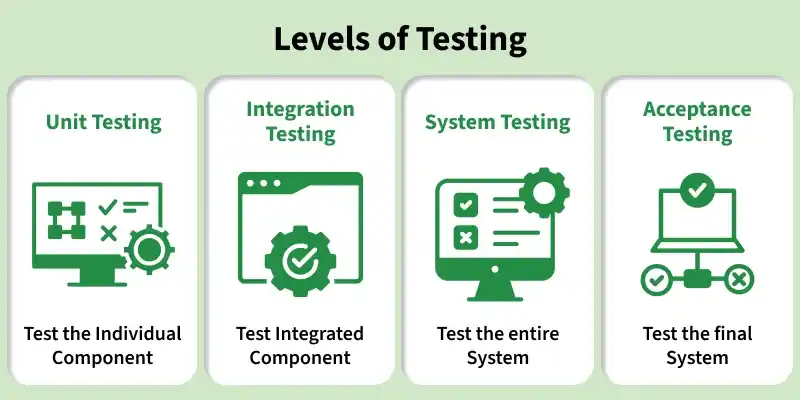
Levels of Testing
**1. Unit Testing
Unit Testing is the first level of software testing and focuses on verifying individual units or components of the application in isolation. The main goal is to identify and fix defects early before integrating these components with other parts of the system.
Unit tests help developers spot bugs early in the development process, making it easier and quicker to fix them. It's the first layer of defense to verify that each part of the application performs as expected.
- Testing individual functions or components.
- Ensuring correct behavior at the smallest level.
- Catching errors early.
**2. Integration Testing
After Unit Testing, Integration Testing is performed to verify the interaction and communication between software modules or components. It is important because even if individual parts work perfectly, issues may arise when they interact with one another.
Integration testing ensures that data flows correctly between modules and that they communicate seamlessly. It helps catch problems that might arise when different parts of the system interact.
3. System Testing
System Testing is performed to evaluate the complete and fully integrated software system to ensure it meets the specified requirements. This stage checks whether the entire system functions as expected in a real-world environment. It includes both functional and non-functional tests to ensure that the software meets customer needs.
- Full end-to-end testing of the software.
- Verifying both functional and non-functional requirements.
- Testing the software's behavior in real-world conditions.
4. Acceptance Testing
Acceptance Testing, also known as User Acceptance Testing (UAT), is the final test before releasing the software to the end-users. In this phase, the customer or end-users verify if the software meets their needs and expectations.
UAT is crucial because it verifies whether the software is ready for production and meets business requirements. It’s the last chance to catch any overlooked issues before deployment. If the software passes this stage, the customer gives the green light for release.
- Validating the software against business requirements.
- Ensuring the software meets customer expectations.
- Getting final approval from the customer.
Testing Principles
While performing the software testing, following Testing Principles must be applied by every software engineer:
- Customer requirements should be traceable and covered by all relevant tests.
- Test planning, including how testing will be conducted, should be completed well before test execution begins.
- The Pareto Principle can be applied to software testing: 80% of the errors identified during testing are likely to originate from 20% of the program modules.
- Testing should begin “in the small” and progress toward testing “in the large”.
- Exhaustive testing, which means testing all possible combinations of data, is not possible.
- Testing should be conducted effectively, and for this purpose, an independent third party may be involved.
**Related Article: Software Development Life Cycle