Unit Testing (original) (raw)
Last Updated : 19 May, 2026
Unit Testing is a software testing method in which individual units or components of a software application (such as functions, methods, or classes) are tested in isolation to verify that they work correctly as expected.
- It helps find and fix defects at the very beginning of the development cycle, reducing the cost and effort of debugging later.
- It promotes writing modular, clean, and maintainable code by ensuring each small part of the application behaves correctly on its own.
Real-World Examples
Unit testing is widely used across real-world applications to verify critical business logic and ensure reliable system behavior:
- **Banking Applications: Testing interest calculation, loan eligibility, and transaction validation logic.
- **E-Commerce Systems: Verifying price calculations, discount rules, tax computation, and cart total updates.
- **Authentication Systems: Testing login validation, password strength checks, and token generation.
Workflow of Unit Testing
The unit testing workflow includes the following step by step process:
1. Create Test Case
Writing the actual unit test cases for a specific function or method before review.
- Identify positive, negative, boundary, and exception scenarios
- Write test cases following AAA pattern (Arrange-Act-Assert) with clear names and assertions
- Prepare the test file with all required mocks and test data
2. Review Test Case
Peer or senior review of the created test cases for quality and completeness.
- Check coverage of all scenarios, correctness of assertions, and edge cases
- Verify naming standards, readability, and adherence to testing guidelines
- Record comments and get the test cases updated based on feedback
3. Baseline Test Case
Officially approving and freezing the reviewed test cases as the standard version.
- Approve the test cases after successful review
- Commit the test cases into version control with "Baseline" tag
- Mark them as official and ready for execution
4. Execute Test Case
Running the baselined test cases to verify the code behavior and generate results.
- Run the tests locally and through CI/CD pipeline
- Analyze pass/fail results and prepare test execution report
- Log defects for failed tests and re-execute after code fixes
Types of Unit Testing
Unit testing can be performed manually or automatically:
1. Manual Unit Testing
Manual Testing involves developers testing individual code units manually without using automation tools. It is not commonly used for large-scale testing, but it can still be useful during debugging and initial verification of code logic.
- Developers may manually verify small units of code during debugging or early development.
- It is useful for quick checks when writing or fixing specific functions.
- However, it is not scalable and becomes inefficient for repeated testing.
- Automated unit testing is preferred for consistency, speed, and long-term maintainability.
2. Automated Unit Testing
Automated Unit Testing checks software functionality automatically using testing tools and frameworks, reducing manual effort and improving accuracy. Developers write small test cases to validate individual functions automatically during development. These test cases verify whether the function behaves as expected under different conditions.
- Tests focus on single units, run in memory, and do not depend on external systems.
- Automated unit tests are commonly integrated into build and CI/CD pipelines to ensure continuous code quality.
Architecture of Unit Testing
Unit Testing Architecture defines the structured approach used to design and organize unit tests, ensuring that individual components are tested in isolation for correctness and reliability.
It forms the base of the Testing Pyramid (Unit -> Integration -> End-to-End) and is the most frequently used due to its speed and efficiency.
Components of Unit Testing Architecture
**1. Test Isolation & Dependencies: Each unit is tested in complete isolation from external systems such as databases, APIs, and file systems. To achieve this, mocks, stubs, or fakes are used to simulate dependencies so that only the internal logic of the unit is tested.
**2. AAA Pattern (Arrange–Act–Assert): A widely used structure for writing clean and readable unit tests:
- **Arrange: Prepare test data, objects, and required mocks
- **Act: Execute the function or method being tested
- **Assert: Verify that the output or behavior matches the expected result
This architecture focuses on modular design and isolated testing of individual components using structured approaches like the AAA pattern. Since unit tests run quickly (often in milliseconds), they provide rapid feedback to developers.
It is commonly supported by frameworks such as JUnit (Java), pytest (Python), xUnit (.NET), and Jest (JavaScript).
Unit Testing Strategies
To create effective unit tests the following techniques are commonly used:
- **Logic Checks: Verify that calculations are correct and all logical paths in the code are executed as expected.
- **Boundary Checks: Test normal, edge, and invalid inputs to ensure the system handles limits correctly.
- **Error Handling: Ensure the system responds properly to errors instead of crashing.
- **Object-Oriented Checks: Confirm that object states are correctly updated after method execution.
Unit Testing Techniques
There are 3 types of Unit Testing Techniques. They are as follows:
- **Black Box Testing: Black Box Testing is a technique where the system is tested based on inputs and expected outputs without any knowledge of internal code or logic. It focuses on validating functionality from a user’s perspective and ensures the system behaves correctly for given inputs.
- **White Box Testing: White Box Testing is a technique where the internal structure, logic, and code of the application are tested. It ensures that all code paths, conditions, and statements work correctly as expected.
- **Gray Box Testing: Gray Box Testing is a technique that combines both black box and white box testing approaches, where the tester has partial knowledge of the internal system. It helps in testing both functionality and some internal behaviors of the application.
Characteristics of Unit Testing
A good unit test ensures reliable and maintainable software by validating individual code units effectively. The key characteristics of a unit test are:
- **Fast: Executes quickly so tests can be run frequently during development.
- **Independent: Runs in isolation without relying on other tests or external systems.
- **Repeatable: Produces the same result every time, regardless of environment.
- **Self-Validating: Clearly indicates pass or fail without manual inspection.
- **Focused: Tests a single function or behavior at a time.
- **Readable and Maintainable: Easy to understand, update, and maintain.
Benefits of Unit Testing
Unit testing helps ensure reliable software by validating individual components of an application in isolation.
- Detects bugs early in the development cycle, reducing debugging cost.
- Improves code quality by ensuring each unit works correctly.
- Increases confidence when making code changes or adding new features.
- Speeds up development by allowing quick validation of code changes.
- Supports safe refactoring without breaking existing functionality.
- Acts as documentation for understanding code behavior.
Limitations of Unit Testing
Unit testing is an important part of software testing, but it has certain limitations that affect its scope and effectiveness.
- Focuses only on individual components and does not test overall system behavior.
- Cannot detect integration issues between different modules or services.
- Requires additional effort to write and maintain test cases for large projects.
- May not identify usability or UI-related issues that require end-user interaction.
- Effectiveness depends on the quality of test cases written by developers.
Implementation Example
The following example demonstrates Java code with appropriate unit test cases.
**Step 1. Create the Calculator class.
Java `
public class Calculator {
// Method to add two numbers
public int add(int a, int b) {
    return a + b;
}

// Method to subtract two numbers
public int subtract(int a, int b) {
    return a - b;
}
}
`
**Step 2. Create the TestNG test class.
Java `
package com.example.tests;
import org.testng.Assert; import org.testng.annotations.BeforeMethod; import org.testng.annotations.Test;
public class CalculatorTest {
private Calculator calculator;

// This method runs before each test method
@BeforeMethod
public void setUp() {
    calculator = new Calculator();
}

// Test for the 'add' method
@Test
public void testAdd() {
    int result = calculator.add(5, 3);
    // Assert that the result of 5 + 3 is 8
    Assert.assertEquals(result, 8, "Addition result is incorrect");
}

// Test for the 'subtract' method
@Test
public void testSubtract() {
    int result = calculator.subtract(5, 3);
    // Assert that the result of 5 - 3 is 2
    Assert.assertEquals(result, 2, "Subtraction result is incorrect");
}
}
`
**Output:
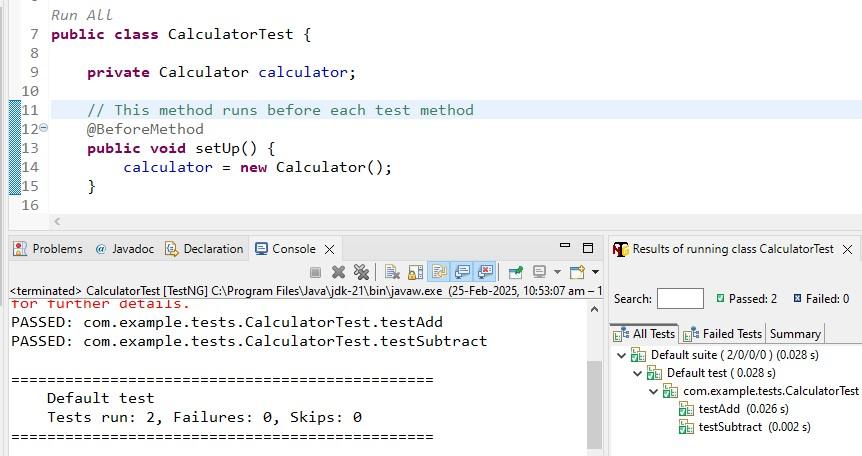
Unit Testing Example Output
Best Practices for Unit Testing
Following best practices ensures that unit tests are effective, reliable, and easy to maintain over time.
- Create simple, clear, and independent test cases.
- Use meaningful test names that describe expected behavior.
- Follow the Arrange–Act–Assert (AAA) pattern.
- Avoid external dependencies by using mocks or stubs.
- Include boundary and edge case testing.
- Run and maintain tests regularly, ideally through CI/CD pipelines.
Following are some of the unit testing tools:
- **TestMu AI: A cloud-based AI-powered testing platform for cross-browser testing and automated testing support.
- **JUnit: A widely-used Java testing framework for creating and running unit tests.
- **NUnit: A .NET framework for unit testing C# applications.
- **TestNG: An advanced Java testing framework with features like parallel testing.
- **PHPUnit: A PHP testing framework for unit and integration tests.
- **Mockito: A Java mocking framework for simulating dependencies.
- **Cantata: A tool for unit and integration testing in C/C++.
- **Karma: A JavaScript test runner for browser-based testing.
- **Mocha: A flexible JavaScript testing framework for Node.js and browsers.
- **TypeMock: A .NET mocking framework for isolating dependencies.