Integration Testing Tool Software Testing (original) (raw)
Last Updated : 23 Jul, 2025
**Integration Testing Tools are essential in the software development lifecycle, designed to streamline the process of testing how different components of an application work together. Unlike unit testing, which focuses on individual components, integration testing ensures that multiple modules or services interact as intended. These tools facilitate **automated testing, allowing developers and testers to identify and resolve issues arising from the integration of different system parts.
By using integration testing tools, teams can achieve greater **software quality, enhance collaboration, and expedite the development process. The right tool can significantly improve testing efficiency and effectiveness, ultimately leading to a more robust and reliable software product.
Table of Content
- What Is Integration Testing?
- Integration Testing Example
- Process
- What Are Integration Testing Tools?
- Best 10 Integration Testing Tools in 2024 (Detail Overview and Key Features)
- Conclusion
- Frequently Asked Questions on Integration Testing Tool
What is Integration Testing?
**Integration Testing is a crucial phase in the software development process where individual modules or components of an application are combined and tested as a group. The main goal is to identify any issues that may arise when these components interact with each other.
Integration Testing Example
**Scenario: Testing the integration between a User Registration Module and an Email Notification Service.
In this scenario, we will test how the **User Registration Module interacts with the **Email Notification Service to ensure that users receive a welcome email after successful registration.
Test Cases
**1. Preparation
- **Test Environment: Set up a test server with the User Registration Module and Email Notification Service integrated.
- **Test Data: Prepare a set of test user data, including:
- Valid user information (e.g., username, email, password).
- Invalid user information (e.g., missing email).
- **Tools: Use tools like Postman for API testing and a mock email server to verify email delivery.
**2. Execution
- Execute the following steps to test the integration:
- Send a POST request to the User Registration API with valid user data.
- Monitor the request and ensure it hits the User Registration endpoint.
- Check the response from the API for success status (e.g., HTTP 200 OK).
- Verify that the Email Notification Service receives the request to send an email.
- Check the mock email server to confirm that the welcome email has been sent.
**3. What to Test
- **Data Flow: Ensure that the data from the User Registration Module correctly flows to the Email Notification Service.
- **Email Content: Verify that the content of the email sent matches the expected format and includes the correct user information.
- **Error Handling: Test scenarios where invalid user data is provided (e.g., missing email) to ensure appropriate error messages are returned, and no email is sent.
**4. Outcome
- **Expected Outcome: For valid user data, the User Registration API should return a success response, and a welcome email should be sent to the user. For invalid user data, the API should return an error response, and no email should be sent.
- **Actual Outcome: After executing the test cases, compare the expected outcomes with the actual outcomes to determine if the integration between the User Registration Module and Email Notification Service functions correctly.
This structured approach to integration testing helps ensure that different components of the application work together seamlessly and that the user experience is as expected after registration. By following these steps, you can effectively verify the integration points between systems or modules.
Advantages of Integration Testing
- **Identifies Interface Issues: Detects problems in module interactions.
- **Enhances Software Quality: Ensures the software functions as intended.
- **Validates Data Flow: Confirms accurate data transfer between components.
- **Early Bug Detection: Uncovers defects early, reducing future costs.
- **Improves Reliability: Ensures components work seamlessly together.
- **Facilitates System Testing: Provides a solid foundation for subsequent testing.
- **Encourages Collaboration: Promotes teamwork among development teams.
- **Supports Continuous Integration: Enables frequent and reliable software updates.
- **Provides Better Understanding of System: Enhances insight into component interactions.
- **Boosts User Confidence: Ensures software meets user requirements.
**Integration Testing Tools are software applications that help developers test how different parts of an application work together.
Here’s a simple breakdown of their main features:
- **Automated Testing: These tools can run tests automatically. Once set up, they save you time by testing your code without needing manual intervention each time you make changes.
- **Component Simulation: They can mimic different parts of the application, allowing you to test how components interact without requiring the entire system to be running. This makes testing faster and more efficient.
- **Continuous Integration (CI) Support: Many tools work well with CI systems, meaning they automatically test your code every time you make a change. This ensures that new code doesn’t break existing functionality.
- **Detailed Reports: After running tests, these tools provide clear reports showing what worked and what didn’t. This helps developers quickly identify and fix any issues.
- **Environment Management: They assist in managing different testing environments, allowing you to test your application under realistic conditions. This helps ensure that your application performs well in real-world scenarios.
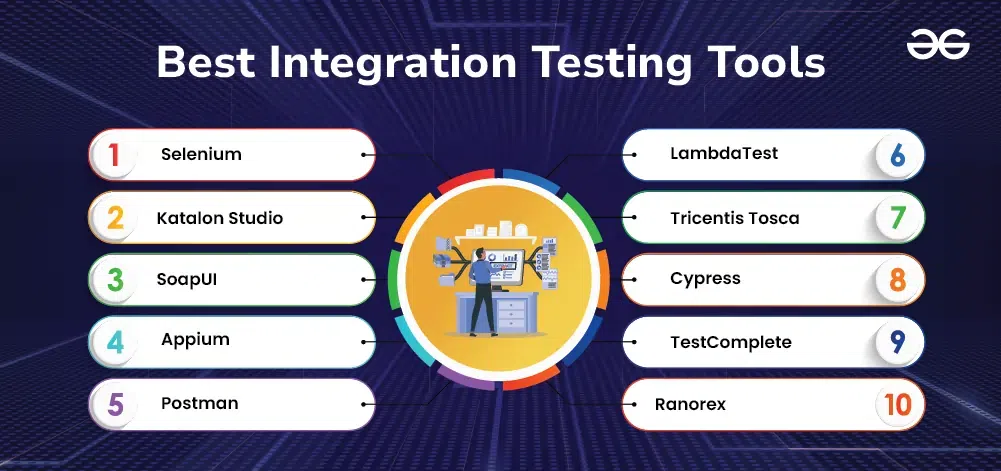
Best Integration Testing Tools
1. Selenium
Selenium is a widely-used open-source framework for automating web browsers. It supports multiple programming languages like Java, C#, and Python, making it versatile for developers. Selenium allows users to write tests that can run on various browsers and operating systems, ensuring that web applications perform consistently across different environments.
**Features:
- Supports multiple browsers (Chrome, Firefox, Safari, etc.)
- Works with various programming languages (Java, C#, Python, Ruby)
- Allows for parallel test execution
- Provides a robust set of APIs for web automation
- Integrates with tools like TestNG and JUnit for enhanced testing capabilities
2. Katalon Studio
Katalon Studio is a powerful automation testing tool that supports web, API, mobile, and desktop applications. It is user-friendly, making it suitable for both beginners and experienced testers. Katalon Studio provides built-in features to streamline the testing process, including record and playback functionality.
**Features:
- Supports web, API, mobile, and desktop testing
- User-friendly interface with drag-and-drop features
- Built-in keyword-driven testing capabilities
- Integrates with CI/CD tools for continuous testing
- Provides detailed reports and analytics
3. SoapUI
SoapUI is a widely recognized tool for testing APIs, particularly SOAP and REST services. It offers robust features for functional and load testing, allowing testers to verify the reliability and performance of web services. SoapUI's user-friendly interface makes it accessible for users at all levels.
**Features:
- Supports SOAP and RESTful web services
- Allows for functional, security, and load testing
- Provides a drag-and-drop interface for test creation
- Supports data-driven testing
- Generates detailed test reports
4. Appium
Appium is an open-source mobile application automation tool that enables users to test native, hybrid, and mobile web applications. It supports both Android and iOS platforms, allowing for cross-platform testing with a single codebase. Appium is flexible, making it a preferred choice for mobile app testing.
**Features:
- Supports native, hybrid, and mobile web apps
- Cross-platform testing for Android and iOS
- Uses WebDriver protocol for test automation
- Integrates with various programming languages (Java, Python, Ruby)
- Allows for parallel execution of tests
5. Postman
Postman is a powerful tool for API testing, allowing developers and testers to send requests and analyze responses. It simplifies the process of testing APIs and offers features for automating and documenting API workflows, making it essential for modern development practices.
**Features:
- Supports RESTful and SOAP APIs
- User-friendly interface for creating and sending requests
- Automated testing with JavaScript-based tests
- Collaboration features for team-based API development
- Comprehensive API documentation generation
6. LambdaTest
LambdaTest is a cloud-based cross-browser testing platform that allows users to run automated tests on a variety of browsers and operating systems. It enables testers to ensure their web applications function correctly across different environments without needing extensive local setup.
**Features:
- Supports over 2000 browsers and operating systems
- Real-time testing and screenshot capture
- Integration with Selenium and other testing frameworks
- Supports automated and manual testing
- Detailed reporting and analytics
7. Tricentis Tosca
Tricentis Tosca is an enterprise-grade test automation tool that uses a model-based approach to enhance testing efficiency. It supports end-to-end testing and offers advanced capabilities for API, web, and mobile application testing, making it suitable for large-scale projects.
**Features:
- Model-based testing for efficient test design
- Supports continuous testing and integration
- Test case design and management tools
- API testing capabilities
- Comprehensive reporting and analytics features
8. Cypress
Cypress is a modern front-end testing framework designed for web applications. It enables developers to write and execute tests directly in the browser, providing real-time feedback. Cypress is known for its fast execution and intuitive syntax, making it a favorite among developers.
**Features:
- Real-time reloading of tests in the browser
- Easy setup with a simple installation process
- Supports time-travel debugging
- Provides an extensive API for test automation
- Integrates seamlessly with CI/CD pipelines
9. TestComplete
TestComplete is a commercial test automation tool that supports various technologies, including web, mobile, and desktop applications. It provides a scriptless testing environment, allowing users to create automated tests using a record-and-playback feature, which is ideal for teams without extensive programming skills.
**Features:
- Supports web, mobile, and desktop applications
- Scriptless test creation with record-and-playback
- Integration with various testing frameworks
- Supports data-driven testing
- Comprehensive reporting and analysis tools
10. Ranorex
Ranorex is an automation testing tool designed for desktop, web, and mobile applications. It combines a user-friendly interface with powerful features to support both technical and non-technical testers. Ranorex allows for extensive test automation capabilities, making it suitable for a wide range of projects.
**Features:
- Supports desktop, web, and mobile applications
- User-friendly interface with drag-and-drop functionality
- Extensive reporting and analytics capabilities
- Integration with CI/CD tools
- Supports data-driven testing
Conclusion
In summary, **Integration Testing Tools play a crucial role in delivering high-quality software by ensuring seamless interaction between various components. They provide valuable features such as **automated testing, **detailed reporting, and **environment management, enabling teams to conduct thorough testing with ease. By investing in the right integration testing tools, organizations can enhance their development workflow, reduce the likelihood of defects, and deliver a superior end product. As software complexity continues to grow, the importance of effective integration testing cannot be overstated, making these tools indispensable for modern software development.