Test Plan Software Testing (original) (raw)
Last Updated : 16 May, 2026
A **test plan is a project-level document that defines what will be tested, how testing will be conducted, and who will perform the testing. It serves as a blueprint for the QA team.
- Prepared by the Test Manager before testing begins
- Guides and coordinates all testing activities
- Updated regularly as the project progresses
- Shared with stakeholders like BAs, PMs, and the Development Team
Roles and Responsibilities
| Factors | Roles |
|---|---|
| Who writes test plans? | Test lead, Test Manager, Test Engineer |
| Who reviews the test plan? | Test Lead, Test Manager, Test Engineer, Customer, Development Team |
| Who approves the test plan? | Customer, Test Manager |
| Who writes test cases? | Test Lead, Test Engineer |
| Who reviews test cases? | Test Engineer, Test Lead, Customer, Development Team |
| Who approves test cases? | Test Manager, Test Lead, Customer |
Types of Test Plan
There are three main types of test plans, each focusing on different levels and aspects of testing:
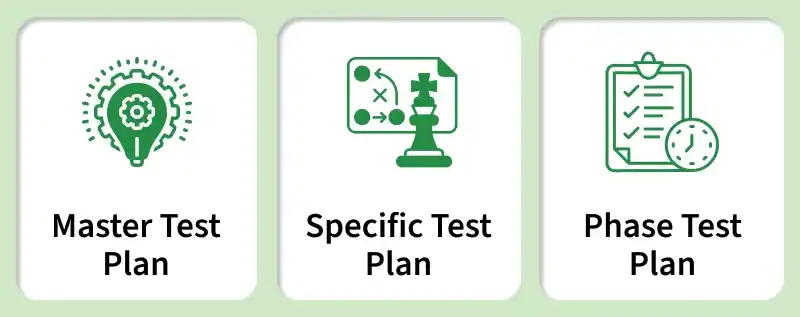
Types of Test Plan
1. Master Test Plan
Master Test Plan is a high-level document that defines the overall testing strategy, objectives, scope, and approach for the entire project.
- Defines the overall testing strategy and scope of the project.
- Includes resources, timelines, and testing approach.
- Acts as a reference for all detailed test plans.
2. Specific Test Plan
Specific Test Plan is a detailed document that focuses on testing a particular module, feature, or phase of a project.
- Focuses on a specific module or testing phase.
- Includes detailed test cases, data, and environment setup.
- Helps ensure thorough testing of a particular feature.
3. Analytical Test Strategies
Analytical Test Strategies are testing approaches based on analysis of requirements, risks, and system behavior to design effective test cases.
- Based on risk analysis and requirements evaluation.
- Focuses on high-risk and critical functionalities.
- Helps optimize testing effort and improve coverage.
**Test Plan Development Process
Below are the eight steps that can be followed to write a test plan****:**
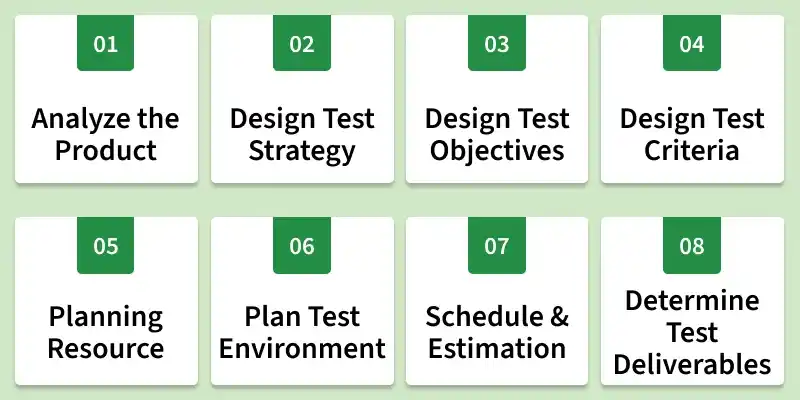
Test Plan creation process
1. Analyze the product
Understand the product by reviewing requirements and holding discussions with clients, developers, and stakeholders.
Identify:
- Product objectives
- Target users
- System specifications (hardware/software)
- How the system works
2. Design the test strategy
Define the overall testing approach, including:
- Scope (what to test and what not to test)
- Types of testing (functional, regression, performance, etc.)
- Risks and mitigation plans
- Test team responsibilities
3. Define test objectives
This phase defines the objectives and expected results of the test execution. Objectives include:
- A list of software features like functionality, GUI, performance standards, etc.
- The ideal expected outcome for every aspect of the software that needs testing.
4. Define test criteria
Set conditions for controlling testing activities:
- **Suspension Criteria: When testing should be paused
- **Exit Criteria: When testing can be completed successfully
5. Resource planning
Identify required resources, including:
- Team members and effort
- Hardware and software
- Tools and infrastructure
6. Plan test environment
Planning the test environment involves setting up the required hardware, software, tools, and configurations needed to execute testing effectively.
- Defines hardware, software, and network requirements.
- Sets up testing tools, databases, and configurations.
7. Schedule and Estimation
Schedule and Estimation involves planning the timeline and effort required for testing activities in a project. It helps ensure that testing is completed within deadlines and resources are used efficiently.
- Defines timelines, milestones, and deadlines for testing.
- Estimates effort, resources, and cost required.
8. Determine test deliverables
List all expected outputs such as:
- Test plan and test cases
- Test scripts and test data
- Defect reports and test summary reports
Importance and Objectives
A test plan provides clear direction and control over testing activities throughout the project lifecycle. It ensures structured execution, proper resource utilization, and alignment among stakeholders.
- Defines clear testing goals and scope
- Establishes timelines and resource planning
- Prevents scope creep and confusion
- Identifies risks and mitigation strategies
- Acts as a blueprint for systematic test execution
- Improves communication and transparency
**Components and Attributes of Test Plan
A standard test plan typically includes the following components:
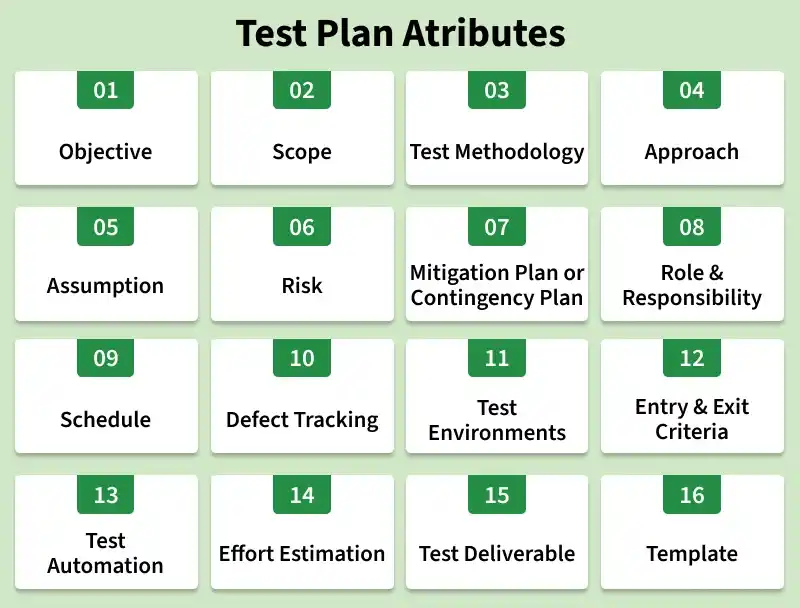
Components and Attributes of Test Plan
- **Objective: Defines testing goals and quality targets.
- **Scope: Specifies in-scope and out-of-scope features.
- **Test Strategy & Approach: Describes testing types, techniques, and execution flow.
- **Assumptions & Risks: Lists assumptions and potential risks with mitigation plans.
- **Roles & Responsibilities: Defines duties of team members involved in testing.
- **Schedule & Estimation: Specifies timelines and effort required.
- **Test Environment: Details hardware, software, and configurations needed.
- **Defect Management: Explains defect tracking and reporting process.
- **Entry & Exit Criteria: Defines conditions to start and complete testing.
- **Test Automation Plan: Identifies scope and tools for automation.
- **Test Deliverables: Lists outputs like test cases, reports, and logs.
- **Templates & Standards: Ensures consistency in documentation.
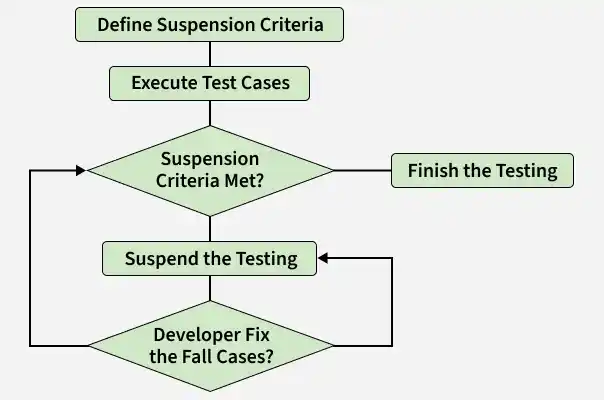
Example of Test Plan
Test Strategy Vs Test Plan
| Test Strategy | Test Plan |
|---|---|
| High-level document outlining overall testing approach and goals. | Detailed document describing specific testing activities for a project. |
| Provides general testing guidelines across the organization. | Defines exact tasks, resources, and timelines for a project. |
| Broad and organization-wide. | Project-specific and focused. |
| Conceptual and methodology-focused. | Detailed with test cases, schedules, and environments. |
| Created by senior management or test architects. | Created by test managers or test leads. |
| Reviewed by Stakeholders and senior management. | Used by project team (testers, developers, managers). |
| Emphasizes what and why of testing. | Emphasizes how, when, and who will test. |
| Long-term and stable. | Short-term and updated as the project evolves. |
Best Practices
- **Understand Requirements: Clearly analyze functional and non-functional needs with stakeholder input.
- **Define Objectives and Scope: Specify testing goals and clearly mark in-scope and out-of-scope areas.
- **Develop a Test Strategy: Choose appropriate testing types, techniques, and tools.
- **Create Strong Test Cases: Cover all major scenarios and maintain requirement traceability.
- **Prepare Test Environment: Ensure proper setup that mirrors production.
- **Plan Data and Reporting: Use realistic test data and establish clear reporting and defect tracking processes.