Cache Write Policies System Design (original) (raw)
Last Updated : 23 Jul, 2025
Cache write policies play a crucial role in determining how data is written to the cache and main memory in computing systems. These policies are essential for improving system performance and ensuring data consistency. This article explains what cache write policies are, explains various cache write policies in detail, and discusses how to choose and apply the right write policy for your needs.

Cache Write Policies
Important Topics for Cache Write Policies
- What are Cache Write Policies?
- Types of Caches
- Cache Write Policies
- Write-Allocate vs. No-Write-Allocate
- Combining Write Policies
- Choosing the Right Cache Write Policy
- Applications of Cache Write Policies
- Challenges in Implementing Cache Write Policies
- FAQs for Cache Write Policies
What are Cache Write Policies?
Cache write policies dictate how data modifications in the cache are propagated to the main memory. The primary goal of these policies is to balance performance and data consistency. They determine when and how the changes made to the cached data are written back to the main memory.
Types of Caches
Caches can be broadly categorized into several types based on their position in the memory hierarchy and their functionality:
- **L1 Cache: The first level of cache, closest to the CPU, offering the fastest access times.
- **L2 Cache: A larger, slightly slower cache that sits between the L1 cache and main memory.
- **L3 Cache: An even larger cache that serves multiple CPU cores.
- **Disk Cache: Used to speed up access to data stored on disk drives.
- **Web Cache: Stores frequently accessed web content to reduce latency and bandwidth usage.
Cache Write Policies
1. Write-Through
In the write-through policy, data is written to both the cache and the main memory simultaneously. This ensures data consistency between the cache and main memory at the cost of higher write latency.
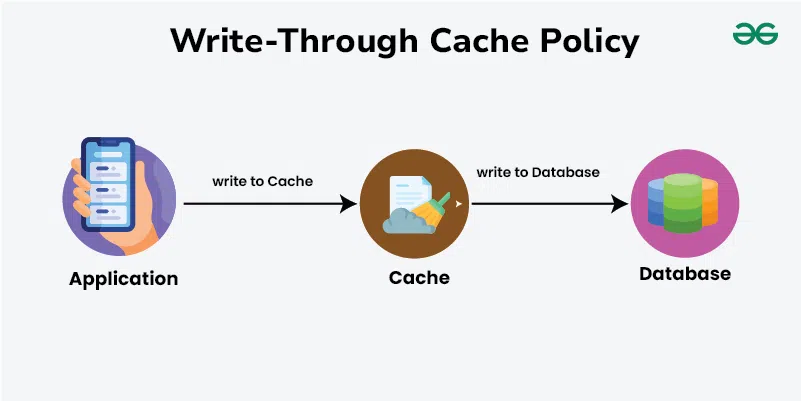
Write-Through Cache
Advantages
- Ensures data consistency.
- Simplifies the process of maintaining coherency between cache and memory.
Disadvantages
- Slower write operations due to simultaneous writes.
- Increased memory bandwidth usage.
2. Write-Back
The write-back policy, also known as write-behind, allows data to be written only to the cache initially. The modified data is written to the main memory at a later time, either when the cache block is evicted or at specific intervals.

Write-Back Cache
Advantages
- Faster write operations as writes are initially only to the cache.
- Reduced memory bandwidth usage.
Disadvantages
- Requires mechanisms to ensure data consistency.
- Complexity in handling cache coherency.
3. Write-Around
In the write-around policy, data is written directly to the main memory, bypassing the cache. The cache is only updated if the same data is read again.

Write-Around Cache
Advantages
- Reduces cache pollution with infrequently accessed data.
- Suitable for workloads with low write locality.
Disadvantages
- May lead to slower write operations.
- Potential for cache misses on subsequent reads.
Write-Allocate vs. No-Write-Allocate
Below are the differences between Write-Allocate and No-Write Alllocate:
| Feature | Write-Allocate (Fetch-on-Write) | No-Write-Allocate (Write-No-Allocate) |
|---|---|---|
| Definition | On a write miss, the block is loaded into the cache, then the write is performed. | On a write miss, data is written directly to memory, bypassing the cache. |
| Cache Miss Handling | Loads the block into the cache before writing. | Does not load the block into the cache. |
| Subsequent Reads | Subsequent reads benefit from the cached data. | Subsequent reads do not benefit from cache; may result in more cache misses. |
| Write Performance | Can be slower initially due to fetching block into cache. | Can be faster for initial writes as no block fetching is involved. |
| Cache Pollution | Higher likelihood of cache pollution due to loading on writes. | Reduced cache pollution as blocks are not loaded on write misses. |
| Use Cases | Useful for workloads with frequent read-after-write scenarios. | Suitable for workloads with infrequent read-after-write scenarios. |
Combining Write Policies
Combining write policies involves using different strategies to balance the advantages and disadvantages of each. This can be tailored to specific use cases and workload characteristics to optimize performance, consistency, and resource utilization.
1. Write-Through with Write-Allocate
This combination involves writing data to both the cache and main memory simultaneously (write-through) and loading the block into the cache on a write miss (write-allocate).
**Advantages of combining these policies
- Ensures data consistency between cache and memory.
- Benefits subsequent reads by having the data in the cache.
**Disadvantages of combining these policies
- Slower write performance due to simultaneous writing to cache and memory.
- Increased memory traffic due to block fetching on write misses.
**Example of combining these policies
- **Use Case: Database systems where data consistency is crucial, and there are frequent read-after-write operations.
- **Scenario: An online transaction processing system where updates to user account balances need to be immediately reflected in both cache and main memory for consistency, and subsequent queries benefit from having the updated balance in the cache.
2. Write-Back with Write-Allocate
This combination involves writing data only to the cache initially (write-back) and updating main memory later when the cache block is evicted. On a write miss, the block is loaded into the cache (write-allocate).
**Advantages **of combining these policies
- Faster write performance due to delayed writing to main memory.
- Benefits from subsequent reads as the data is loaded into the cache.
**Disadvantages **of combining these policies
- Risk of data loss or inconsistency if the cache fails before writing to memory.
- Increased complexity in tracking dirty cache blocks.
**Example **of combining these policies
- **Use Case: High-performance computing applications where write performance is critical, and there are frequent read-after-write operations.
- **Scenario: A scientific simulation that frequently updates large data sets, benefiting from fast write performance and subsequent read operations from the cache.
3. Write-Through with No-Write-Allocate
This combination involves writing data to both the cache and main memory simultaneously (write-through) but not loading the block into the cache on a write miss (no-write-allocate).
**Advantages **of combining these policies
- Ensures data consistency between cache and memory.
- Reduces cache pollution by not loading blocks on write misses.
**Disadvantages **of combining these policies
- Slower write performance due to simultaneous writing to cache and memory.
- Subsequent reads may result in more cache misses if the data is not in the cache.
**Example **of combining these policies
- **Use Case: Systems where data consistency is crucial, and write operations are not followed by immediate reads.
- **Scenario: Logging systems where logs are written to both cache and disk for consistency but are rarely read back immediately, reducing cache pollution.
4. Write-Back with No-Write-Allocate
This combination involves writing data only to the cache initially (write-back) and updating main memory later when the cache block is evicted. On a write miss, the data is written directly to memory, bypassing the cache (no-write-allocate).
**Advantages **of combining these policies
- Faster write performance due to delayed writing to main memory.
- Reduces cache pollution by not loading blocks on write misses.
**Disadvantages **of combining these policies
- Risk of data loss or inconsistency if the cache fails before writing to memory.
- Subsequent reads may result in more cache misses if the data is not in the cache.
**Example **of combining these policies
- **Use Case: Write-intensive applications where write performance is critical, and write operations are not followed by immediate reads.
- **Scenario: Batch processing systems where data is written in bulk and processed later, benefiting from fast write performance and reduced cache pollution.
Choosing the Right Cache Write Policy
1. Factors to consider
- **Write Frequency: How often data is written to the cache.
- **Read Frequency: How often data is read from the cache.
- **Data Consistency Requirements: The importance of keeping cache and main memory data consistent.
- **System Performance Goals: The balance between read/write performance and overall system efficiency.
- **Workload Characteristics: The nature of the workload, such as high locality or random access patterns.
2. Important scenarios
- **High Consistency Requirements: Use write-through or write-back with write-allocate.
- **High Write Throughput: Use write-back with no-write-allocate.
- **Reduced Memory Bandwidth Usage: Use write-back policies.
Applications of Cache Write Policies
- **Database Systems
- **Application: Ensures data consistency and optimizes read and write performance in transactional databases.
- **Policy: Write-Through with Write-Allocate for consistency; Write-Back with Write-Allocate for high-performance analytics.
- **Web Servers and Caching Systems
- **Application: Improves web content delivery speed and ensures the consistency of frequently accessed content.
- **Policy: Write-Through with No-Write-Allocate to avoid cache pollution for static content; Write-Back with No-Write-Allocate for dynamic content updates.
- **High-Performance Computing (HPC)
- **Application: Enhances performance in scientific simulations and data-intensive computations.
- **Policy: Write-Back with Write-Allocate to provide high throughput for frequent read/write cycles.
- **Embedded Systems and IoT Devices
- **Application: Ensures data reliability and optimizes power consumption in resource-constrained environments.
- **Policy: Write-Through with Write-Allocate for real-time data consistency; Write-Back with No-Write-Allocate for efficient power usage.
- **Virtualization and Cloud Computing
- **Application: Improves virtual machine disk performance and ensures efficient data management in cloud environments.
- **Policy: Write-Back with Write-Allocate for caching VM disk writes and reads to enhance performance.
Challenges in Implementing Cache Write Policies
- **Maintaining Data Consistency: Ensuring that the cache and main memory are synchronized.
- **Managing Cache Coherency: Handling coherency in multi-core systems.
- **Performance Overheads: Balancing performance trade-offs in different write policies.
- **Complexity: Implementing and managing complex cache control mechanisms.
Conclusion
Understanding and implementing the right cache write policy is essential for optimizing system performance and ensuring data consistency. Each write policy has its own set of advantages and challenges, and the choice depends on the specific requirements of the application and workload. By carefully considering the factors and scenarios discussed in this article, you can select the most suitable cache write policy for your needs.