Consistency in System Design (original) (raw)
Last Updated : 1 May, 2026
Consistency in system design means that all nodes in a distributed system agree on the same data value based on the chosen consistency model. It ensures that updates are eventually reflected across all nodes, even with concurrent operations or network delays.
- All users and system nodes read the same data value after an update.
- Prevents conflicts or mismatched data across different parts of the system.
**Example: In an online banking system, if money is transferred from one account to another, all servers should immediately show the updated balance so that users always see the correct information.
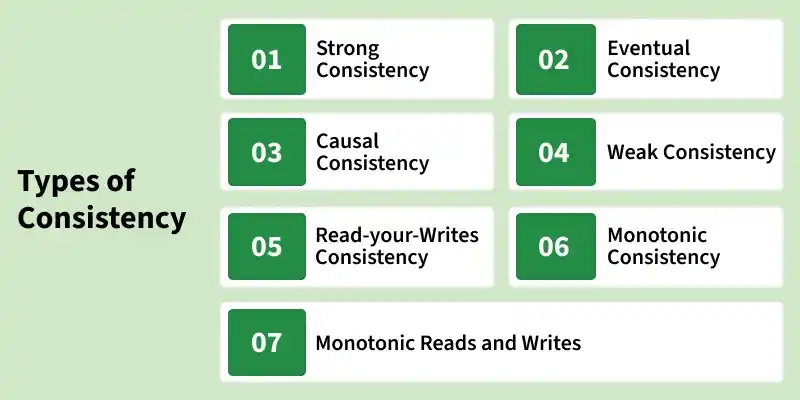
Types of Consistency
This section explains different consistency models used in distributed systems along with examples.
1. Strong Consistency
Strong Consistency (also known as linearizability or strict consistency) ensures that every read returns the most recent write or an error, providing a single, up-to-date view of data. It requires coordination between nodes, which can impact performance and availability.
- Ensures all clients see the same sequence of updates with no stale or outdated data, maintaining a fully consistent system state.
- Requires synchronization across nodes to keep data aligned, which can increase latency and reduce overall system availability in distributed environments.
**Example: In a traditional SQL system with a single master and multiple replicas, writes go to the master and are synchronously replicated to all replicas. This ensures that reads from any replica return the latest data, maintaining a consistent view across all clients.
2. Eventual Consistency
Eventual consistency ensures that all data replicas will converge to the same value over time, even if they temporarily differ. It relaxes strict consistency to improve system availability and performance.
- Allows temporary inconsistencies between replicas, but guarantees that all updates will eventually propagate and become consistent across the system.
- Improves scalability and performance by reducing synchronization requirements, making it suitable for distributed and high-availability systems.
**Example: Amazon DynamoDB is a distributed NoSQL database where writes are first stored on one node and then asynchronously replicated to others. This means reads may briefly return stale data, but all replicas eventually synchronize and reflect the same value over time.
3. Causal Consistency
Causal consistency ensures that related events are seen in the correct order across all nodes, preserving cause-and-effect relationships. It maintains a logically consistent view of operations without requiring full synchronization.
- Guarantees that if one operation depends on another, all nodes will observe them in the same causal order, preserving application correctness.
- Allows concurrent independent operations without strict ordering, improving performance while still maintaining meaningful data relationships.
**Example: In a collaborative document editing application, multiple users can edit different parts simultaneously while maintaining correct order of dependent changes. Edits that rely on others are seen in the proper sequence, ensuring a consistent and meaningful document for all users.
4. Weak Consistency
Among consistency models, weak consistency provides the least strict guarantees, allowing replicas to diverge significantly without ensuring immediate or predictable convergence. It prioritizes availability and low latency over data accuracy.
- Does not guarantee when or if all replicas will become consistent, allowing temporary or even prolonged inconsistencies across the system.
- Supports high availability and fast performance by permitting simultaneous updates without strict synchronization, but may lead to data discrepancies.
**Example: In distributed caching systems like Redis or Memcached, data is stored in memory for fast access and updates are propagated asynchronously across nodes. This can cause temporary inconsistencies where clients may read outdated or different values until all nodes are synchronized.
5. Read-your-Writes Consistency
Read-your-writes consistency ensures that once a client updates data, it will always see its own latest changes in subsequent reads. It provides a user-centric consistency guarantee within a session.
- Guarantees that a client immediately observes its own writes, preventing confusion caused by stale data after an update.
- Maintains session consistency, making it suitable for applications where users expect instant visibility of their actions (e.g., posts, updates).
**Example: In a social media platform, users can immediately see their own posts or comments after publishing them. This ensures that their updates are instantly reflected in their timeline or profile without any delay.
6. Monotonic Consistency
Monotonic consistency ensures that once a client observes a sequence of updates, it will always see those updates in the same order. It prevents the system from going back to older or conflicting states.
- Guarantees a consistent order of operations for a client, so previously seen updates are not contradicted by later reads or writes.
- Prevents reverting to older states, helping maintain data integrity and a coherent view of changes over time.
**Example: A distributed key-value store maintains monotonic consistency by guaranteeing that once a client observes a particular sequence of updates, it will never observe a conflicting sequence of updates. For instance, if a client reads values A, B, and C in that order, it will never later observe values C, A, and B.
7. Monotonic Reads and Writes
Monotonic Reads and Writes ensure that a client observes a consistent progression of data over time, without seeing older values after newer ones. They maintain order and consistency within a client’s operations.
- Monotonic reads guarantee that once a client sees a value, it will not read an older value later, ensuring a forward-moving view of data.
- Monotonic writes ensure that all writes from a single client are applied in the same order across replicas, preserving the correct sequence of updates.
**Example: In Google Spanner, clients observe a consistent progression of reads and writes, where updates follow a defined order across replicas. This ensures that operations are applied in sequence and clients do not see older values after newer ones.
Importance
Consistency plays a crucial role in system design for several reasons:
- **Correctness: Consistency guarantees that the information accessible by various system components is always correct and up-to-date.
- **Reliability: Because they lower the possibility of mistakes and inconsistencies that could result in unpredictable behavior or corrupted data, consistent systems are more dependable. Users may rely on the system to deliver reliable and accurate results.
- **Data Integrity: The integrity of the data kept in the system is preserved by consistency. Consistency aids in preventing data loss and corruption by guaranteeing that all changes are applied and distributed appropriately.
- **Concurrency Control: Consistency strategies help with access control to prevent conflicts and ensure that changes are applied in a coordinated way in distributed or multi-user systems, where multiple clients may access and modify the same data at the same time.
- **User Experience: Because it makes system interaction predictable and smooth, consistency improves the user experience. The system is reliable in providing users with current and logical information, which increases user happiness and usefulness.
Challenges with maintaining Consistency
Maintaining consistency in distributed systems can be difficult because data is stored and processed across multiple nodes and locations.
- **Coordination Overhead: Maintaining consistency requires coordination between nodes, which adds overhead and can create scalability bottlenecks
- **Latency: Strong consistency increases latency as operations must wait for acknowledgments from multiple nodes, affecting user experience.
- **Operational Complexity: Ensuring consistency involves complex configurations, where mismanagement can lead to inconsistencies or performance issues.
- **Data Synchronization: Keeping data consistent across platforms is challenging due to network delays, device limits, and asynchronous updates.
- **Concurrency Control: Managing concurrent access to shared data requires careful design to maintain consistency across systems.
Strategies for achieving Consistency
In distributed systems, achieving consistency requires the use of a number of strategies, such as best practices, consistency models, design patterns, and dispute resolution methods. The basic outline of each is as follows:
1. Design Patterns and Best Practices
These design practices help maintain data consistency in distributed systems and reduce the chances of conflicting data updates.
- **Single Source of Truth: Design systems with a single authoritative source of truth for critical data. This reduces the potential for inconsistencies arising from multiple conflicting sources.
- **Unchanged Operations: Design operations that can be applied multiple times without changing the result. Idempotent operations are essential for ensuring consistency in the face of network failures and retries.
- **Versioning: Implement versioning mechanisms for data objects to track changes over time. Versioning helps in detecting conflicts and resolving inconsistencies.
- **Asynchronous Updates: Use asynchronous communication patterns to decouple components. By enabling components to handle updates independently, asynchronous updates lower congestion and increase scalability.
2. Consistency Models
Consistency models define how and when updates made to data become visible across different nodes in a distributed system.
- **Eventual Consistency: In situations where instant consistency is not necessary, accept eventual consistency. Allow a brief variation between replicas while guaranteeing their eventual convergence to a consistent state.
- **Strong Consistency: Utilize strong consistency models when strict consistency is necessary for correctness, such as in financial transactions or critical system operations. Ensure that all updates are immediately visible to all clients.
- **Causal Consistency: Apply causal consistency for preserving causal relationships between events in distributed systems. Ensure that events causally related are observed in the correct order across all replicas.
3. Conflict Resolution Techniques
Conflict resolution techniques help handle situations where multiple updates to the same data occur at the same time.
- **Last-Writer-Wins (LWW): Resolve conflicts by favoring the update with the latest timestamp or version. LWW is a simple conflict resolution strategy but may lead to data loss or inconsistency in some scenarios.
- **Merge Strategies: Use custom merge strategies or conflict resolution algorithms tailored to the specific requirements of the application domain. Merge strategies reconcile conflicting updates based on application-specific semantics and user preferences.
Roadmap to understand Consistency
1. Introduction to Consistency
2. Types of Consistency Models
- Strong Consistency
- Eventual Consistency
- Weak Consistency
- Sequential Consistency
- Causal Consistency
- Read-your-Writes Consistency
- Monotonic Reads Consistency
- Monotonic Writes Consistency
3. Techniques to Achieve Consistency
4. Advance Concepts and Tradeoffs
- Eventual consistency between Microservices
- Does MongoDB use Eventual Consistency?
- Does Redis have Eventual Consistency?
- Consistency vs. Availability
- Weak vs. Eventual Consistency
- Strong vs. Eventual Consistency
- Difference between Soft State and Eventual Consistency
- Measurement of Eventual Consistency